Monday, February 15, 2021

IAVOM and Bloom Day Intersection

Two of my favorite memes, In a Vase on Monday and Garden Bloggers' Bloom Day, intersect once again this month.  This means a longer than usual post, especially as the floral parade is already getting started in my area of coastal Southern California.  The good news is that I'll limit the commentary that usually accompanies my photos.

I'll start with this week's floral arrangements for In a Vase on Monday, hosted by Cathy at Rambling in the Garden.

The Anemone that provides the focal point here wasn't the bulb I ordered but at least it was appropriate for a Valentine's Day arrangement.  Front, top and back views are shown.  The contents include: Anemone coronaria 'Bicolore', noID Antirrhinum majus, Calliandra haematocephala, Grevillea lavandulacea 'Penola', Leptospermum 'Copper Glow', and Leptospermum scoparium 'Pink Pearl.

The second arrangement took advantage of the first of the Freesias to bloom.  The contents include: Agryranthemum frutescens, white and yellow Freesias, noID Narcissus, Senna artemisioides, and Westringia fruticosa 'Morning Light'.

Moving on to Garden Bloggers' Bloom Day, hosted by Carol at May Dreams Gardens, I'll start with the plants that are putting on the best floral show this month.  Unlike much of the US, we haven't faced freezes or snow.  We also have had woefully little rain but that's a whole other issue.

Anemone coronaria grown from corms planted in November.  Clockwise from the upper left: 'Mistral Azzurro', 'The Bride', 'Mistral Bicolore', and 'Lord Lieutenant'.

Arctotis 'Pink Sugar'

Calliandra haematocephala (aka pink powder puff)

Coleonema puchellum 'Sunset Gold'

Echium handiense 'Pride of Fuerteventura'

The smaller-flowered Grevillea have taken off this month.  Clockwise from the upper left: G. alpina x rosmarinifolia, G. 'Poorinda Leane', G. sericea, G. lavandulacea 'Penola', a close-up of G. 'Scarlet Spite', and a wider view of the same plant in the landscape

The large-flowered Grevillea never stop.  Left to right: 'Ned Kelly', 'Peaches & Cream', and 'Superb'.

Leptospermum scoparium 'Pink Pearl'

It'll be time to cut back the "flowering" Leucadendrons soon.  Top row: Leucadendron 'Safari Sunset'.  Bottom row: Leucadendron 'Wilson's Wonder' and L. 'Summer Red', which shifted from blonde to red this month.

Osteospermums prefer cool temperatures.  Clockwise from the top left: '4D Silver', two views of 'Violet Ice, 'Berry White', 'Zion Copper Amethyst', a self-seeded mix, and a self-seeded pink variety.

Pyrus calleryana (aka ornamental pear)

Rosmarinus officinalis 'Gold Dust'


A couple of plants deserve special mention.

Isopogon anemonifolius, planted in 2018, has bloomed only once before but it appears to be preparing to do so again

At last xMangave 'Silver Fox' is blooming.  It's bloom spike first appeared in August!  Whether it'll emulate its Agave parent (and die after blooming) or its Manfreda parent (and live on) has yet to be determined.


A couple of plant species are just beginning their bloom cycle, leaving me more to look forward to as the month continues.

The first Freesia and Helleborus 'Red Lady'


As usual, I've organized the best of the rest of what's blooming in my garden in color collages.

Clockwise from the upper left: Felicia aethiopica, Lavandula dentata (I think), L. multifida, Limonium perezii, Polygala fruticosa, and Trichostemma 'Midnight Magic'

Clockwise from the upper left: Argyranthemum frutescens, Coleonema album, Crassula multicava 'Red', Gazania 'White Flame'', Trifolium (aka common clover), and Westringia fruticosa 'Morning Light'

Clockwise from upper left: Aeonium arboreum, noID Cymbidium, Euphorbia rigida, Euryops chrysanthemoides 'Sonnenschein', noID Gazania, Lomanda 'Breeze', and Senna artemisioides

Clockwise from the top left: Aloe deltoideodonta, A. striata, Alstroemeria 'Indian Sunset', Bignonia capreolata, Bryophyllum fedtschenkoi, and noID Kalanchoe

Clockwise from the upper left: Antirrhinum majus, self-seeded Gazania, Gomphrena decumbens 'Itsy Bitsy', Lobelia laxiflora, Metrosideros collina 'Springfire', and Ribes viburnifolium (aka Catalina perfume currant)

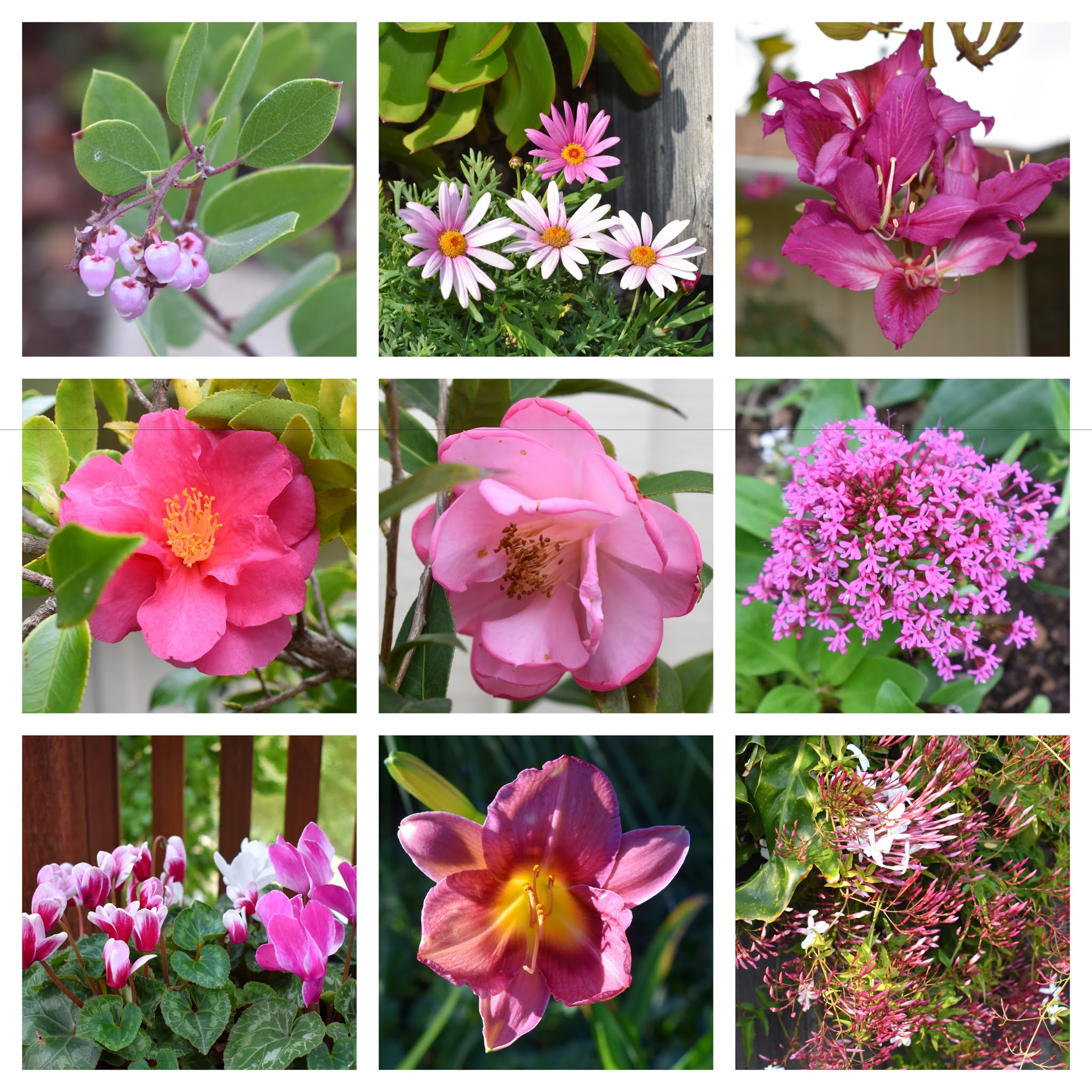
Top row: Arctostaphylos bakeri 'Louis Edmunds', Argyranthemum frutescens, and Bauhina x blakeana
Middle row: last noID Camellia sasanqua, C. williamsii 'Taylor's Perfection', and Centranthus ruber
Bottom row: noID Cyclamen, Hemerocallis 'Russian Rhapsody', and Jasminum polyanthum


For more GBBD posts, visit Carol at May Dreams Gardens.  For more IAVOM posts, visit Cathy at Rambling in the Garden.


All material © 2012-2021 by Kris Peterson for Late to the Garden Party


Friday, February 12, 2021

Fabulous February Foliage

As the title of this post indicates, I do love alliteration.  But before spring formally arrives and flowers dominate the scene, February is a good time to take stock of the foliage plants that add so much to my garden.  This won't be a comprehensive review as I've skipped some of the major players that are at risk of overexposure after repeated inclusion in my posts, like Acacia cognata 'Cousin Itt'.  I should also note that many of the plants I've included here flower at some point during the year; however, I want to emphasize that these are plants that won a place in my garden in large part because of their foliage.

I'll start with those that shine in different shades of green.

Acanthus mollis was a major player in my former shady garden.  In contrast, the plants have struggled here, although I have at least three clumps like this one that appear in response to rain every year.  They usually fade away as the soil gets drier and our temperatures rise.  I only occasionally get flowers but I value those large leaves, which are relatively unusual in my climate.

I introduced Arthropodium cirratum (aka Renga Lily), a New Zealand native, to my garden in 2011 and it's proliferated, mostly through divisions of my original plants.  I've found it to be an excellent plant for use in dry shade.  The graceful foliage is evergreen and the flowers that appear in May are a plus.

I expect most people grow Echium webbii principally for its brilliant blue flowers but I'd grow this plant even if it didn't flower.  It has a beautiful shape (at least until it gets old and woody) and the foliage gives off a silvery-blue glint in the sun.

Next up are the standouts in shades of silver.

Centaurea 'Silver Feather' is another plant I'd grow even if it didn't flower.  I planted an excess of these in my back garden, underestimating their mature size but, positioned at appropriate distance from one another, they make a stunning statement in the garden.  One of my plants in the front garden died back but I rooted a cutting to fill the empty spot.

I wish these Helichrysum thianschanicum 'Icicles' didn't bloom.  After bloom, they looked misshapen.  I cut them back hard in late summer, not sure they'd survive, but I'm happy with how they look now.

Salvia canariensis var candidissima has fuzzy silvery-white foliage.  It produces interesting flowers in summer.

Variegated plants and those with unusual foliage color also play important roles.

I determined that, in my garden, Cordyline 'Can Can' is happier in a pot than in the ground.  The smaller plant is Cordyline terminalis 'Chocolate Queen', a recent mail order purchase from Little Prince of Oregon.

Echium candicans 'Star of Madeira' has great presence in my front garden in bloom and out.  It does get woody over time and in another year or so I expect I'll have to replace it.  I'll try taking cuttings this spring to get a replacement queued up.

Hebe 'Purple Shamrock' is a dwarf evergreen shrub.  It needs a regular trim to keep its shape (something I don't always handle on a timely basis) but it's otherwise a carefree plant.  It produces small purple flowers in summer but, with foliage like that, who cares?

Yucca 'Blue Boy' has wonderful purple foliage.  It's supposed to grow 4-6 feet tall by 3-5 feet wide but mine have stayed smaller (or are just biding their time).

When we acquired this garden just over ten years ago, the only succulent plant in the garden was a single clump of Agave attenuata in the front garden.  In every year since, they've gained a larger foothold.  If I were to venture a guess, I'd say succulents now account for roughly one quarter of the plants in my garden.  Many of these, like the larger agaves, regularly crop up in my posts so I've included just a few of the more demure specimens in this one.

These two 'Joe Hoak' Agaves have been in place since 2015, slowly growing in size.  One came to me as a pup from blogger friend Denise of A Growing Obsession.   

I showed this Crassula Senecio amaniensis in a recent post but here it is again.  I love its shape.  The one in my street-side bed develops long decumbent branches, which is apparently a response to receiving less water.

Years ago, I stuck a tiny cutting of Crassula ovata 'Gollum' below the Xylosma hedge running along the street.  It's become a nice accent with its orange-red tips and I've now used other cuttings as fillers among succulents elsewhere.

Graptoveria 'Fred Ives', shown here in front of three Hesperaloes, remains one of my favorite succulents.  It's tough as well as pretty.

Mangave 'Jaguar', a birthday gift from my husband the year before last, has proven to be a very attractive plant.  I need to surround it with more succulents that'll pick up the copper and burgundy tones in its foliage.

Mangave 'Spotty Dotty' has been happier since I relocated it to this sunnier spot.  Its coloring is unusual, even for a Mangave.

I took numerous photos of Aeoniums in preparing this post but I decided they deserve their own separate post, which I'll share sometime later this month.

That's it from me this week.  I had my first Covid-19 vaccine shot yesterday and I'm starting the weekend with a positive outlook as a result.  I hope you find something to put a positive spin on your weekend too.


All material © 2012-2021 by Kris Peterson for Late to the Garden Party


Wednesday, February 10, 2021

Wednesday Vignette: Freakish fruit

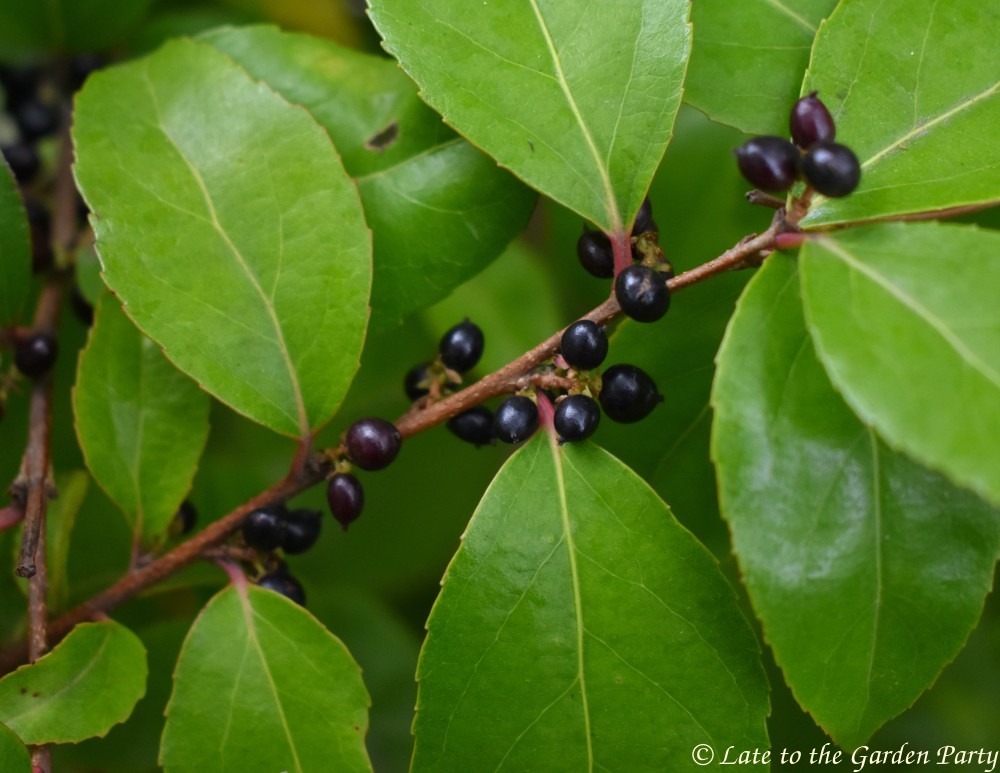
I was back at work on my street-side succulent bed on Monday.  In the process, I gave the Xylosma congestum shrubs we added back in May 2016 to extend the existing hedge a light trim and made a surprising discovery: berries I'd never seen before on these shrubs.

There are a LOT of these shrubs here.  They make up hedges that run not only along the front of our property but also one side and the entire stretch of the backyard border so I found it peculiar that I'd never seen the berries before.

These photos, taken last February show the Xylosma hedge that runs in front of the house along the street.  The shrubs shown in the photo on the right behind the succulents are those we added in 2016.  They haven't yet grown large enough to merge with the original shrubs.
    
I saw flowers on the shrubs for the first time last November.  Most online sources I checked don't even mention that they flower.  One source simply stated that flowers are rare.  The fact that we got so much rain in winter through spring last year may have been a factor in producing both the flowers and the berries.

Oddly, I found only the one shrub that had berries.  The hedges are sheared 3 to 4 times a year but the 3 shrubs added in 2016 are still playing catch-up so they're rarely touched, which may explain why I didn't find the berries anywhere else.  I think they're pretty and I may find a way to use them in a floral arrangement before they're gone.

While the berries on the Xylosma are attractive, I can't make that claim with respect to the mutant lemons I discovered on the lemon tree at the bottom of our back slope.

I consulted online sources once again and found that the fruit has probably been affected by bud mites.  In most circumstances, predatory mites keep these in check but water stress and dust on trees can tip the balance.  Since my run-ins with fire ants last year, I've seriously neglected the hand-watering I usually do on the back slope so I accept responsibility for this problem.

Luckily, only a small portion of the fruit has been affected thus far.  The sources I consulted also indicate that that the taste and quality of the fruit isn't impaired by the mites.

Both discoveries provided useful information.  I can use stems of the Xylosma to provide interest in flower arrangements but I also need to be more mindful about watching out for seedlings around any shrubs that produce berries.  The mutant fruit on the lemon tree is a reminder to keep the tree well watered during periods of drought and hose down the foliage periodically to keep it clean.

For more Wednesday Vignettes, visit Anna at Flutter & Hum.


All material © 2012-2021 by Kris Peterson for Late to the Garden Party

Monday, February 8, 2021

In a Vase on Monday: Spring is creeping closer

There seems to be a little more color in my garden with each passing week, a sure sign that spring is in the wings.  The blue Anemones in my cutting garden are producing more flowers every day so they were the most obvious candidates for "In a Vase on Monday" this week.

Unfortunately, I wasn't able to find many white flowers to accent the blue ones.  Mysteriously, my white Anemones are flowering on stems shorter than one-inch so they weren't candidates.

Back view: I tucked in a few stems of Argyranthemum to brighten things up

Top view

Clockwise from the upper left: Anemone coronaria 'Lord Lieutenant', Argyranthemum frutescens (returning for a second year), noID Ceanothus, Osteospermum 'Violet Ice', and Prostanthera ovalifolia 'Variegata' (aka mint bush)

Initially, I wasn't sure I had enough of anything for a second vase but then I spotted new blooms on one of my potted Alstroemerias, which gave me a springboard for a second arrangement in shades of pink.  The vase I chose gave it the extra pizazz it needed.

The pinks play off the painted fingernails of the hands clasped to form the vase

Back view: The bloom of the noID snapdragon is almost an exact match for those colorful fingernails

Top view

Clockwise from the upper left: Alstroemeria 'Inca Vienna', noID Antirrhinum majus, Coleonema pulchellum 'Sunset Gold', Jasminum polyanthum (spilling over the fence from my neighbor's garden), and Leptospermum scoparium 'Pink Pearl'.  (More Prostanthera was included in this arrangement but it isn't shown in closeup here.)

Last week's arrangement featuring Hippeastrum 'Lemon-Lime' still looks presentable, even though the Grevilleas had fallen apart.  I pared down that arrangement and relocated it the bedroom mantle.


The new arrangements got the usual spots in the front entry and the dining room table.


For more IAVOM creations, visit Cathy at Rambling in the Garden.


All material © 2012-2021 by Kris Peterson for Late to the Garden Party