Wednesday, December 21, 2022

The trees get spiffed up

Years ago, blogger friend Denise of A Growing Obsession said that my recently pruned trees looked as if they'd had a trip to the beauty parlor.  That image stuck with me.  Our trees got their annual spiff up on Monday.  Actually, I don't have all my trees trimmed each year, although several of them do receive that treatment.  I didn't take "before" photos of this year's contestants but I'll share their beauty shots anyway.

All 4 Arbutus 'Marina' get pruned annually.  This one sits on the northeast side of the house.

They receive annual pruning to maintain airflow within their canopies, which prevents the leaves from developing sooty mildew

This smaller tree sits alongside the larger one shown in the previous shot.  All 4 Arbutus were here when we moved in 12 years ago.

My concern with this Arbutus on the northwest side of the house is always the prospect of damage to the succulents below but the tree trimmers used tarps to protect them, which worked well

This is the largest of the 4 Arbutus.  It sits atop a moderate slope covered by more succulents.  That area usually sustains the most damage but I discovered only one relatively minor casualty this year.

I don't usually have the citrus trees pruned but they're now large enough to present a challenge for me so I had the one on the left, a Mandarin orange, and the one on the right, a lime, trimmed.  The crew reduced the height a little and cleaned out dead stems.  All 3 trees badly need to be fertilized but, according to the experts, I should wait until February for that.

The Magnolia grandiflora has been looking stressed, possibly due to our persistent drought, so I had the trimmers remove just sucker growth and deadwood

The ornamental pear, Pyrus calleryana, got only a light pruning as well


Several large shrubs also received a beauty treatment.

This cherry laurel hedge (Prunus ilicifolia) stands along one side of our property line overlooking a neighbor's driveway.  It consists of 5 shrubs, all of which received a buzz cut.

I asked the arborist to have his team trim my tree-like Leucadendron 'Pisa' for the first time.  I was very nervous about it.  I've discovered that, if cut back too hard, the branches won't leaf out.  They took out the worst of the top-heavy growth and plucked out all the dead cones that detracted from its appearance, restoring a semblance of its formerly graceful shape.

I'm still finding little cones everywhere


All told, my annual tree trimming exercise was relatively drama-free this year.  There was very little collateral damage, for which I'm grateful.

This is Aeonium 'Cabernet', which in its current spot doesn't get enough sun to color up properly.  Whether it was stepped on or simply hit by a falling branch, it lost a few arms but I think it's time to take cuttings and replant it in any case.


Much more dramatic was the trimming of the neighbors' giant pine trees earlier this month.

I looked out the kitchen window early on a Saturday morning and saw the work already underway.  There were 2 men in the adjacent pine trees already hard at work using hand tools.  The only sounds I heard were occasional verbal exchanges between them.

You can make out both men here - plus the rope used to help ensure their safety - if you look closely

At this point, the tree trimmers were about one-third the way through the process with these 2 trees.  My photographs were taken from the main level of our back garden.  These 2 trees are planted many feet below that in a canyon that sits significantly lower than the lowest level of my back slope.

This is what the trees looked like from my back patio when trimming was completed

This photo was taken a day later from the bottom of my slope.  Even from this angle you can't see the base of these 2 trees.  Some commentators on Instagram expressed concern about the amount of foliage that was removed.  All I can say is that these neighbors have had these pine trees pruned this severely before and they've always spring back.


As best as I can tell, the neighbors had all their trees trimmed at the same time, which literally took all day with some followup the next morning.  In contrast, because all my trimming was relatively light and only about one-third of my trees were pruned, the crew at my house were done in just over four hours.  I'm glad to have the project behind me so I can focus on other garden projects in the new year, including my own pruning of some of my larger shrubs.

Happy Winter Solstice to those of you in the Northern Hemisphere!


All material © 2012-2022 by Kris Peterson for Late to the Garden Party

Monday, December 19, 2022

In a Vase on Monday: Gift flowers - and a hand-made wreath

With Christmas a week away, time is short and flowers are few.  A friend stopped by on Saturday for a pre-Christmas get-together and gift exchange.  She brought flowers so those went into a vase for the dining room table.

The vase holds Chrysanthemums, bicolor and red Gerberas, Dianthus, and greenery


Among other things, I gave her this:

The seashell is one of many that were left behind by a prior owner.  I recently filled a larger clam shell with succulents (as shown here).  This smaller version was filled with miscellaneous succulents I had on hand.


On Sunday, I made another stab at creating a wreath using material in my garden.  This is the third time I've done this and I'm only nominally more pleased with this year's effort.  I used larger bundles of material this time but, in retrospect, I think I should have used shorter stems and more bundles.  As in prior years, I didn't give the project the time and patience it needed.  Here's a run-down:

I used a 14-inch metal ring as a base

I assembled various cuttings from the garden cut in roughly 8-9-inch lengths.  I didn't end up including the Magnolia grandiflora seed cones (mainly because I ran out of time and patience).

This was my first sample bundle, which I decided was too wispy.  I ended up including 3 stems of Acacia cognata 'Cousin Itt', 2-3 stems of Leucadendron 'Chief', and one stem of Cotoneaster berries in each bundle. 

This is what the wreath looked like after the first pass.  I used 22-gauge paddle wire to attach the bundles, overlapping each with the next one in an alternating in-out pattern.

The finished wreath is shown above in place on the gate that separates my cutting garden from the northeast side dry garden.  I wired up the heavy Aeonium rosettes separately and added a small red ribbon as the final touch.  Clockwise from the upper right, the following 4 photos show closeups of Acacia cognata 'Cousin Itt', Aeonium haworthii 'Kiwi Verde', noID Cotoneaster berries, and Leucadendron salignum 'Chief'.


Our annual tree pruning is scheduled to start early this morning.  My husband and I spun around the garden yesterday, moving furniture, pots, and breakable items out of harm's way.  We've used the same tree service, owned by an arborist, for years now.  They always do a good job but there's also always collateral damage and I expect to be spending hours doing cleanup afterwards.  It'll be nice to start the new year with that chore behind us, though.

For more IAVOM posts, visit Cathy at Rambling in the Garden.


All material © 2012-2022 by Kris Peterson for Late to the Garden Party


Friday, December 16, 2022

Bloom Day - December 2022 (Late Edition)

Scanning my garden, my perception is that it's low on flowers but, when I check all its nooks and crannies, there's actually quite a lot out there.  The large splashes of color characteristic of spring and summer are largely missing; however, by comparison to many gardens on the Northern Hemisphere, there are plenty of flowers to be found in my frost-free climate.

I'll start with the flowers that came as the biggest surprise to me.

I planted 3 small bulbs of Lachenalia viridiflora in a pot in October 2021.  They bloomed last December and here they are back for a second year.  The turquoise color of the flowers makes them look like jewels.

The first bloom of Camellia williamsii 'Taylor's Perfection' opened just in time for Bloom Day.  Dry conditions and untimely heatwaves have cost me the majority of these flowers in some years.  I'm hoping the shrub will respond well to our recent rainfall and cooler temperatures and give me many flowers this year.

I stored all but one of my dahlia tubers in late October to wait out their dormant season but Dahlia 'Lavender Ruffles' has continued to throw out a huge bloom (or two) at intervals into December.  The plant's foliage looks terrible but I'll hold off on digging it up as long as buds continue to develop.

I found this Dermatobotrys saundersii (tree jockey) at a Huntington Garden sale in 2017.  It blooms reliably sometime between Halloween and Christmas but always manages to surprise me, producing new leaves, flowers and fruit all at once after dropping its leaves and briefly playing dead.

This Medinilla myriantha (Malaysian orchid) was blooming last month and it's still going strong with a second bud cluster developing this month.  This tropical plant prefers shade, high humidity, and temperatures in the 60s and it's finally got that trifecta.


A couple of plants have made very brief appearances.

Hemerocallis 'Spanish Harlem' (left) is a relatively reliable rebloomer in my climate but it's struggled with the colder temperatures we've had recently.  This is one of its more presentable blooms.  It's been a very poor year for roses in my garden but 'California Dreamin' (right) graced me with a single delicate bloom late last week.


The plants I often describe as my "old dependables" continue to offer blooms.

All 4 of our Arbutus 'Marina' are dripping with flowers but, as the trees are scheduled for pruning next Monday, this will be the end of them for awhile 

Argyranthemum frutescens appreciates cooler temperatures.  'Aramis Bicolor' is on the left and 'White Butterfly' is on the right.

Bauhinia x blakeana (Hong Kong orchid tree) also celebrates cooler temperatures and higher humidity levels with flowers

The raccoons dug up the Calibrachoas I grew in another barrel last summer but none have touched this peach variety

These 2 noID varieties of Camellia sasanqua are putting on a particularly good show right now 

Felicia aethiopica has been blooming continuously for months

My garden wouldn't be the same without Grevilleas.  Clockwise from the upper left are: Grevillea alpina x rosmarinifolia, dwarf G. rosmarinifolia, G. 'Scarlet Sprite', G. 'Peaches & Cream', and G. 'Superb'.

The Leucadendrons continue to mimic flowers.  Left to right are: Leucadendron salignum 'Blush', L. salignum 'Chief', and hybrid L. 'Safari Sunset'

The Osteospermums are returning in greater numbers as the cooler temperatures persist.  Clockwise from the upper left: Osteospermum '4D Pink' (without the blue blue color it showed off last year), O. '4D Silver', O. '4D White', O. '4D Violet Ice', and a mutant variety.

Ivy geraniums (Pelargonium peltatum) in burgundy and lavender 

Pennisetum advena 'Rubrum', not quite as vigorous as in prior years

Tagetes lemmonii (Mexican marigold) in full bloom in partial shade


I've grouped the best of the rest in color-coded collages.

Top: Barleria obtusa, Lavandula multifida, and Teucrium fruticans 'Azureum'
Middle: Lantana montevidensis, Salvia rosmarinus, and Scabiosa columbaria
Bottom: Gomphrena decumbens 'Itsy Bitsy', Viola cornuta 'Penny Peach', and Vitex trifolia

Clockwise from the upper left: Achillea ptarmica, Primula vulgaris, Westringia fruticosa 'Morning Light', Achillea 'Moonshine', noID Calendula, Gaillardia 'Spintop Copper Sun', and Nemesia 'Banana Split'

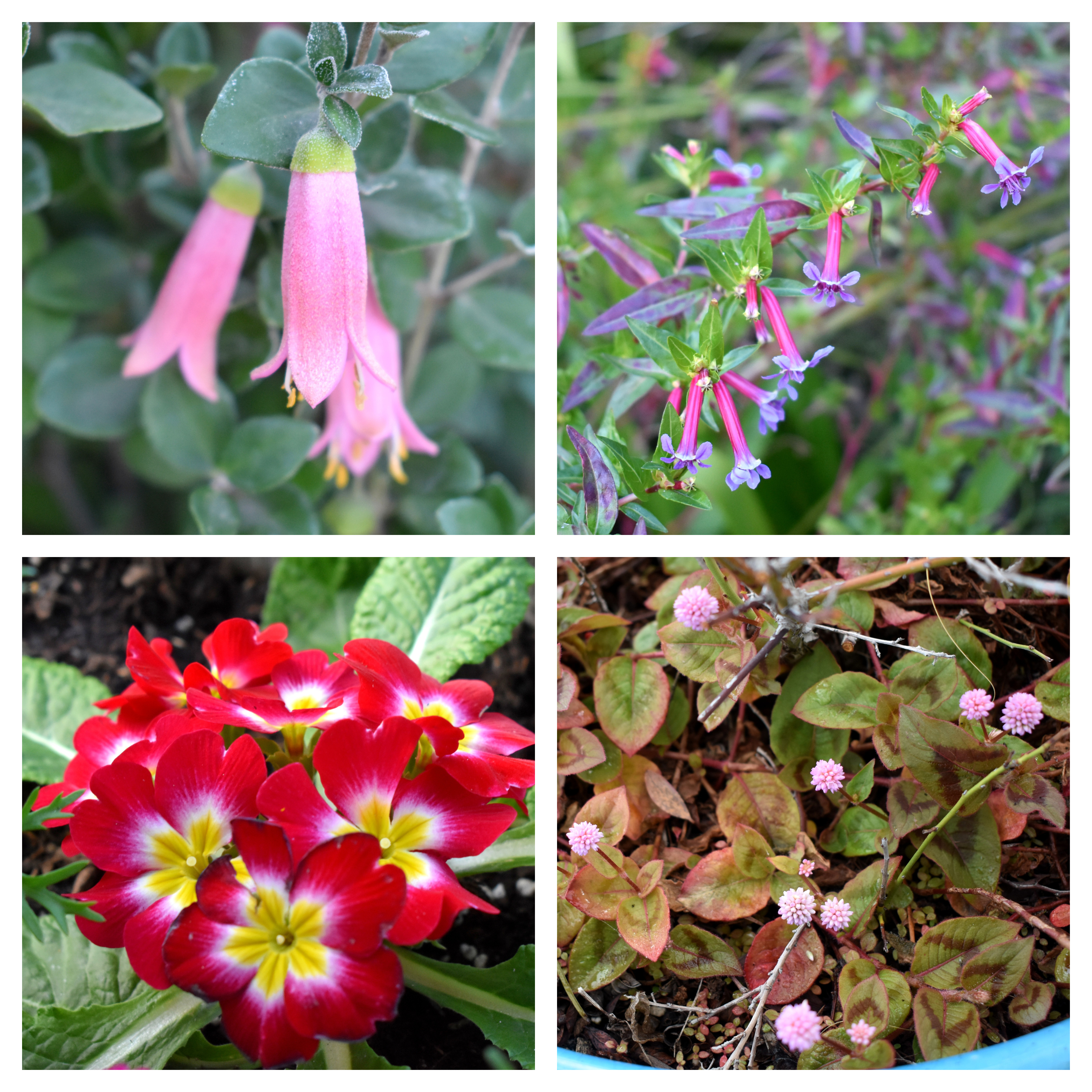
Clockwise from the upper left: Correa 'Dusky Bells', Cuphea 'Starfire Pink', Persicaria capitata, and Primula vulgaris


A check of my December 2021 and 2020 Bloom Day posts indicates that there are fewer flowers in my garden this year.  After three years of seriously low rainfall, that's to be expected.  This December also seems colder than those prior years, which may be slowing the bloom cycles of some plants.  The Aloes and Aeoniums are gearing up to put on show in January and hopefully other tardy bloomers will join in.


Visit Carol at May Dreams Gardens to find other Garden Bloggers' Bloom Day posts.


All material © 2012-2022 by Kris Peterson for Late to the Garden Party


Wednesday, December 14, 2022

Filling bird feeders energizes the garden

Early in 2022, in response to an epidemic of salmonellosis that was killing wild birds, I decided to leave my bird feeders empty because I wasn't confident I could keep them clean enough.  With spring off to an early start in my part of the country, I felt there was enough in my garden to feed the birds without providing store-bought seed.  Recently, however, as Thanksgiving approached, I felt it was time to supplement their diet again and I filled my feeders once more.  My garden was never without birds over the course of the year but their activity has certainly increased in the past few weeks.

These 3 feeders sit outside my home office window where I can view the activity every time I sit down at my computer.  The hazy view in the distance is the Los Angeles harbor.  There are 3 more feeders in the front garden close to the street but they're not readily visible from inside the house.

Closeups of birds at the feeder.  Lesser goldfinches and house finches are year-round residents (along with mockingbirds, scrub jays, and hummingbirds) but the white-crowned sparrows just spend the winter here.  I hadn't seen a single white-crowned sparrow until the feeders were filled and they were suddenly everywhere.

Closeups of white crowned sparrows - males on the left and a female on the upper right - as well as what I believe is an immature house finch.

The smaller finches hang out in the nearby Ginkgo tree until the pushy sparrows and other invaders leave space for them at the seed portals.  When a hawk zooms in the direction of the feeder, the birds all dart into the safety of the strawberry trees (Arbutus 'Marina') only a few feet away.


When the feeders were empty, the squirrels virtually disappeared, although I occasionally found evidence of their inept burials of unripe guavas and persimmons in the garden.  They immediately reappeared as soon as the feeders were full again.

All my feeders are "squirrel resistant" but that doesn't mean the critters don't make a concerted effort to get to the seed.  While some squirrels accept eating seed the birds drop to the ground, there are always others that aim higher.

The largest feeder is particularly challenging for the squirrels.  Resting any weight on the ring surrounding the feeder's seed portals causes them to close.

The smaller side feeders are easier to circumvent, provided a squirrel hangs upside down from the top of the feeder without putting downward pressure on the wire cage surrounding the tube containing the seed.  No squirrel can maintain that position for long.  They inevitably fall to the ground or grab the feeder pole and slowly slide their way down.  Hanging upside down from the top of the larger feeder is impossible for them.

Like the birds, the more timid squirrels sometimes hang out in the tree-like Leucadendron 'Pisa' near the feeder, waiting for the aerialists in their group to give up.  They also steer clear of the scrub jays that periodically seek to dominate the feeders.  As in the case of the squirrels, the jay's weight also closes the seed portals.

I've enjoyed watching the birds from my office window, and even the persistent efforts of the squirrels.  I'm already running low on seed but I'll probably get enough to keep them all going for a couple more months before I let them return to foraging on their own.  If you know of any squirrel resistant feeders that are especially easy to clean, please let me know.


All material © 2012-2022 by Kris Peterson for Late to the Garden Party


Monday, December 12, 2022

In a Vase on Monday: Different spins on the same old flowers

I returned to my old standbys for flowers this week as there's nothing new in the garden to share.  It's been colder than usual by our standards for the last couple of weeks with temperatures seldom reaching much over 60F (15C) but we also got a real rainstorm on Sunday and we're expecting a bit more overnight.  I'm hoping the rain will work its magic in the garden, bringing new blooms in the coming weeks.


Grevilleas 'Peaches & Cream' and 'Superb' bloom year round.  The small-flowered Grevillea alpina x rosmarinifolia joined in last month with colors that echo those of the large-flowered Grevilleas.

Back view: The Mexican marigold (Tagetes lemmonii) is still going strong so I added a few stems of those, much to my husband's irritation.  He didn't notice the scent the last time I cut them but he immediately wrinkled his nose this time.  The Anthurium stems are the same ones I cut for IAVOM on November 21st!

Top view

Clockwise from the upper left: Agonis flexuosa 'Nana', Anthurium 'Maine', Grevillea alpina x rosmarinifolia, G. 'Peaches & Cream', G. 'Superb', Pennisetum advena 'Rubrum', Rosa 'California Dreamin' (making a surprise appearance), and Tagetes lemmonii


Believe it or not, Dahlia 'Lavender Ruffles' is still blooming, although the flowers seem to take an especially long time to open fully.

Once again, the dahlia bloom is huge, a full 8 inches in diameter, but I sacrificed a partially opened bud in cutting this stem

Back view: I used stems of trailing Lantana from my back slope and the variegated foliage of mint bush (Prostanthera) as fillers in this small vase

Top view

Clockwise from the left: Dahlia 'Lavender Ruffles', Lantana montevidensis, and Prostanthera ovalifolia 'Variegata'


The holidays crept up on me this year.  We brought home a Christmas tree on Friday and the decorations are slowly going up.  I'd hoped to make a wreath this year but I've yet to carve out the time to do that.  Maybe next week...


To find other IAVOM creations, visit Cathy at Rambling in the Garden.


All material © 2012-2022 by Kris Peterson for Late to the Garden Party