Showing posts with label bird feeders. Show all posts

Wednesday, November 26, 2025

Bird feeder traffic

When I think of Thanksgiving, it's mostly about getting together with family and eating, not necessarily in that order.  It seems an appropriate time to make sure that I feed the birds too.  I used to keep the feeders full year-round but some years ago, concerned with reports of birds spreading disease at feeders, I reduced my provisions of seeds to the colder months of the year when there's less food available to them.

The finches are usually the first to appear.

The Lesser Goldfinches (Spinus psaltria) showed up in greater numbers but the House Finches (Haemorhous mexicanus) were present too.  I haven't seen the Spice Finches (Lonchura punctulata) at all yet.  The latter are native to Asia but escaped pets have spread in the US, and notably California.


The White-crowned Sparrows showed up slightly later.  There was a good crowd of them at one point but I didn't capture it.  However, the sparrows and the finches always seem comfortable mingling at the feeder and I did capture one in the group shown below.  

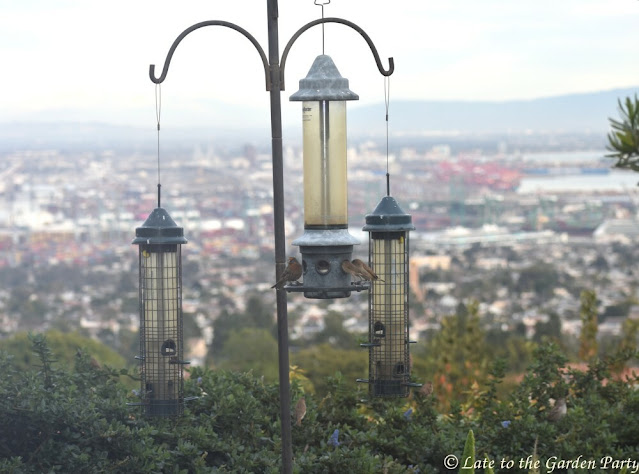
The bird sitting in the Ceanothus just below the middle feeder is a White-crowned Sparrow (Zonotrichia leucophrys).  Unlike the finches, species noticeably differentiated by gender, these sparrows are described as "sexually monochromatic," which means they can't be readily differentiated based on their appearance, although there are apparently nominal size differences.


On the other hand, when the California Scrub Jays arrive, all the other birds back off.

California Scrub Jays (Aphelocoma californica) are described as "assertive" and they take over the feeders and send the smaller birds off as soon as they arrive.  Two of these jays jockeyed for control of the feeders even though they're "squirrel resistant," which means they also lock out the heavier birds to a significant degree.  Even so, the jays are adept at getting to the seeds to some extent.

This is a closeup of one of the jays.  This bird's underside was particularly fluffy.  It occurred to me that it might be a somewhat immature bird but then it's possible it was fluffed up due to either the wind or its conflict with the other jay.  Like the White-crowned Sparrows, adult Scrub Jays can only be differentiated by size, not appearance. 

The finches use the bare Ginkgo tree some 20 feet away as a waystation when the Scrub Jays are in takeover mode


Best wishes for a happy Thanksgiving and may you get all you want to eat!


All material © 2012-2025 by Kris Peterson for Late to the Garden Party

Wednesday, December 14, 2022

Filling bird feeders energizes the garden

Early in 2022, in response to an epidemic of salmonellosis that was killing wild birds, I decided to leave my bird feeders empty because I wasn't confident I could keep them clean enough.  With spring off to an early start in my part of the country, I felt there was enough in my garden to feed the birds without providing store-bought seed.  Recently, however, as Thanksgiving approached, I felt it was time to supplement their diet again and I filled my feeders once more.  My garden was never without birds over the course of the year but their activity has certainly increased in the past few weeks.

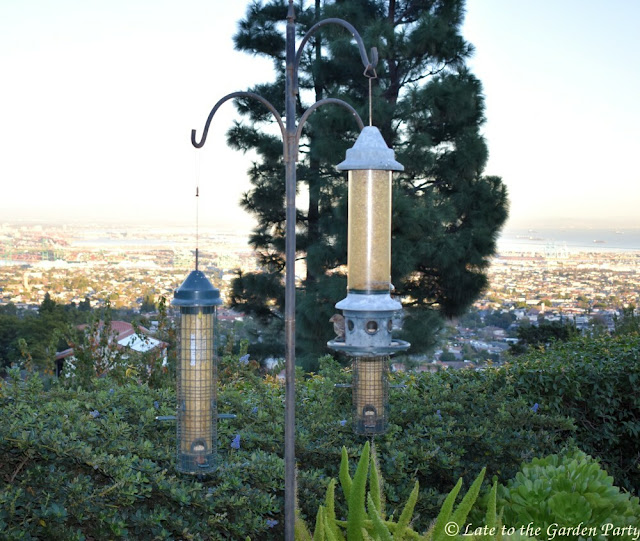
These 3 feeders sit outside my home office window where I can view the activity every time I sit down at my computer.  The hazy view in the distance is the Los Angeles harbor.  There are 3 more feeders in the front garden close to the street but they're not readily visible from inside the house.

Closeups of birds at the feeder.  Lesser goldfinches and house finches are year-round residents (along with mockingbirds, scrub jays, and hummingbirds) but the white-crowned sparrows just spend the winter here.  I hadn't seen a single white-crowned sparrow until the feeders were filled and they were suddenly everywhere.

Closeups of white crowned sparrows - males on the left and a female on the upper right - as well as what I believe is an immature house finch.

The smaller finches hang out in the nearby Ginkgo tree until the pushy sparrows and other invaders leave space for them at the seed portals.  When a hawk zooms in the direction of the feeder, the birds all dart into the safety of the strawberry trees (Arbutus 'Marina') only a few feet away.


When the feeders were empty, the squirrels virtually disappeared, although I occasionally found evidence of their inept burials of unripe guavas and persimmons in the garden.  They immediately reappeared as soon as the feeders were full again.

All my feeders are "squirrel resistant" but that doesn't mean the critters don't make a concerted effort to get to the seed.  While some squirrels accept eating seed the birds drop to the ground, there are always others that aim higher.

The largest feeder is particularly challenging for the squirrels.  Resting any weight on the ring surrounding the feeder's seed portals causes them to close.

The smaller side feeders are easier to circumvent, provided a squirrel hangs upside down from the top of the feeder without putting downward pressure on the wire cage surrounding the tube containing the seed.  No squirrel can maintain that position for long.  They inevitably fall to the ground or grab the feeder pole and slowly slide their way down.  Hanging upside down from the top of the larger feeder is impossible for them.

Like the birds, the more timid squirrels sometimes hang out in the tree-like Leucadendron 'Pisa' near the feeder, waiting for the aerialists in their group to give up.  They also steer clear of the scrub jays that periodically seek to dominate the feeders.  As in the case of the squirrels, the jay's weight also closes the seed portals.

I've enjoyed watching the birds from my office window, and even the persistent efforts of the squirrels.  I'm already running low on seed but I'll probably get enough to keep them all going for a couple more months before I let them return to foraging on their own.  If you know of any squirrel resistant feeders that are especially easy to clean, please let me know.


All material © 2012-2022 by Kris Peterson for Late to the Garden Party


Wednesday, January 12, 2022

Wednesday Vignette: Saucy Sparrows

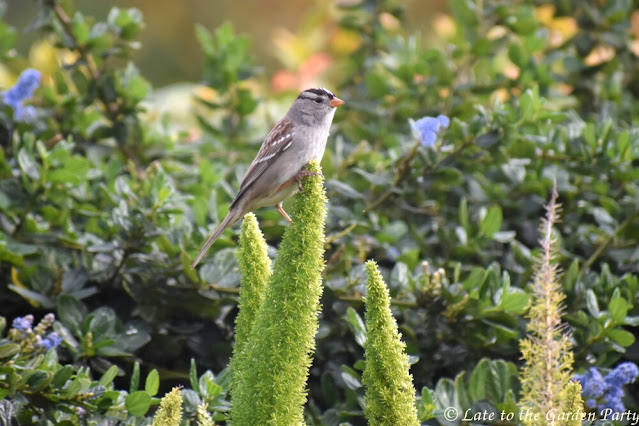
The white-crowned sparrows (Zonotrichia leucophrys) seem to arrive as a flock, swamping my feeders and emptying them in record time (with some help from the finches).  As I looked out my home office window Monday afternoon, I noted that the three feeders I can see were once again empty, or at least nearly so.


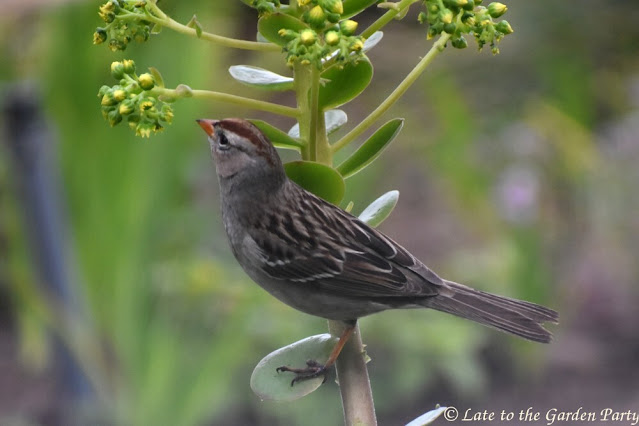
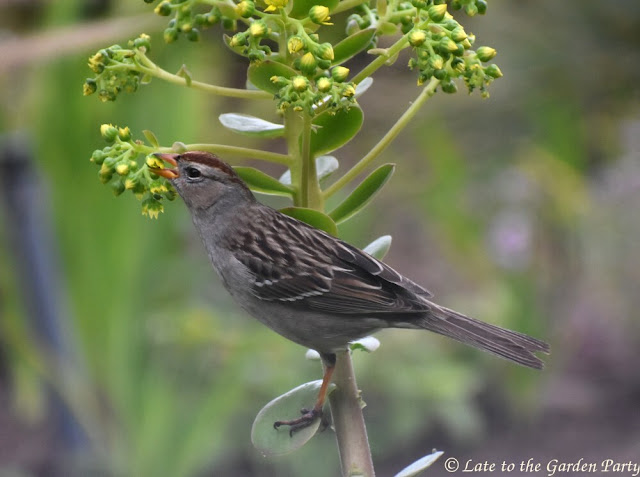
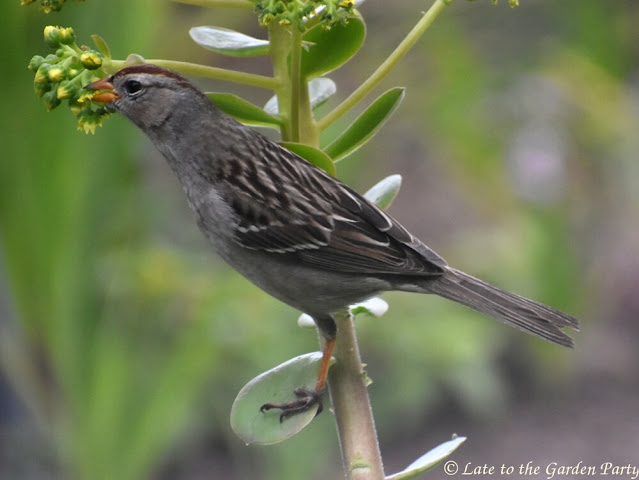
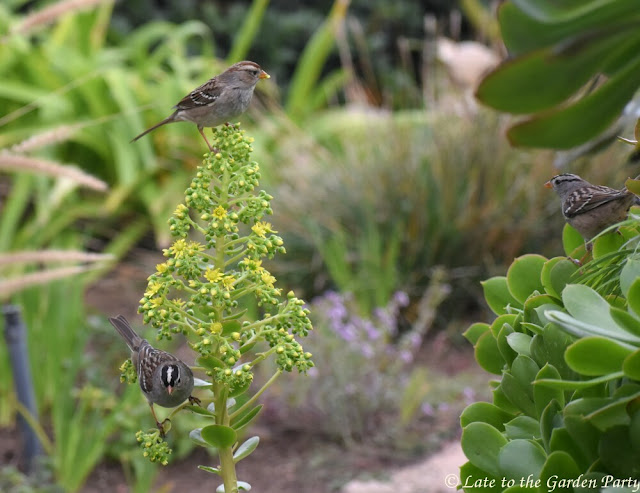
But the sparrows didn't take off.  Some hopped about cleaning up seed on the ground but others went after my succulents, specifically the Aeonium arboreum currently in flower.

This particular sparrow, perched atop an asparagus fern, was well-behaved

However, this was one of several that focused on my Aeoniums

Nothing in The Cornell Lab's summary of this bird's behavior mentions an appetite for succulents

but I've seen these same birds go after these succulents in previous years

They even fought over Aeonium flowers.

This was a temporary detente.  One bird always chased the others away before nipping away the the flowers.

I got around to refilling the feeders yesterday afternoon.

This isn't a great photo but I noticed a single bird calmly sitting on the refilled feeder, as if wondering where all his cohorts were

Hopefully, the full feeders will distract them from the succulents, at least for a time.

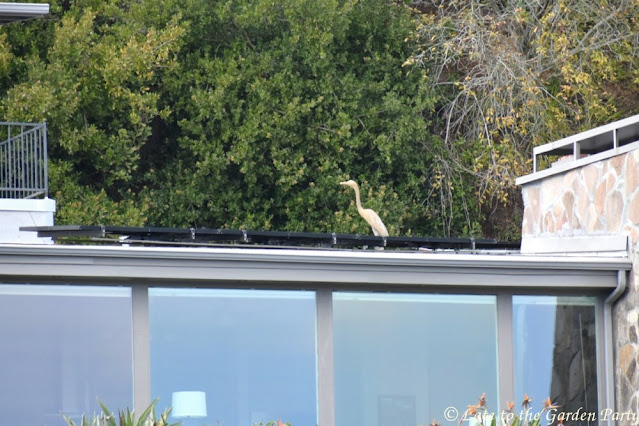
In other unusual bird news, while taking photos in my front garden, I thought I saw a crane standing on the flat roof of a neighbor's house several doors down the street.  After convincing myself that I might have seen the bird move his head, I ran and got my telephoto camera lens as cranes certainly aren't a common sight here.

It's definitely not a real bird.  It didn't move or turn its head.  It's not clear why it was put there, just beyond what appear to be solar panels.  Perhaps, like the plastic owls I often seen mounted on roofs, its purpose was to scare away other birds.

For more Wednesday vignettes, visit Anna at Flutter & Hum.


All material © 2012-2022 by Kris Peterson for Late to the Garden Party

Wednesday, November 24, 2021

Wednesday Vignette: Time to feed the birds

Early this year, when word of a salmonella outbreak among song birds spread, I stopped filling my bird feeders.  After the risk dropped, I held off on filling the feeders as I hosted periodic gatherings with friends in my back garden  - fewer birds in the vicinity reduced the frequency with which I had to scrub my outdoor furniture.  Even as my friends and I got vaccinated against COVID-19 and returned to a semi-normal schedule of meeting at local restaurants, I held off refilling the feeders.  But I've felt guilty every time I looked out my home office window and saw a bird land on the empty feeders.  As Thanksgiving loomed, I decided there was no better time to scrub the feeders and get back to feeding the birds.  It only took a day before they were back.

Most of the avian visitors thus far have been lesser gold finches

Scrub jays show up periodically, scattering the smaller birds, but the weight of the larger birds causes the seed portals to close and the jays haven't figured out how to get around that

Of course the finches and jays the weren't the only creatures to return.

Full feeders or not, the birds have remained in the garden but the squirrels largely disappeared when the feeders were empty.  This fellow showed up at the feeders almost as soon as the birds did.

It took him numerous tries to figure out how to get up the pole but he's yet to master the fine art of feeding from these "squirrel buster" feeders without his weight closing the seed portals

He keeps working at it, though, and I'm sure he'll figure out how to feed upside down one day soon, just like his predecessors

I have three feeders in the front garden too but they've barely been touched thus far. 

These feeders contain a different seed mix but I suspect their closeness to neighborhood street traffic is what's put off both birds and squirrels

Meanwhile, as I pondered when I should cut back the Senna bicapsularis on the north side of the garden, I spotted caterpillars of the cloudless sulphur butterflies (Phoebe sennae) munching away for the first time this year.  Pruning will be delayed for at least a couple of months. 

These caterpillars can be either yellow or green depending on whether they're consuming the flowers or the foliage of the host plant.  The ones I found were feeding on the few flowers remaining on the Senna.  Heat and dry winds have already eliminated most of the flowers on the shrub. 

These three were easy to spot because they were yellow and feeding at eye level.  The Senna grows several feet above my head (where no flowers remain) so I imagine there are probably more I can't see.  According to one source, these caterpillars molt 4 times before forming a leaf-like chrysalis.  Once they form a chrysalis, it takes several weeks for them to transform into butterflies.

Hopefully, offering the birds plenty of seed will discourage them from eating caterpillars!

For more Wednesday Vignettes, visit Anna at Flutter & Hum.

Best wishes for a wonderful Thanksgiving!


All material © 2012-2021 by Kris Peterson for Late to the Garden Party

Wednesday, November 25, 2020

Wednesday Vignette: The birds are still here

One of my biggest concerns about taking down the dying mimosa tree (Albizia julibrissin) was that its removal would impact the bird activity in my back garden.  The mimosa was bare for a good portion of the year but it was nonetheless the favorite perch for every avian visitor.  Situated in between the feeders and the fountain, it provided a handy way-station.  I shifted the backyard feeders a few feet after the mimosa came out, hoping that the small birds would seek cover in either the nearby strawberry tree (Arbutus 'Marina') or the tree-like Leucadendron 'Pisa' just outside my home office window.  As it turned out, bird activity is, if anything, greater than it was before.  The small birds appear perfectly happy to use both the strawberry tree and the Leucadendron to provide safe perches.


Leucadendron 'Pisa' is on the left and Arbutus 'Marina' is on the right, several feet behind the feeders.  There's a second, larger Arbutus behind the first tree.

Last week we had white-crowned sparrows too but this week it's mainly house finches and lesser goldfinches.  In less than a week, they manage to empty all three of these feeders and most of the three feeders in the front garden.

The mimosa's removal hasn't seemed to have affected the birds' use of the fountain for baths either.

Again, the visitors this week were mainly finches

The seashells in the fountain's top tier give them a place to perch as they splash about

The raccoons rearrange the shells every few days during their nightly visits

The tree removal may have impacted the larger birds like the scrub jays and hawks somewhat more than the small birds.  The jays still visit the feeders occasionally, scattering the smaller birds when they arrive, but their visits have been less frequent since the mimosa's removal.  I've yet to see jays, crows or hawks perching in the smaller Arbutus or Leucadendron as they formerly did in the mimosa either.  The hawks haven't entirely disappeared, however.

The hawks that regularly visited the mimosa tree now must content themselves with the tall pine tree in the neighbor's garden behind us

Last week I saw one hawk swoop through our garden just over the roof line but generally they're sticking to the pine tree

I caught this one taking flight after scanning the horizon for a good 15 minutes

I can't state definitively whether this is a Cooper's hawk or a sharp-shinned hawk but the rounded tail shape visible in this photo suggests the former

It's been a very tough year on a lot of fronts and there are more challenges on the horizon before this dreadful year comes to a close.  However, on the cusp of our unusual Thanksgiving holiday this year, I can still say I'm thankful for things both big and small, like the company of birds in my garden.  I hope you have things to be thankful for as well.  Have a happy - and safe - Thanksgiving.

For more Wednesday Vignettes, visit Anna at Flutter & Hum.


All material © 2012-2020 by Kris Peterson for Late to the Garden Party

Friday, February 24, 2017

Who got busted?

Squirrels aren't visitors to my garden - they're residents.  Ever since we moved in and I put up my bird feeders, we've been at loggerheads.  I've gradually replaced my "squirrel resistant" feeders with tougher models, marketed as "squirrel busters."  Have I been successful in eliminating bird seed theft?  You can be the judge.

A squirrel tackles the original "squirrel buster" feeder without success

He shifts position and tries another angle, also without success

These close ups of the same type of feeder show it in the open mode (left) and the closed mode (right).  The squirrel's own weight, whether applied to the perches or the cage surrounding the feeder, covers the feeding portal

He moves over to the next feeder, sold as a "Squirrel Buster Plus," nimbly clinging to the feeder pole using his back legs but his paws on the feeder ring close the seed portals

These close-up show the open feed portals (left) and what happens when pressure is applied to the support ring (right)

He moves to the oldest model feeder, covered by a simple cage

Unlike the cage my husband constructed for one of my earlier feeders, he's been unable to break into this one by chewing through or bending the supports

In a creative play, he tries using the third feeder to access the second but pressing the ring surrounding the feed portals once again shuts off his access to the seed

Frustrated, he takes a break sitting on top of the third feeder.  At this point, I assumed he'd given up.

But then he tries a gymnastic move, clinging to the top of the third feeder by his feet and stretching across to the second feeder.  I initially thought this strategy was also unsuccessful until I reviewed my photos and realized that he'd avoided pressing his paws on the feed portal ring.  You can see that the portals aren't closed.  He's busted the feeder's defenses!


It wasn't the fault of the feeder, though.  It was my fault in providing him a platform to access it.  However, I don't think it was easy for him to feed from that angle as he quickly gave up the effort.  I'll probably replace the old, caged feeder eventually anyway but, for now, I'm satisfied that he's not stealing much from the birds.  He mainly makes do with what the birds drop on the ground, which is plenty.

The side garden, which also has 3 feeders, has one that's vulnerable to intrusions too.  I refilled them yesterday and, as I was doing so this fellow showed up.

This is a Western Scrub Jay (Aphelocoma californica), a pretty bird but a bully of sorts.  When he arrives, the smaller birds scatter until he moves on.  He isn't much afraid of humans either. 


He wasn't at all interested in the dried-up toyon (Heteromeles arbutifolia) berries scattered about.  He wanted bird seed and he wasn't at all afraid to take it with me standing a couple of feet away.  He can't feed from the newer feeders but he has no problem with an old model.  It may be squirrel resistant but it's not Scrub Jay-proof.

The squirrel's weight on the bar the jay is standing on would shut off access to the seed but the jay is light enough  to avoid this.  On occasion, the squirrels manage to lift the lid from the back and dump the seed on the ground.  I haven't seen them do this but I have found the seed covering the ground underneath the feeder.  Having seen their work on the back garden feeders, I now suspect that they may be using the nearby feeders as perches.


Squirrels!  They keep us hopping!


Note: I have no relationship with the companies that make or market the squirrel buster feeders.


All material © 2012-2017 by Kris Peterson for Late to the Garden Party