Wednesday, June 9, 2021

Stepping back in time: The evolution of the back garden

We moved into our current house in mid-December 2010.  I started making small changes almost immediately but family concerns prevented me from taking on any major projects well into 2013.  I didn't begin documenting changes in my garden until I started this blog in late December 2012.  Taking a stroll down memory lane, I thought look at the evolution of my garden, starting with the back borders, one of the first areas I tackled.  I trolled through my photographic records but found I'd taken no proper "before" shots of the area.  The best I could come up with is a photo I retrieved from Zillow some years ago, showing the back garden in 2009, when it was put up for sale by the prior owner.

The photo's resolution is too poor to make out much detail but, given that the mimosa tree (Albizia julibrissin) and the Agapanthus were in full bloom, I expect the photo was taken that summer

Until I started taking wide shots in the summer of 2013, the vase majority of my photos were closeups that don't do a good job of telling the story of the garden.

This photo was taken for my first wide shots post on September 1, 2013.  It reflects the first extension of the back border in 2012, which nearly doubled its width by taking out a large stretch of lawn.

From 2014 through 2016, I took wide shots of broad areas of the garden on a monthly basis, making it easier to track changes.

June 2014 - By this time, my husband and I'd removed another large section of lawn, significantly expanding and extending the border surrounding the fountain.  Mexican feather grass (Nasella tenuissima) had been added there to mirror clumps of the same grass previously planted in the back border.  The orange daylilies (possibly Hemerocallis 'Sammy Russell') are the only plants, other than the trees, the Agapanthus and the hedges, that remain of the those that came with the original garden.


June 2015 - Our drought was in full swing in 2015 and water restrictions were in effect that year, which may account for the subdued color in the following three photos.  The Mexican feather grass was making the biggest statement.  You may note that we'd also "lost" a large peppermint willow (Agonis flexuosa) since the prior year's photos.  It was removed in response to a neighbor's claim that it blocked her view of the harbor.  After its removal, she continued her campaign for further tree removals and, at that point, I refused further cooperation, committing only to have our trees trimmed annually.  I replaced the willow with a Callistemon 'Cane's Hybrid', still too small to be noticeable in the following photos.  I was putting increased emphasis on drought tolerant plants at this point, reflected in the introduction of three small 'Bright Star' Yuccas, just visible on the right in the third photo.


June 2016 - The biggest change between 2015 and 2016 was the removal of the remaining lawn and the introduction of flagstone paving stones interspersed with creeping thyme (Thymus serphyllum 'Minus').  My husband and I handled these tasks entirely on our own.  The Callistemon 'Cane's Hybrid' I'd planted to replace the peppermint willow we'd removed was already well on its way to making a statement in the back border.  I'd planted more drought tolerant plants, including the Echium webbii next to the fountain.  Santolina virens made a major splash that summer, as shown in the second photo.  For some reason, I've no photo of the back garden viewed from the south end looking north during this period.


In late 2017, I switched to a quarterly schedule for wide shots so the time-table for comparisons varies in some cases.

July 2018 - In the next shots, the garden looks very similar to its appearance in 2017, although the third photo clearly reflects a decline in the health of the mimosa tree in the distance.  The front half of the multi-trunked tree never leafed out that year.  We discovered that it'd been attacked by short-hole borers.  In an effort to prolong its life, we had a large portion of the tree removed.  It also became clear to me that a native California aster (now classified as Symphyotrichum chilense) was taking over, although I still thought it was controllable at that point.


May 2019 - We undertook a major home renovation in 2019, starting in late June, and the garden took a back seat.  In the third photo, you can see what was left of the mimosa tree after it was cut almost in half in late 2018.  Although it's still bare in this photo, it did leaf out and flower in 2019.  We got good rain in the "water year" of October 1, 2018 through September 30,2019 and, in general, the garden thrived.


July 2020 - The pandemic kept many people, including me, close to home.  I did less plant shopping and less planting, at least by comparison to prior years.  I tackled other areas of the garden that had been bugging me but I didn't make many significant changes to the back garden.  I removed the large white-flowered Ozothamnus diosmifolius in the fountain bed shown in the photo above because it had gotten woody but, looking at the June 2019 photo, I'm feeling a bit regretful about that decision.  (Pulling out that blasted native aster would've been a smarter investment of my time.)  The evergreen native Toyon (Heteromeles arbutifolia) shown in the second photo, draped in reddish leaves to the rear right of the peppermint willow, died suddenly, probably due to the same pathogen than cause sudden oak death.  The mimosa tree (in the distance in the third photo) declined further and I ended up having both it and the Toyon taken out in late October 2020.


June 8, 2021 - I took the last three photos yesterday.  The mimosa and the Toyon are long gone.  The mimosa was replaced by a Ginkgo biloba 'Autumn Gold' and the Toyon by a still tiny Olearia albida (aka tree daisy, not visible in the following photos).  I cut back the bloomed-out Echium webbii next to the fountain on Monday.  The orange daylilies surrounding the fountain have bloom spikes and should begin to open within days.  Before the mimosa tree was cut down last October, I dug up many of the Agapanthus skirting it, divided them, and replanted the best bulbs.  They're just starting to bloom but their summer show will be less splashy than in prior years.  Callistemon 'Cane's Hybrid' continues to get bigger and is currently covered in peachy-pink blooms.  That California aster must come out this year, even if I have to dig up half the fountain bed to be rid of it.


I hope this post wasn't too repetitive or boring for the reader.  It helps me track the garden's progress and provides some food for thought about changes that might be useful moving forward.


All material © 2012-2021 by Kris Peterson for Late to the Garden Party


Monday, June 7, 2021

In a Vase on Monday: Under gray skies

As much of the northeastern and mid-Atlantic areas of the US experienced scorching heat this weekend, coastal Southern California was comfortably cool, thanks to our seasonal "June Gloom."  The gray clouds usually move out by early afternoon but that morning cloud cover keeps our afternoon temperatures down.  Today's expected to be especially gloomy, even offering the opportunity of light drizzle.  I'm not holding my breath over the prospect of real rain but even the high humidity that accompanies our June Gloom often causes the roof to shed some moisture into my rain barrels, which is always welcome.

View looking toward Angel's Gate, the entrance to the Port of Los Angeles, from my backyard late Sunday afternoon

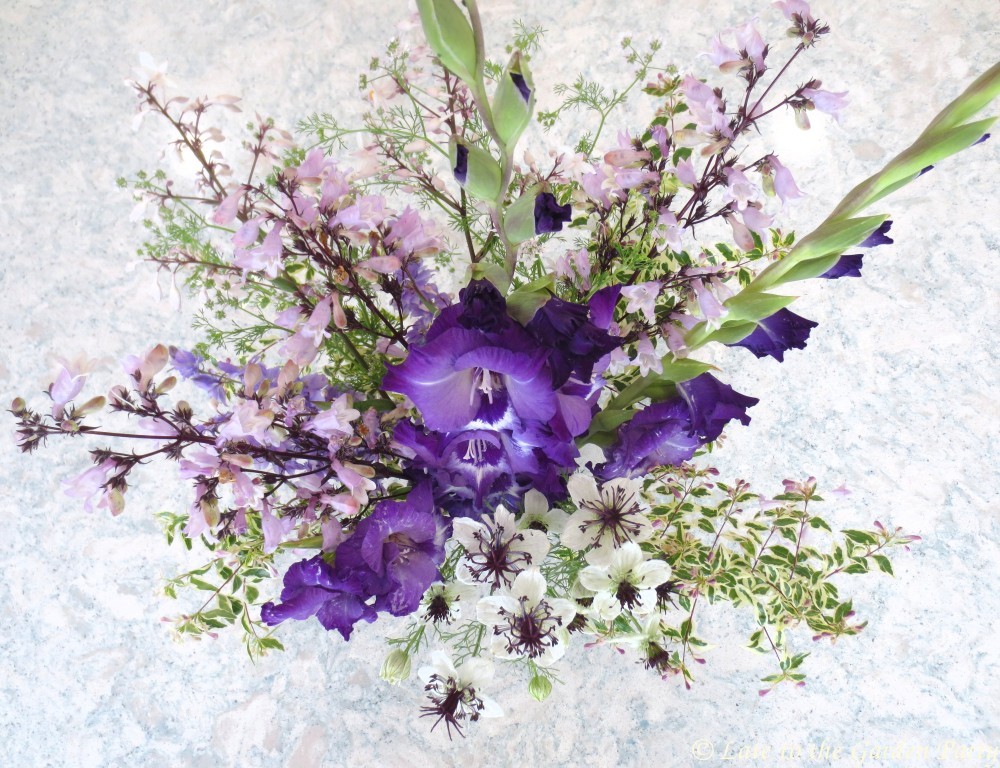
My garden is slowly shifting from its cool season mode to its warm-hot season mode in anticipation of summer.  My cool season annuals are dying off quickly while many of my summer-flowering plants have been slow to get started but there's still plenty of color to be found.  The inspiration for my first vase this week was three gladiola stalks that surprised me with blooms in my cutting garden.  I thought I'd dug all the gladiola corms out of my raised planters last fall but apparently I missed a few.

I recently planted a package of orange gladiola corms and I have another collection yet to plant but the early arrivals of the dramatic purple Gladiolus 'Vuvuzela' were appreciated

Back view: As usual, I picked more than I actually needed to fill my vase, much of which got stuffed to the rear of the arrangement 

Top view

Clockwise from the upper left: Abelia grandiflora 'Hopley's Variegated', Arthropodium cirratum (aka Renga Lily), Coriandrum sativum (aka cilantro/coriander, which is popping up all over my garden), Gladilous 'Vuvuzela', white and lavender Consolida ajacis (aka larkspur), Penstemon digitalis 'Onyx & Pearls', and Nigella 'African Bride'

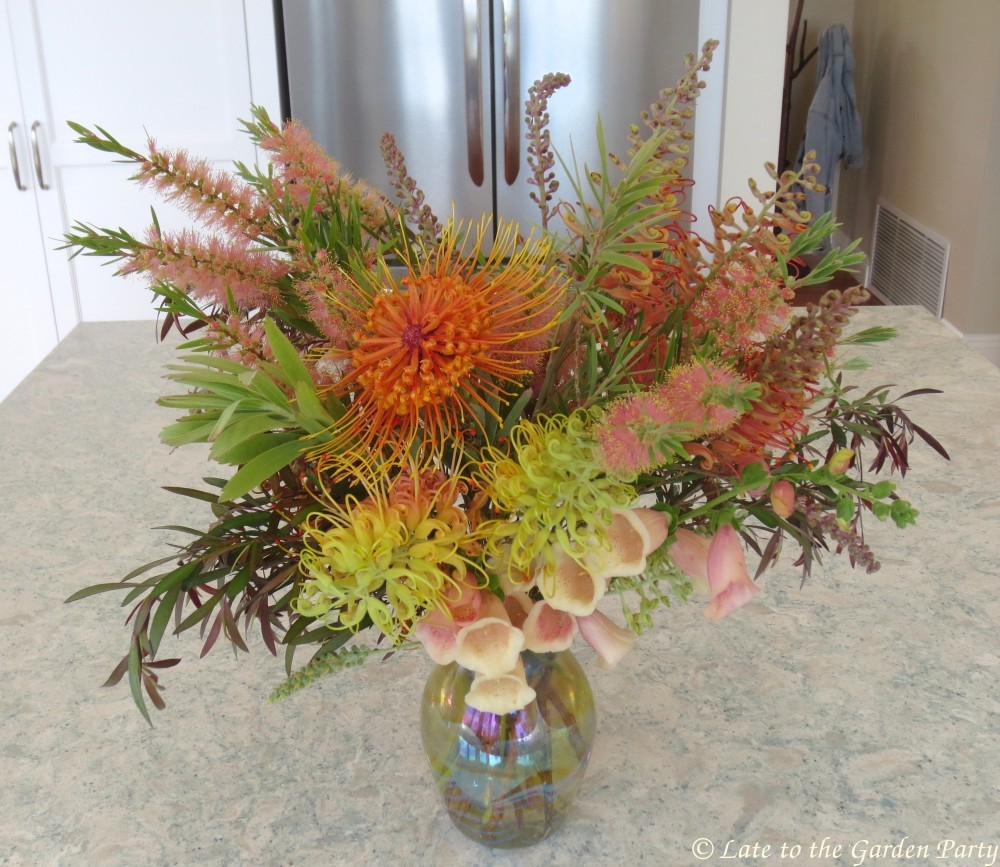
My second arrangement was inspired by the first flush of blooms on the tree-sized Callistemon 'Cane's Hybrid' in my back border.

The appearance of a few short stems of Digitalis 'Dalmatian Peach' in my cutting garden sealed the peachy-orange color scheme.  I couldn't help myself from cutting one stem of Leucospermum 'Brandi' as it's nearing the end of its season and as the squirrels polished off the majority of Leucospermum 'Goldie'. 

Back view: The foliage of Leptospermum 'Copper Glow' picked up the raspberry undertones evident in some of the flowers

Top view

Clockwise from the upper left: Callistemon 'Cane's Hybrid', Digitalis purpurea 'Dalmatian Peach', Grevillia 'Peaches & Cream', G. 'Superb', Leptospermum 'Copper Glow', and Leucospermum 'Brandi'

With the usual touch of sadness, on Saturday I tore out the sweet peas that occupied most of one raised planting bed in my cutting garden.  It always seems that they forever to grow from seed to flowering plants, only to be gone all too soon.  I met three friends for lunch (at a restaurant!) last Friday and I'd hoped to bring each one a small bouquet of sweet peas but there weren't enough presentable flowers left to do that.

I managed a small vase for the kitchen island and my office from what was left.  The very short stems came from Lathyrus odoratus 'Sir Jimmy Shand','Blue Shift', and 'High Scent'.

For more IAVOM creations, check in with our host, Cathy of Rambling in the Garden.


All material © 2012-2021 by Kris Peterson for Late to the Garden Party

Friday, June 4, 2021

Barrels of Fun

A couple of weeks ago my husband asked me what I'd like for my birthday.  He reminded me that I'd mentioned a new set of everyday dishes following our 2019 home renovation but I had zero interest in shopping for china.  I told him what I'd really like was three more half-barrels for the garden and, two days before my birthday that's what I received, along with some bags of top soil to fill them.

Two of the barrels joined the three I already had in the front garden under the magnolia tree.  I've made minor attempts to plant directly into the ground under the tree but tree roots have prevented me from getting very far.  When we moved in, there was lawn there but it struggled too and required too much water.  So we put in a bench around the tree and covered the soil with bark mulch.  Planting in barrels has provided the color I wanted.


So, lets look at what I've got in the barrels, starting with the two newest ones in the foreground of the above photo.

This is the first of the new barrels, which I planted using mostly plants considered annuals here

The photo on the left provides an overhead view of the contents shown on the right, plugs of Cosmos bipinnatus, a white-flowering Delphinium (moved from my cutting garden to make room for a dahlia), and plugs of Salvia lyrata

This is the second of the new barrels, containing a mix of plants, at least two of which I hope will last more than a season

Clockwise from the upper left, this barrel contains: a white Bacopa, a single Cosmos plug, Dahlia 'Kogane Fubuki', hybrid Digitalis 'Pink Panther', Pimelea ferruginea 'Magenta Mist', and Salvia 'Danielle's Dream'

The third barrel, one of those I received for my birthday last year, had been filled with Iceland poppies which for some reason never took off and, with summer coming, I pulled them and replanted from scratch.

I included Dahlia 'Iceberg', which gets big.  The tomato cage was added to provide support, assuming that the tuber takes off.  This one is a division taken from the plant I grew last year.

Clockwise from the upper left: overhead view of the barrel, Dahlia 'Iceberg' (with lavender alyssum), Penstemon 'Rock Candy Blue', Nepeta 'Blue Prelude', Scabiosa columbaria 'Flutter Deep Blue', Angelonia 'Archangel White' and, in the center, Calibrachoa 'Ice Blue'.  I'm hoping the Nepeta won't be eaten to the ground by the neighbor's cat, which has been the fate of every other Nepeta I've tried to grow.

I didn't touch the next barrel.  It contains the same plants I installed last year.

The pink Scabiosa bloomed lightly last year but took off this year.  The new blue Scabiosa is part of the same 'Flutter' series so I'm hoping it'll also thrive.

Clockwise from the upper left: overhead view, Prostanthera ovalifolia 'Variegata' (aka mint bush), Pelargonium peltatum 'Burgundy' and 'Lavender', and Scabiosa columbaria 'Flutter Rose Pink'.  There's a Penstemon mexicali in there somewhere but it seems to have been swamped by its companions.

I replanted the last barrel earlier this year.

I had herbs, principally basil, in this tub last year

Clockwise from the upper left: overhead view, Dichondra 'Silver Falls', noID Hedera, Hemerocallis 'Space Coast Behavior Pattern', and Nemesia 'Banana Swirl'

The third barrel my husband bought me was intended for a shady corner near the street.  I'd had a barrel there for years but it literally disintegrated over time.

This barrel was intended for a spot in the background on the right

The wood slats of the barrels pulled away easily but it took a good deal of work to wrangle out the metal bands and dig up the Salvia and Abelia that had rooted into the ground below the barrel

Cleared area

With the area cleared, I moved in the new barrel, balancing it atop several concrete bricks in the hope of providing this one a longer useful life.  As this area behind the front hedge and directly below a peppermint willow (Agonis flexuosa) is very shady, I selected plants that tolerate those conditions.

It gets a little sun in the late afternoon

Clockwise from the upper left: overhead view; Calathea 'Medallion'; Fuchsia 'Miss California'; and three varieties of  Plectranthus scuttellariodes (aka coleus) 'Flame Thrower Salsa Verde', 'Sea Monkey Purple', and 'Vino' 

All things considered, even given the hassle of pulling out the disintegrated barrel and its contents, this was a fun project.  Now, fingers are crossed that all new plants will do as well as that fourth one I showed you.

Best wishes with whatever new projects you have in store for the weekend.


All material © 2012-2021 by Kris Peterson for Late to the Garden Party

Wednesday, June 2, 2021

A lower profile

Five years ago, after removing the last of our lawn, I planted the area on the east side of our back patio with small succulents, including two 6-packs (12 plugs) of Aeonium haworthii 'Kiwi Verde'.  The Aeoniums thrived and grew much larger than I'd anticipated based on my prior experience with 'Kiwi Verde's' flashier cousin, 'Kiwi'.  In contrast to 'Kiwi', which produces relatively few blooms each year, 'Kiwi Verde' produces a larger number of blooms.  This year it produced a profusion of them.  As Aeoniums are monocarpic, these can distort the look of the plant clusters.

With all those flowers springing from individual succulent rosettes, the succulents lost their neat mounded appearance.  However, the bees love the flowers so I left the area alone until the flowers had faded.

Once the flowers were spent, the plants looked terrible so I decided to start over from scratch.

As the Aeoniums' roots spread far and wide, removing the plants meant removing many of the surrounding succulents as well.

After I tore out the plants, I harvested a mountain of cuttings, most larger than those I'd purchased in those original 6-packs.  As I didn't have any better idea what to plant in the area I'd cleared, I decided to replant some of the 'Kiwi Verde' cuttings but add a border of 'Kiwi' cuttings.

Two of the flats shown here were filled with 'Kiwi Verde' cuttings and one with 'Kiwi' cuttings, collected from elsewhere in my garden

'Kiwi' doesn't grow as tall as 'Kiwi Verde' and it works well as an edging plant.  

Before replanting, I added planting mix in an effort to improve the sandy soil somewhat.  In addition to planting the Aeoniums, I removed two offsets from the large Yucca 'Blue Boy' shown in the background and replanted those in bed to echo the three Yuccas that were already there.  I considered massing more blue fescue grass (Festuca glauca) here in lieu of the succulents but the fescue doesn't do as well in the sandy soil.

I tweaked the smaller bed on the other side of the path to roughly mirror the succulent plants in the larger bed.

There's already a border of Aeonium 'Kiwi' just beyond the Euphorbia 'Sticks on Fire' so adding more 'Kiwi' here should create greater cohesion

I like the lower profile of the beds surrounding the path as they don't interfere with the view of the new Ginkgo tree.  However, if I come across an interesting groundcover that can tolerate the sandy soil in the area adjacent to the patio, I may change it out again.  


I can always use the leftover succulent cuttings elsewhere - or give them away.

I used up all the 'Kiwi' cuttings I'd taken but I put the remaining 'Kiwi Verde' and some Aeonium arboreum and Euphorbia 'Sticks on Fire' cuttings out for neighbors to take.  The first cuttings went before I'd even finished putting everything out.  


All material © 2012-2021 by Kris Peterson for Late to the Garden Party