Friday, January 12, 2018

The lath house gets dressed up

Since my husband finished my lath (shade) house in late December, I've been working to dress up the outside area and, to a lesser extent, have begun acquiring shade plants to be kept inside.  I've got more to do on the outside but as I have tree trimming scheduled later this month, I'm holding off on further changes until that's done.  Careful as the crew usually is, there's almost always some collateral damage.

View of the lath house after its recent embellishments

View of the space from the other direction


The most noticeable changes to the lath house exterior are the pots on either side of the door and the window boxes.

I planted the pots on either side of the lath house door with the same materials: Plumbago auriculata 'Imperial Blue', 2 varieties of pansies, and alyssum

And I planted the 2 window boxes with duplicates too: Heuchera 'Cocomint', Nemesia 'Sunshine', Pelargonium crispum, noID pansies and more alyssum


Other changes are less noticeable in the wide shots shown above.  I transplanted 3 clumps of Agapanthus moved from elsewhere in the garden; added 2 shrubs with large white blooms (Argyranthemum 'Go Daisy Mega White') and plugs of sweet alyssum (Lobularia maritima) and lobelia (Lobelia erinus 'Crystal Palace'); planted a flat of creeping thyme (Thymus serphyllum 'Elfin') and spread Mexican tulip poppy seeds (Hunnemannia fumariifolia).  I also spread 5 bags of wood mulch and created an informal seating area using 3 chunks of a tree trunk.

The tree trunk slices came from the peppermint willow (Agonis flexuosa) we removed years ago to address a neighbor's concerns with perceived obstructions of her view


In general, I'm satisfied with the views from inside the lath house but I still plan to do a bit of tweaking.

This view from the east-facing window is the one I'm happiest with

This view from the lath house door is the least satisfying.  I'm planning to remove the scraggly remnants of Liriope spicata, which has never looked good but refuses to die.  I'll  probably fill in with succulents.  This area is tough as it's sloped, poorly irrigated, and plants face root competition from the Arbutus 'Marina'

This is the view from the north-facing window.  The 5 Xylosma congestum shrubs we planted in the Spring of 2016 to fill in the gap in the hedge long the street are growing very slowly but, eventually (or perhaps I should say theoretically), this area will be more secluded in the future. 


Once the laurel shrubs (i.e. the Prunus laurocerasus I hesitate to call a hedge at this point) are topped off, I'll plant the area at the rear of the lath house along the property line.

The 'Golden Celebration' rose I currently have in a large pot needs more room in a sunnier spot and I'm hoping to plant it in the corner behind the lath house.  I may also add some ornamental grasses or grass-like plants along the boundary line.


I moved my orchid plants into the lath house as soon as it was completed.  I haven't gone crazy buying plants to fill the interior space (yet) but that doesn't mean I haven't already picked up some.  Most of my purchases so far have been small-sized plants that I'll pot up as they grow, assuming that they like life in the lath house.

There are a total of 9 orchid plants on the shelves on the left.  The pots in the corner section of the lower shelf contain a Cyclamen, an Iresine, and a coleus I'm trying to help limp through winter.  Two of the pots on the upper shelf on the right contain Fuchsias delivered by mail order yesterday.  (The other pot is currently empty.)

Tucked into this corner of the space are 2 small florist Hydrangeas (H. macrophylla 'Shooting Star' and a noID blue variety), Begonia 'Escargot', 2 ferns (Cyrtomium falcatum 'Rochfordianum' and Pellaea falcata), and Fuchsia procumbens


Here are close-ups of selected plants:

Top row: Gynura aurantiaca, the hydrangeas and begonia mentioned above, and 2 ferns (Belchnum brasiliense and Microsorum diversifolium)
Middle row: noID pink Cyclamen, Iresine herbstii 'Brilliantissima', and a noID white Cyclamen with Tillandsia sticta
Bottom row: Anemone coronaria planted with Ajuga 'Catlin's Giant' and Fatsia japonica 'Camouflage' (the latter found at 50% off!)


I couldn't find perfect matches among my collection of wide shot photos to compare the January 2017 view of this area with the current 2018 view but these came closest:

January 2017 view looking west toward the street (left) versus the current view (right)

The 2017 and 2018 views from the street looking east


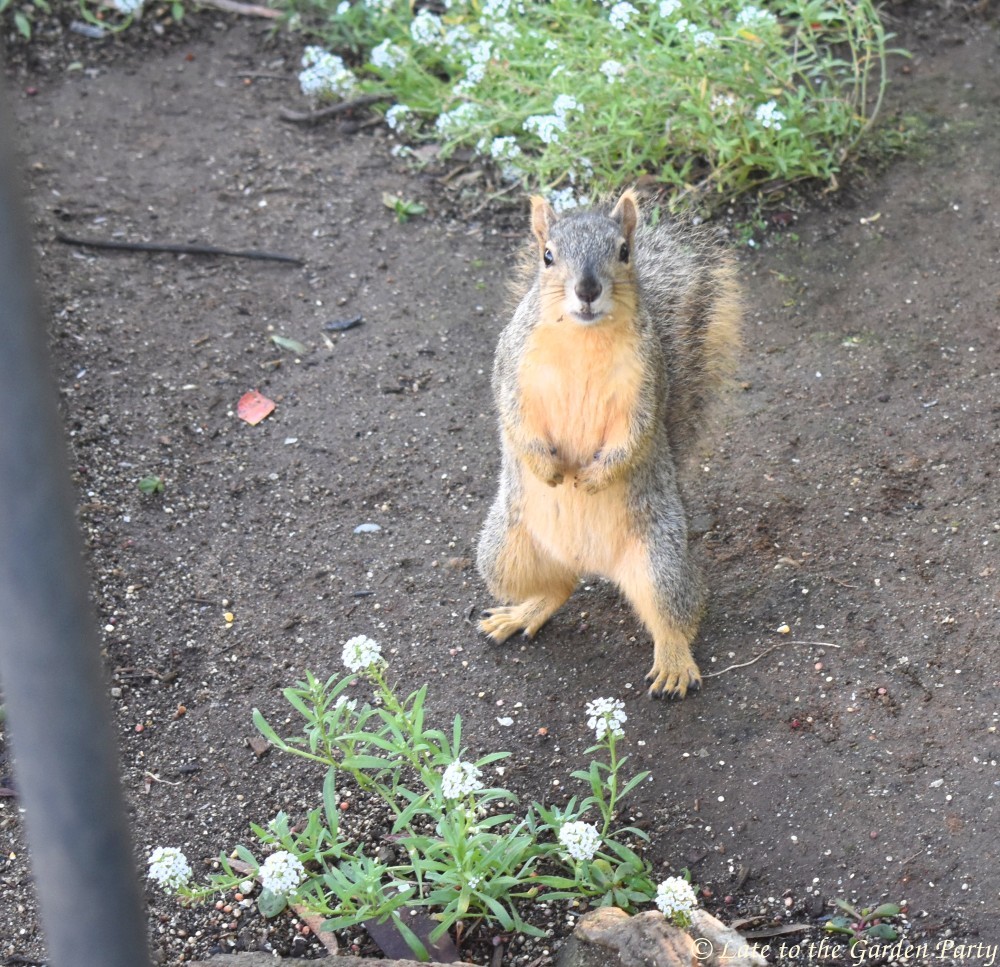
I'm done with photos of the lath house for now.  Even the squirrel trying to forage under the bird feeders was tired of my frequent appearances trying to catch the right angles and the right light conditions.  It's time to just enjoy the space.

Mr. Squirrel and I wish you a peaceful and pleasant weekend!


All material © 2012-2018 by Kris Peterson for Late to the Garden Party


Wednesday, January 10, 2018

Wednesday Vignette: Rain effects

Yesterday, I started a very different post focused on our recent rain.  I was happy to see the first real rainfall since last March.  According to one account, this has been the driest start to our winter rainy season since 1930.  My rain barrels were empty and I'd been forced to run our irrigation system during a period that usually finds it off more often than on.  After frequent fizzled forecasts of rain dating back to November, I turned a deaf ear on the rain forecasts I heard last week so, when a gentle rain started on Monday, I was delighted.  I wasn't even annoyed when I got drenched in a brief deluge as I headed across a parking lot to the grocery store or when I discovered that my beautiful Hong Kong orchid tree (Bauhinia x blakeana) had been stripped of all its blooms overnight.

The photo on the left was taken Sunday afternoon.  The one in the middle was taken Tuesday morning.  The Bauhinia's flowers (right) blanket the area below the tree and petals are scattered throughout the garden.  I'd been puzzled by why the tree was so floriferous this year and now I have the explanation: until now we'd been virtually rain-free.


My joy over the rain dimmed markedly when details came in on the mudslides in Santa Barbara County, still struggling to recover from the devastating effects of the Thomas Fire, now classified as the worst in California's recorded history.  At least 15 people were killed by mudslides there that swamped houses, throwing some off their foundations, and burying everything in their paths.  Two dozen people are still missing and dozens more were injured.  Mudslides are a fact of life in California following major wildfires but it's easy to underestimate their force.  Santa Barbara County issued a mandatory evacuation order for 7000 people but many ignored it.  Following a year of heartbreaking natural disasters, here's another one.  Mother Nature can be brutal.

The rain here wasn't nearly as heavy or intense as it was to the north of us.  Our roof-top weather station recorded just over an inch of rain over a 2-day period.  Most of it came down slowly.  Late afternoon sunshine on both Monday and Tuesday produced rainbows.

This rainbow appeared over the Los Angeles Harbor late Monday afternoon

On Tuesday, the rainbow sat closer to Angel's Gate, the spot through which ships enter and exit the harbor.  A cruise ship, the Island Princess, sat in port (left) awaiting departure.


I wondered if I could catch the cruise ship leaving port with the rainbow shining over it but Mother Nature and the Island Princess did not conspire to make that happen as I stood there shivering and snapping more photos.

As the sun went down, the rainbow gradually faded into the surrounding clouds.  The Island Princess turned on its lights but remained sitting at port, eventually heading to Fort Lauderdale under the cover of night (with scheduled stops in Mexico, Nicaragua, Panama, Columbia and Aruba).


There's another chance of light rain 8 days from now and several more opportunities in the long-term forecast over the next 2 months but it doesn't look like like we'll have the kind of rain we had last year, which is probably fortunate for the burn areas.  In my own case, everything is thoroughly soaked and the irrigation system is off.  I estimate I've accumulated a little over 320 gallons of rainwater among my 3 barrels too.  That will do for now.

For more Wednesday Vignettes, visit Anna at Flutter & Hum.


All material © 2012-2018 by Kris Peterson for Late to the Garden Party

Monday, January 8, 2018

In a Vase on Monday: No, it's not spring yet

It's not spring here yet but perhaps my first vase will make you think it is.  Winter in my area of Southern California is admittedly different from many places in the Northern Hemisphere.  I hope those of you dealing with snow, ice and freezing temperatures will forgive me for pointing that out.

The blue Plumbago was the starting point for this arrangement.  I came across it at my local garden center last week and couldn't pass up buying 2 plants to fill the large pots that sit outside my new lath (shade) house.

The Plumbago flowers really are as blue as they appear in these photos

The blue and purple Anemones came from inside my lath house

Clockwise from the upper left, the vase contains: purple and blue Anemone coronaria, noID Lonicera japonica, Argyranthemum 'Go Daisy Mega White', Osteospermum '4D Silver', Rosmarinus officinalis, and, in the center, Plumbago auriculata 'Imperial Blue'


The Hong Kong orchid tree (Bauhinia x blakeana) in the front garden has been blooming more heavily than I can remember for well over a month now and, although past experience indicates that the flowers will not last long in a vase, I couldn't stop myself from cutting some this week.

I always believed that the tree bloomed best when the air was on the humid side but that must not be the factor I thought it was as December was unusually dry

I found a surprising number of plants to complement the almost glow-in-the-dark Bauhinia blooms but they didn't all fit in the vase I selected

The wire-thin stems of Gomphrena were the primary accent

The vase contains Gomphrena decumbens 'Itsy Bitsy' (shown with Lobularia maritima), Bauhinia x blakeana, and Pseuderanthemum 'Texas Tri-star'


Finding the right vase for the Bauhinia stems proved a problem as the stems are top-heavy and need support.  I ended up using a vase with a small opening that couldn't accommodate everything I'd cut so the extras went into a tiny vase that now sits by the kitchen sink.

The small vase contains Alternanthera 'Little Ruby', Ocimum hybrid 'African Blue Basil', and Persicaria capitata


I moved this week's vases around a bit before they finally found their spots.

The blue vase sits in the front entry and the pink one on a side table in the living room


Last week's vase remains in its place on the dining room table, looking little different than it did last week.

Ignore the blue tape on the wall in the background.  My husband is starting another project, which I fear may involve drilling through walls.


For more IaVoM, visit our host, Cathy at Rambling in the Garden.


All material © 2012-2018 by Kris Peterson for Late to the Garden Party

Friday, January 5, 2018

Friday Miscellany

I've been busy with the garden for the past week but not at all focused, jumping from one activity to another.  As I did so, various sights caught my interest, if only temporarily, so I decided to consolidate them into a grab-bag post.

Staring out my home office window, I noticed some bright green spots on the mimosa tree (Albizia julibrissin) and promptly went outside to investigate.  As background, this is a tree that spends a good deal of the year naked (except for the seedpods that it drops all year).  It doesn't leaf out until late April or early May and it begins dropping both foliage and flowers once in starts blooming in late June, returning to its naked state in October.

Here's what the tree looks like at the moment when viewed from a distance


So what's happening here?!

When I first noticed the green foliage, all I could see were green leaves.  The stems started to develop a couple of days afterwards, when I took this photo.  It looked so odd and so unlike anything I'd seen the tree do before that I briefly wondered if some other plant had colonized the tree's trunk.

But no, yesterday I found signs of more conventional stem development on a couple of the tree's higher branches.  Still, the fact that it's leafing out almost 4 months ahead of schedule is very odd.


Perhaps the fact that we've had the driest start to our "rainy season" since 1930 has the tree acting as if we've leap-frogged winter into spring?  Or perhaps it overheard me talking to the arborist about cutting it back or even taking it out?  It remains to be seen whether the fresh green foliage will be short-lived or the start of a trend.

Meanwhile, across the street, the tree that MDN of Un jardin en clima subtropical húmedo identified for me as Melia azedarbach (aka Chinaberry or Persian Lilac) is positively glowing.

Right now, the tree's foliage almost matches the new paint color of the house just up the hill from it, barely visible in the background here.  Unlike my fig tree at the bottom of the back slope, I also noticed that the one here next to the Melia azadarbach still has some lovely yellow leaves, whereas mine dropped the last of its leaves during October's extended heatwave.


Back in my own garden, our citrus trees look to be headed for a banner year despite the woeful lack of rain.

The noID Mandarin orange tree is loaded with fruit, still not quite ripe but getting there.  We're already eating some of the Washington navel oranges, which are nearly the size of grapefruits and so much tastier than the fruit bought at the supermarket.  The lime tree (far right) is bearing well too but its fruit is less visible.

And our lovely lemon tree remains the best feature of the back slope.  Despite my massive giveaway of fruit several weeks ago, there's still plenty on the tree.  This tree bears continuously year-round - the only time we were without ripe lemons was the year following the the intense heatwave in June 2015, when all the fruit dropped as the temperature suddenly hit 106F.


I've even paid a couple of visits to my local garden centers since Christmas and, although they've yet to restock after clearing out their Christmas trees, I managed to find sufficient items of interest to liquidate the gift cards I received as Christmas presents.  Most of those purchases have gone into plants for the new lath house, which I'll share at another time.  However, I saw some interesting cacti on one recent trip, which I thought I'd share.

This is Opuntia subulata montrose 'Gumbi'.  I'd never seen an Opuntia sporting bright colored foliage reminiscent of Euphorbia 'Sticks on Fire' before.

The garden center also stocked several of 'Gumbi's' relatives, including this one labeled as Christmas Tree Cactus

And this hybrid (Opuntia vestita x subulata), labeled as Opuntia hybrid crest 'Roller Coaster'

This plant was also new to me.  It's Pereskia grandiflora violacea.  My photo doesn't do the flower justice.  All these plants were under a shade structure that made them difficult to photograph.

Unlike some of my favorite bloggers, I shy away from true cactus, especially the really prickly kinds.  However, I found myself repeatedly thinking about this plant, Pilosocereus azureus, after I left the garden center.  This photo doesn't fully capture its ethereal blue color.  After looking it up on-line I'm even more covetous.  But it was expensive and it apparently grows rather quickly to 12 feet tall.  Perhaps, if I can find a window-sill size plant to start with, I'll try it one day...


That's my wrap up for the week.  Enjoy your weekend!


All material © 2012-2018 by Kris Peterson for Late to the Garden Party

Wednesday, January 3, 2018

Wide Shots - January 2018

Since I put my wide shots posts on a quarterly schedule their timing always seems to catch me by surprise.  I took photos at intervals between December 29th and January 2nd for this post, trying to work around shifting light conditions.  With a few exceptions, there aren't many dramatic changes since my last wide shots post in early October but I'll take you on a full-blown tour anyway.  I'll start as I usually do with the view from the back door and take you clockwise around the house.

I stepped back closer to the house to broaden this month's view from the backyard patio.  For the last week, the view of the harbor has been particularly hazy, worse even than when fires were raging in Southern California in December.  The haze in this photo, taken yesterday morning, was a mix of smog and marine moisture.

View from the northeast corner of the house facing south

View from the south end of the flagstone path looking back toward the mimosa tree (Albizia julibrissin), now bearing only seedpods.  This photo was also taken from a somewhat different vantage point than I usually choose, the dirt path behind the back borders, where the ground starts to slope downward from garden's main level.


Next we turn to the garden on the south side of the house, starting with a view looking west.  To provide perspective, I pulled out a photo my brother took of roughly the same area on December 24th, 2011.

The Eucalyptus in my brother's 2011 photo on the right was cut down in February 2013 at the behest of a neighbor who claimed it interfered with her view.  The tree's removal triggered a broad number of other changes, including removal of the lawn in this area and the eventual development of a bed dominated by succulents. 

The succulent bed in question is shown in the background of this photo.  Most of the orange color you see is provided by succulent foliage.

The photo on the left is my usual view of the south side garden looking east through the arbor.  The photo on the right, taken from a spot a few feet beyond the arbor, provides a clearer view of the succulent bed.


Turning our backs to the arbor and looking north, we see the front garden.

The most significant splashes of color here are provided by Grevillea 'Superb', which blooms year-round, and Leucadendron 'Wilson's Wonder', which produces cones and yellow flower-like bracts during the winter months

This looks remarkably like the October view except that the Hong Kong orchid tree (Bauhinia x blakeana) is in full bloom (and the Christmas wreath was still up when I took the shot)

This is the area on the other side of the driveway, adjacent to the garage.  The succulent bed I planted in September (bottom, left) is doing nicely but hasn't changed much.  However, the bromeliad bed I planted behind it (bottom, right) was bare earth at the time of my last wide shots post.

These photos offer more historical perspective on the evolution of the garden.  The current photo on the left shows roughly the same area as my brother captured in a photo of the front garden in December 2011.  We removed the front lawn in the fall of 2014.

This photo shows the garden from the other direction, looking back to the north

Walking through the opening between the northwest end of the house (just past the chimney) and the garage brings us to what is now my cutting garden.

In October, there were still dahlias and zinnias in bloom here.  The dahlia tubers were pulled and stored away in early November.  I supplemented the soil in the raised planters and planted foxglove plugs, ranunculus tubers, and sweet pea and snapdragon seeds.  I dealt with problems with birds and squirrels for a time by covering seedlings with empty plastic flats.  While they helped keep birds and critters away, they also diminished the light the seedlings needed to develop.  Our long spell of especially dry weather probably didn't help either but everything's looking a bit better now, although in the absence of any rain I'm watering the beds regularly.  Surprisingly, the dry weather hasn't kept the Camellias from blooming.  'Taylor's Perfection', planted alongside the garage, has been blooming since before Christmas and the Camellia sansanquas (outside the range of this photo on the left) have been blooming since late October.  And, as you can see, the citrus trees are bearing well.


Passing through the gate behind the spot I stood in to take the previous photo has us facing the garden on the northeast side of the house.

Nothing much has changed here except that the Alliums I planted have started to grow.  Flax seeds, which I'd sowed intending to provide temporary floral color in the bare area, haven't germinated but that may be attributable to December's long dry spell.


The gravel path in the photo above takes us to the back slope, which is otherwise largely hidden from view.

The back slope looks much the same.  The photo on the left shows the area looking downward from the top of the cement block stairway.  The middle photo shows the Pittosporum 'Silver Magic' planted at the property line.  The photo on the right shows the area looking back up toward the main level of the garden.


So, once again we missed a couple of areas.  Backtracking to the driveway at the front of the house, we walk along a narrow path behind the hedge facing the street.

This is the succulent bed I planted in November 2016 on the moderate west-facing slope after removing a dead Ceanothus hedge


The dirt and moss covered path shown above leads to my new lath (shade) house, featured in my anniversary post on December 29th.

This structure was my husband's handiwork, designed to allow me to keep plants that need more shade than the topography provides


The only other view we've missed is that of the succulent bed that sits between the area occupied by the lath house and the street on the southwest side.

This succulent bed could use a bit of a refresh but, overall, it's stood up well.  The Xylosma congestum shrubs planted behind the succulents 19 months ago to extend the front hedge are still growing very slowly.


Are you winded from the walk?  I hope not!  Thanks for hanging in through the end.  If you've viewed the post on the lath house build-out, you may have noticed that I've done some work embellishing the area around the structure.  I'll cover those changes and the shade plants I've added inside in a later post.


All material © 2012-2018 by Kris Peterson for Late to the Garden Party

Monday, January 1, 2018

In a Vase on Monday: Happy New Year!

I invested so much time fussing with my new lath (shade) house this past weekend, I'd little time for cutting flowers, especially as I'd set myself a goal of packing away all our Christmas decorations prior to the new year.  Of course, that doesn't mean I'd let Monday go by without cutting something!  It just means I didn't go over the top as I'm inclined to do.

Last year, I had pink Lisianthus (Eustoma grandiflorum) in my vase in the beginning of January.  No such luck this year but Leucadendron 'Wilson's Wonder' with its flower-like yellow bracts is putting on a good show and so became the centerpiece of this New Year's Day bouquet.

The soft, lacy foliage of Acacia cognata 'Cousin Itt' provided a textural contrast for the Leucadendron

And the bright red-orange berries of Nandina domestica echoed the tinges of red in the Leucadendron's "petals"

I tried to find additional blooms and foliage for the vase shown above but nothing else I cut looked quite right in the arrangement, partly because the stems weren't long enough to stand up to the Leucadendron.  I tucked the leftovers into 2 small vases.

The amber vase on the left contains Coprosma repens 'Plum Hussey' and Gaillardia 'Fanfare Citronella'.  The green vase on the right contains another stem of Leucadendron 'Wilson's Wonder' and Argyranthemum 'Mega White'.


For more IAVOM posts, visit Cathy at Rambling in the Garden.  Best wishes for happy, healthy and productive new year to all.  May 2018 find us living in a better, kinder, and more peaceful world.


All material © 2012-2018 by Kris Peterson for Late to the Garden Party