Sunday, January 15, 2017

Bloom Day - January 2017

Although the last couple of days have been sunny and warm, it's been raining cats and dogs here off and on since December (hurrah!).  Drought conditions in much of Southern California have been down-graded from "exceptional" to "extreme," which believe it or not is tremendous progress.  If forecasts of rain into February and March prove accurate, our situation could improve still further.  In any case, we have every reason to look forward to the prospect of a wonderful spring.

At present, my January garden looks similar to my December garden, with a few notable exceptions.

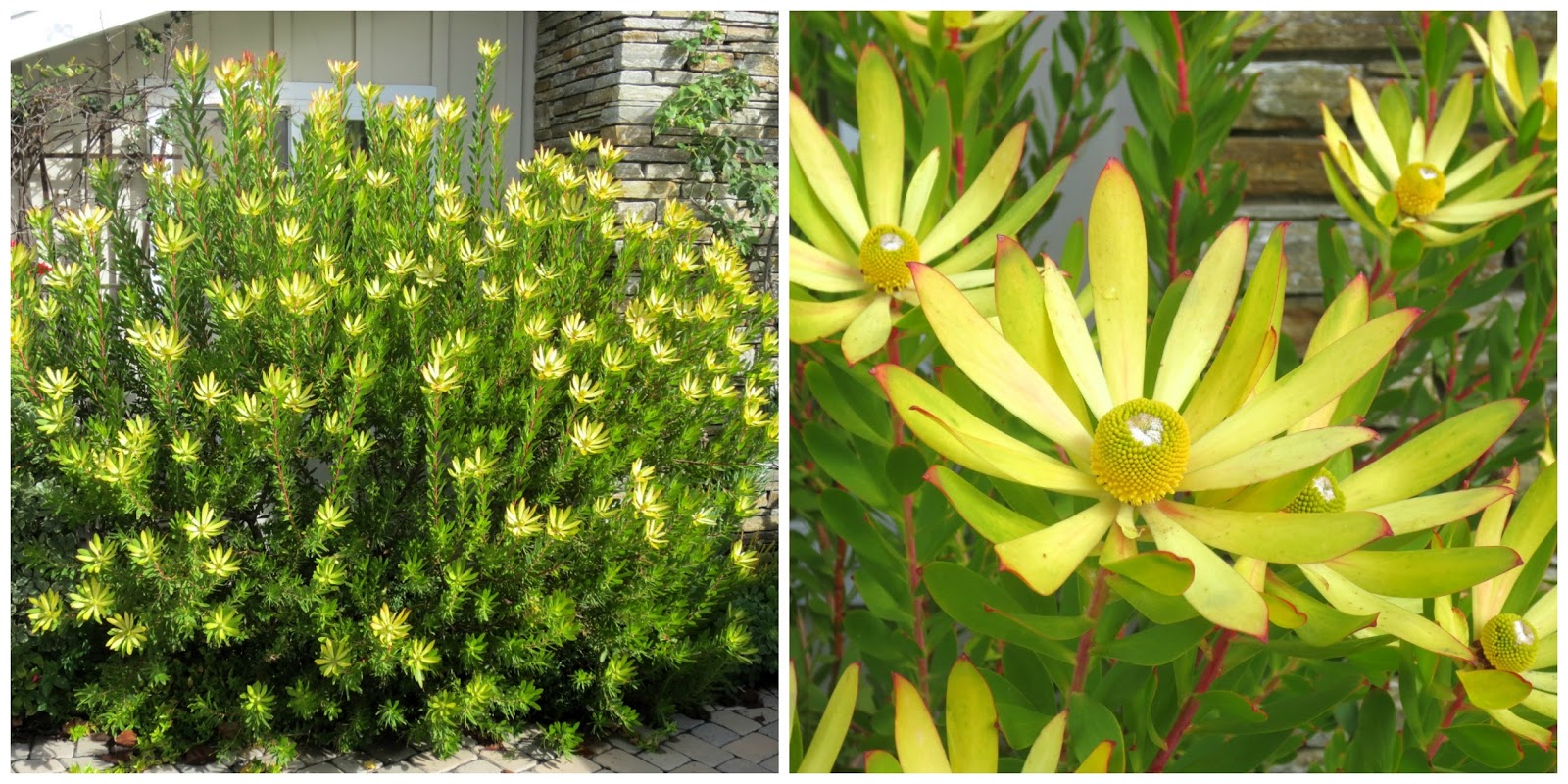
Leucadendron 'Wilson's Wonder' is now in its full winter glory

Arctotis 'Pink Sugar' is off to an early start

Despite turning most of its flowers to face the garage wall, Camellia x williamsii 'Taylor's Perfection' is proving itself worthy of its name

All 3 Grevillea rosmarianifolia 'Scarlet Sprite' bear tiny rosy red blooms


Many of the boldest bloomers from December are still going strong.

Bauhinia x blakeana bounces back quickly after each rainstorm

Nothing bothers Gomphrena decumbens 'Itsy Bitsy', which continues to produce a plethora of tiny purple flowers

Grevillea 'Superb' never takes a break

I don't give Grevillea lanigera 'Mount Tamboritha' the attention it deserves.  This low-growing ground cover is also in bloom year-round.

Leptospermum scoparium 'Pink Pearl' blooms its heart out throughout our cool season


A couple of support players with long bloom periods are putting on particularly strong showings this month.

Argyranthemum frutescens is at its best in cooler weather

The Osteospermums, like their African daisy cousins in the Arctotis genus, also come on strong when the weather cools.  On the left is O. 'Violet Ice', another in the 4D series.  On the right, are O. '4D Silver'  and what I think is a mutant offspring of O. '3D Berry White'


There are other blooms worthy of honorable mentions, shown here in collages organized by color.

Blue and purple blooms, clockwise from the left: Rosmarinus 'Gold Dust', Lavandula multifida, noID Pericallis (reblooming for a second year), and Polygala myrtifolia 'Mariposa'

Pink and red blooms, clockwise from the left: Aechmea fasciata, Arctotis 'Opera Rose', Coleonema pulchellum 'Sunset Gold', Cuphea 'Starfire Pink', noID Dianthus, Mimulus 'Jelly Bean Red', and Ribes viburnifolium

Orange, yellow and white blooms, top row: Kalanchoe fedtschenkoi, Gazania 'Yellow Flame', and Grevillea 'Peaches & Cream'
Middle row: noID Narcissus, Papaver nudicaule, and Pennisetum advena 'Rubrum'
Bottom row: Phylica pubescens, Rhodanthemum hosmarianense, and Tagetes lemmonii


Next month's coming attractions are anxious to take the stage.

From left to right: the first blooms of Calliandra haematocephala; buds of Grevillea lavandulacea 'Penola'; and early risers among the Zantedeschia aethiopica


I recognize how lucky I am to enjoy so many blooms in the middle of winter, especially when so many areas are blanketed in snow or plagued by ice.  I hope that the warm breath of spring reaches those of you dealing with real winters soon.

For more January bloom stories, visit Carol at May Dreams Gardens, our Garden Bloggers' Bloom Day host.


All material © 2012-2017 by Kris Peterson for Late to the Garden Party


Wednesday, January 11, 2017

Wednesday Vignette: Growing from seed

I don't grow much from seed.  It's not for lack of trying.  I've planted seeds of some kind most years since we moved to our current location.  Inadequate water accounts for some failures and raccoon rampages account for most of the rest.  (I've had better luck with bulbs but, with the exception of those that are deeply planted, the raccoons tend to mess with those too.)  Some of my sweet pea seedlings made it this year but not all.  I've also had a bit of luck with self-seeding this past year.  But the California poppies I sowed at repeated intervals have made a paltry showing, even this year with much more regular winter rain.

This wasn't the worst of the raccoon rampages, only the most recent I bothered to photograph.  Some mornings I spent a good half-hour replanting and filling furrows with the dirt they've dug out in search of grubs.  Their friends, the skunks, fill in now and then.  Both critters leave distinctive calling cards.


But I've gotten off-track.  In contrast to me, my brother and his girlfriend structure their garden in one of Southern California's inland valleys around wildflower seeds.  They scattered about 2 pounds of seed this fall, half of it collected from last spring's plants.  Germination wasn't great - until the rains arrived in December.  I think he's probably looking at a banner year.  I offer this photo of the front of his house as my Wednesday Vignette.

Photo courtesy of ericnp.net.  (You can find close-ups of flowers from his 2015 wildflower garden here and photos taken on his nature-focused walks on his blog here.)


Most of that green mass is comprised of seedlings.  There are some shrubs mixed in - Eremophila divaricata in front of the windows; Lavatera maritima, Tecoma stans, and an immature Chilopsis in front of the garage; and Echium candicans and Tecoma capensis on the right side.  Prostrate rosemary, Agapanthus and Stipa tenuissima are scattered about, partially engulfed by seedlings and some weeds, which they generally ignore.

If this winter rain thing becomes a regular event, maybe I'll try seeding more wildflowers of my own.

Visit Anna at Flutter & Hum for more Wednesday Vignettes.


All material © 2012-2017 by Kris Peterson for Late to the Garden Party

Monday, January 9, 2017

In a Vase on Monday: Cleaning Up

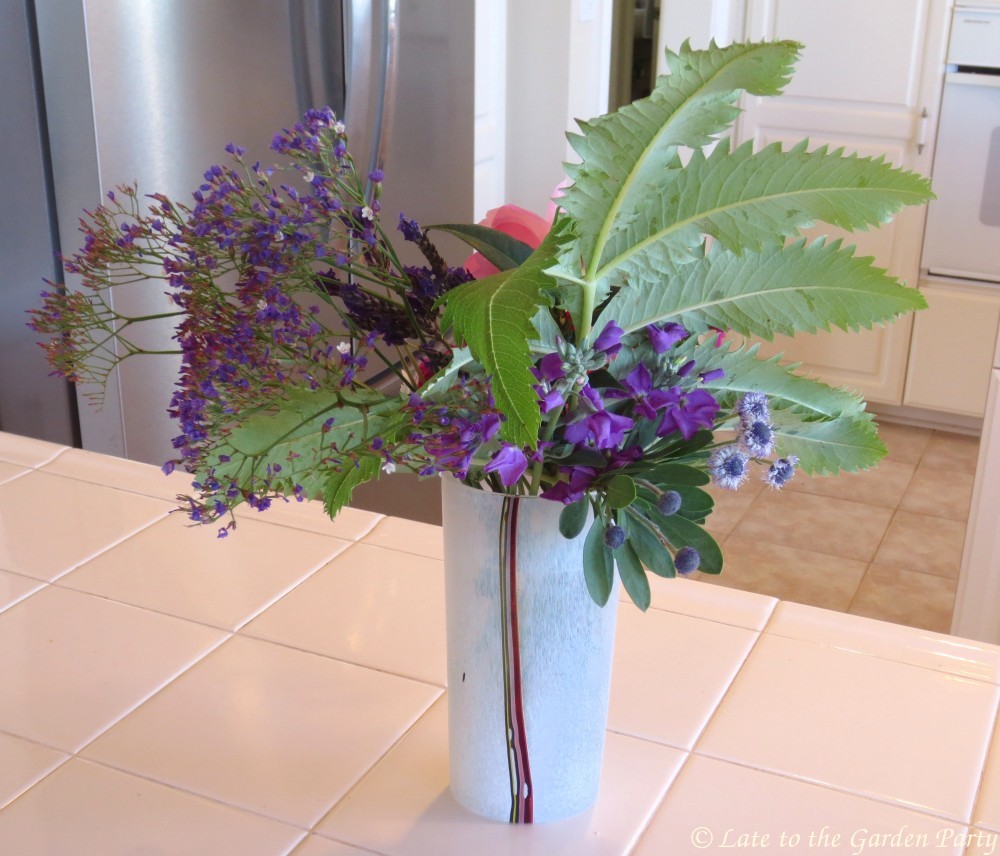
I took advantage of a warm, dry spell to do some clean-up in the garden this weekend.  My chores started with cutting back the tall, lanky stems of Melianthus major to make way for the new growth that had already sprouted at the plant's base.  I pulled the snapdragons that were covered in rust in the cutting garden, preserving just a few of the less blemished stems.  I cut the Narcissus flowers that got plastered in our last rain storm to save them the indignity of a repeat performance when rain arrived again Sunday night.  And I cut back the floppy stems of the Copper Canyon daisies (Tagetes lemmonii), the Moroccan daisies (Rhodanthemum hosmariense) that had their faces in the dirt, and some lanky stems of stock (Matthiola incana).  All these elements were retained for use in this week's vase, or rather vases.  While the Melianthus foliage complemented everything well enough, the flowers fought with one another and had to be separated.

I'd wanted to use purple and blues this week; however, there weren't enough blooms in those colors to make a splash.  In contrast, the pink flowers in the garden screamed for attention.

Pink flowers were used as the focal point in this vase with purple and blue serving as accents

Most of the purple and blues were relegated to the back of the vase

The large leaves of the Melianthus made it difficult to get decent views of the vases from the top

Clockwise from the upper left, this vase contains: Camellia x williamsii 'Taylor's Perfection', noID Dianthus, Lavandula multifida, Limonium perezii, Melianthus major, Rhodanthemum hosmariense, Globularia indubia, and Matthiola incana


The last few stems of the snapdragons set the color scheme for the second vase.

I tried to give the arrangement some panache with the first Calla Lily of the season

The back is all about the Melianthus foliage

Clockwise from the left, the vase contains: Zantedeschia aethiopica, Antirrhinum majus, noID Narcissus, Melianthus major, and Tagetes lemmonii


I threw the leftover stems of Melianthus and Narcissus into a third vase because I didn't have the heart to toss them in the trash.


Both the Narcissus and the Tagetes have scents my husband doesn't particularly like but he hasn't complained (yet).

The pink and purple vase sits in the entry; the second vase is on the dining room table; and the third is in my office


For more "In a Vase on Monday" arrangements, visit our host, Cathy at Rambling in the Garden.


All material © 2012-2017 by Kris Peterson for Late to the Garden Party

Friday, January 6, 2017

Glorious Gray Skies

Most years, the annual the Rose Parade in Pasadena, broadcast around the world, proceeds under crystal blue skies on the first or second day of January.  It's only rained 10 times in the parade's 128 year history and, although it didn't rain during Monday's parade, the skies above were gray.  Gray skies don't mesh with people's perceptions of sunny Southern California.


But, for those of us who've struggled with drought for 6 years, those gray skies are to be celebrated, not reviled.  Gray skies brought more rain in December than Los Angeles has seen in the last 6 years and that trend seems set to continue into January and possibly beyond.

Nothing much was expected from the storm that arrived Wednesday night; however, a soft, gentle rain continued overnight and left us socked in Thursday morning.  It felt as if we were living inside a cloud.

The Los Angeles Harbor was invisible

The view from the front door was hazy

What lay beyond our front hedge was shrouded in mist


The rain continued until near noon on Thursday and our roof-top weather station registered 0.72/inch.  The rain flattened the Narcissi by the back door.


But it made the birds happy.


And gave plants a special glow.


The sun made a brief appearance mid-afternoon on Thursday, before the clouds closed in around us again.


Meanwhile, my husband's efforts to calibrate the accuracy of our weather station continue.  The apparatus he set up before Christmas was refined.  I was provided charts showing the variability in the data collected during the last storm of 2016.

This is what happens when you marry a scientist.  You get a lot of charts.


Once he was satisfied with the accuracy of his test gauges, one was mounted on the roof next to our weather station and another was positioned alongside the neighbor's weather station across the street to assess whether the station's position might account for the differences measured earlier in the amount of rain registered by the test gauges and the neighbor's weather station.

Yes, my husband climbed up on top of the roof Thursday morning, in the rain, to read his test gauge


I have yet to receive my updated chart but it now appears clear that the station mounted on our roof consistently underestimates the actual amount of rainfall in our location.  The evaluation has now moved on to determining the underlying mechanical or other problem responsible for this.  For my part, I'm just glad to know that we got a good soaking, that my rain barrels are full, and that our total rain for this season is already well ahead of last year's level.  It's sunny this morning but another rainstorm is due tomorrow.  Let it pour.


All material © 2012-2017 by Kris Peterson for Late to the Garden Party

Wednesday, January 4, 2017

Wide Shots - January 2017

I've taken photos at intervals over the past week in preparation for my now quarterly wide shots post.  I covered all the major areas of my garden this time around and pulled photos from last January's collection for comparison purposes so this is a photo-heavy post.  You've been warned.  Except as otherwise noted, when photos of the same area are shown side-by-side, the photo on the left is from January 2016 and the photo on the right is a current view.

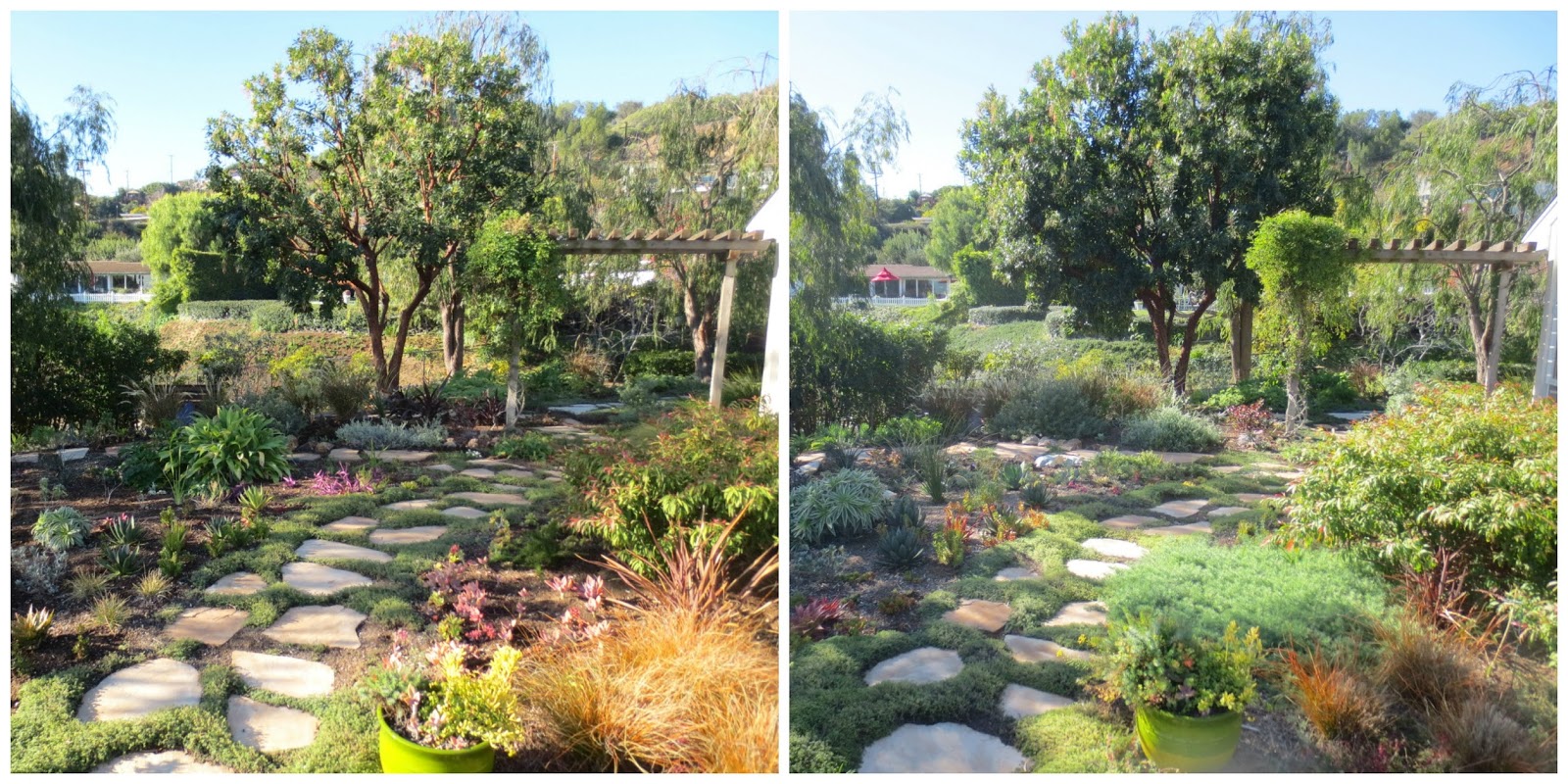
I'll start in the back garden.  The last sections of lawn in the back garden were removed in September 2015.  By January 2016, flagstone had been laid through the mid-section of what had been lawn, or what passed for lawn in our increasingly dry climate, and plants had been added.  The plants have filled out quite a bit over the past year.

View from the back patio looking southeast

View from the south side looking north toward the patio and the mimosa tree (Albizia julibrissin) just beyond

View from the area north of the main patio looking south


Moving southward, here's a look at the garden on the south side of the house.  The changes here are less dramatic than some areas of the garden.  In 2016, while the overall structure of the area remained the same, succulents displaced more of the woody and herbaceous plants.

View from the east looking west toward the arbor leading to the main area of the front garden.  While herbaceous plants on the south/left side of the path (e.g. Acanthus and Arthropodium) were replaced with succulents in 2016, some succulents on the other side of the path were replaced with Lotus berthelotii after raccoons repeatedly dug the succulents up.

View from the small patio on the south end of the house looking to the trees and shrubs that separate us from the neighbors on the south side

View through the arbor looking toward the backyard and the harbor to the east


Taking a turn down the path just to the west of the arbor brings us to an area I call the "glen" for no other reason than it's simpler than describing it as a flat area below the main level of the front garden and behind the succulent bed that runs along the street.  In 2016, the main alteration to this area involved extension of the dry-stacked wall than contains the front slope.

View from the street looking toward the path leading up to the upper level

This current view, looking back toward the street, shows the extension to the dry-stacked wall in the foreground


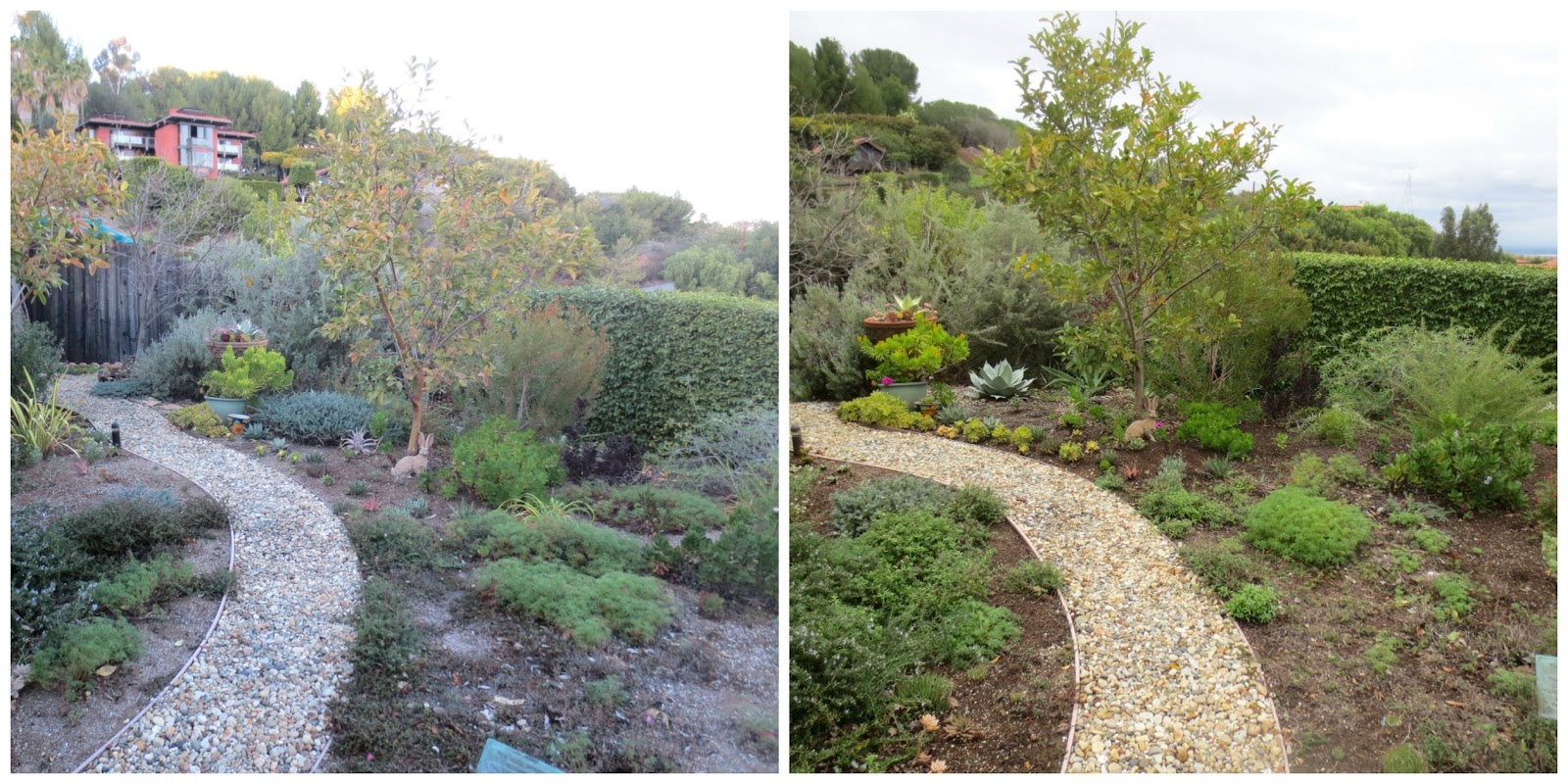
If you're a regular reader, you may recall that we also removed the last remnants of the Ceanothus hedge atop the western side of dry-stacked wall.  This hedge, which ran parallel to the Xylosma hedge along the street at the front of the property had created an odd tunnel approximately 3 feet wide.  When the last of the dying Ceanothus shrubs were removed in November, I replanted the area using succulents and a few other drought tolerant plants.

In this case, the before picture on the left was taken in September 2016.  The photo on the right was taken last week.


This brings us to the main section of the front garden.  Changes in this area were relatively minor in 2016 and mostly involved replacement of plants killed during the horrific heatwave in June and some plants that died later due to a breakdown in a segment of our irrigation system.

Current view of the front of the house from the driveway

View from the side garden arbor looking north toward the driveway.  A large number of plants on the west/left side of the path in the January 2016 photo on the left were replaced following June's heatwave.  The Acacia cognata 'Cousin Itt' in the foreground of the photo on the right is finally gaining ground more than 2 years after it was planted.


A side-by-side comparison of a photo taken in 2011 and a photo I took from roughly the same angle last Thursday is perhaps the most dramatic reflection of the transformation of the front garden.  I offer this as my Wednesday Vignette.  (Visit Anna at Flutter & Hum for more of the images that bloggers found interesting this week.)

The photo on the left looking across the front garden from north to south was taken by my brother on Christmas Eve 2011, one year after we moved in.  It's the closest thing I have to a "before renovation" photo of the front garden.  I took the photo on the right late last week.  In the intervening period, we removed not only the lawn but also the 60-foot Eucalyptus that formerly stood in the distance on the south side of the house.


The last area we stripped of lawn was a parcel sandwiched between the driveway, the street, and our detached garage.  At the start of 2016 we were still in the process of digging out the lawn.  I finished my initial planting of the area in late January.  The plantings have been slow to fill out.

View from the driveway looking north


Turning to the other side of the garage, the vegetable garden looks much the same as it did in January 2016, although the contents of the raised planters have changed.  I've given up vegetables in favor of herbs and flowers for cutting.

This January (right), there are already blooms on the Camellia 'Taylor's Perfection' planted against the garage wall but the fruit on the Washington navel orange tree is not nearly as ripe as it was this time last year.


A fence separates the vegetable, now cutting, garden from the dry garden on the northeast side of the house.  There were no significant changes in this area in 2016 beyond the clean-up and removal of some plants that didn't survive the summer of 2016.  I plan to dig up and replant an area currently overrun by Geranium incanum and Teucrium x lucidrys in 2017.

View from the paved walkway along the house looking north to the fence between us and our neighbors.  The Agave ovatifolia shows up better now as it's gained size and I removed a Dorycnium hirsutum that formerly obscured it from view.


The gravel path through the dry garden, which appears to dead-end at the fence that separates us from our neighbor on the north side, actually turns and runs down our steep back slope.  That area suffered most from June's horrific heatwave.  The upper portion has yet to recover and the area is generally a mess.  I'm still playing with the idea of getting professional help there as I don't think my right knee can make it through a wholesale renovation.  The biggest roadblock may be the limited access to the area, which could put the cost of a professional job beyond my means.

View looking down from near the top of the cement block stairway my husband installed

View looking up from the bottom, with the photo on the right highlighting the damage done by June's heatwave to the plants on the upper section of the slope

The only area left in this very long tour of my garden is the street-side succulent bed on the southwest side of the property.  The changes there were limited to removal of the last dead Auranticarpa rhombifolia that formerly made up a section of the hedge facing the street and the addition of 5 Xylosma congestum shrubs installed in May to extend the existing Xylosma hedge.

The current view here shows the Xylosma hedge on the left, the gap created by the removal of several dead and dying Auranticarpa inherited with the garden, and the 3 relatively healthy Auranticarpa we've left in place for now

View from the across the street looking east.  The 2016 photo shows a nearly dead Auranticarpa, the last of several my husband dug out for me.  The 5 Xylosma shrubs, spaced several feet apart, are doing fine but haven't gained much in height or girth as yet, which leaves the area behind the succulent bed still exposed to view from the street.


If you made it to this point, congratulations!  That's the last of my wide shots until April.


All material © 2012-2017 by Kris Peterson for Late to the Garden Party
Monday, January 2, 2017

In a Vase on Monday: New Year's Surprise

So I ventured into the garden on a very cold New Year's morning (below 50F!) to look for flowers and foliage to fill a vase.  And what did I find but 2 stems of pink Eustoma grandiflorum (Lisianthus) in bloom!  I thought I'd seen the last of these flowers for several months but perhaps the extraordinary amount of rain we received in December gave my plants an extra boost.  As this was a chance to pair Eustoma with Leptospermum 'Pink Pearl', plants that generally don't bloom at the same time, I couldn't resist cutting them.

The Lisianthus flowers were smaller than those cut during their peak bloom period and a little bedraggled but still pretty

Back view

Top view

Clockwise from the top left, the vase contains: Eustoma grandiflorum, Argyranthemum frutescens, Leptospermum scoparium 'Pink Pearl', Persicaria capitata, Pseuderanthemum 'Texas Tri-star', and Violas


I also tweaked a vase I created just before guests arrived late Friday afternoon.  I'd thrown it together and, sitting on our dining room table, it bugged me when I breakfasted with it.  So Sunday afternoon, I removed some of the original stems and added others, creating an airier arrangement, which pleased me more.

Stems of Leucadendron salignum 'Chief' were removed and a couple more stems of Tagetes lemmonii were added

The top photo is a close up of the Tagetes lemmonii (aka Copper Canyon Daisy).  From the bottom, left to right, the other plants are: Agonis flexuosa 'Nana', Gaillardia 'Arizona Sun' and berries of Nandina domestica.


The 2 vases clash horribly with one another but, fortunately, they're not placed close enough for this to be bothersome in situ.

The pink arrangement sits in the front entry, recently cleared of Christmas decorations

The reconfigured vase was returned to the dining room table


For more of this week's contributions to "In a Vase on Monday," visit Cathy at Rambling in the Garden.  If you'd like to see a montage of my favorite 2016 creations for "IaVoM," check out the collages I included in my year-end retrospective, which you can find here.

I hope you enjoyed a glorious New Year's holiday.  It was wonderfully quiet here - almost too quiet.  Perhaps our neighbors imbibed more than my husband and I did on New Year's Eve but I didn't even see children out and about.  It felt a little like an episode of Twilight Zone, where humans have disappeared while everything else seems to be in place.  And then, there were the birds, which I found sitting silent and virtually motionless in the bare branches of the mimosa tree just outside my home office window.

Alfred Hitchcock never directed an episode of Twilight Zone, did he?


The preceding afternoon, I had multiple visits by this guy too...


All material © 2012-2017 by Kris Peterson for Late to the Garden Party