Saturday, January 11, 2014

Misgivings

I have a tendency to fall in love with plants, bringing my infatuations home with what is, at best, a fuzzy notion as to where I might put them.  However, during the fall planting season, when I was focused on the design of the side garden and the redesign of portions of the backyard border, I spent considerable effort in selecting plants that I thought would be culturally suited to the areas in question and would also coordinate well with one another. Nonetheless, plant availability factored heavily into the final selection process as leaving empty spaces in a bed for any extended period goes against my nature.  So, for example, when I planning the area surrounding the side yard patio, I specified "orange flowered annual" and gave myself license to pick from the options available in that category at that time.  I selected Ursinia anthemoides 'Solar Fire,' grown by Annie's Annuals, to fill that role.  I liked the bright green ferny foliage and the flowers I'd seen in a demonstration bed at Roger's Gardens.  Annie's site claimed that, in zone 10, no matter what time of year they were planted, these would bloom "shortly thereafter."  After more than 3 months, the first buds are finally opening but, in the meantime, the foliage has gone from lacy to scruffy.  In addition, the first flowers are much smaller than the 2.5 inches they were advertised to be.

The lower portions of the Ursinia have turned a tawny brown

This flower is about the size of a nickel


The fault may be entirely mine.  I probably didn't provide enough fertilizer.  The water provided by my irrigation system may have been insufficient.  And maybe Ursinia doesn't like our dry Santa Ana winds.  In any case, despite the fact that the plants are finally covered in unopened buds, I'm sorely tempted to yank them out right now and replace them with either Iceland poppies, which are already flowering in the surrounding area, or more dwarf Anigozanthos (Kangaroo Paws), provided I can find them.


I'm very impressed with this dwarf Anigozanthos hybrid so far


I'll probably hold off another couple of weeks to see if Ursinia blankets its scruffy foliage in orange/gold blooms  - unless I come across more of the dwarf Kangaroo Paws first.

In the good news category, I like the mix of Stipa tenuissima (Mexican feather grass), Coprosma repens 'Plum Hussey' and Crassula lycopodioides to the right of the Ursinia.


I also like the nearby combination of Agonis flexuosa 'Nana,' Stipa tenuissima, Iceland poppies, and Alternanthera tenella 'Crinkle Red.'


Unfortunately, I'm also having misgivings about some changes I made to the backyard border.  I admit to being uninspired when it came to replanting the mid-section of that border after tearing out a mass of lavender hiding my Prostanthera ovalifolia 'Variegata' in October.  I ultimately installed 3 Nicotiana alata 'Lime Green' in front of that plant to echo its lime color and added 5 Digitalis x mertonensis in front of those but, from the start, I was concerned that the area looked too flat.  All 8 of those plants hugged the ground.  The Nicotiana is supposed to reach 3 feet and the Digitalis 2 feet so I assumed that time would remedy things.   I may be too impatient but, 10 weeks later, the area still looks flat.  While I'm confident that the Digitalis will be fine, I'm concerned with that the Nicotiana foliage remains utterly prostrate despite the fact that it's already displaying a few short stubby blooms. 


Nicotiana alata 'Lime Green'


It doesn't help that the nearby Alchillea 'Moonshine' and the Itoh peony have yet to put new growth or that I chose the wrong spot to group some bearded Iris tubers I had on hand.  Rather than waiting to see if the Nicotiana gains stature in the next few months, I'm thinking of replacing it with a mass of Lomandra longifolia (recently featured here as one of my current favorite plants).  Any other ideas would be welcome.

The changes I made to the left side of the backyard border turned out somewhat better.  Although the plants still need to fill out a bit, I think the Tulbaghia violacea (Society Garlic) nicely complements the Erysimum linifolium 'Variegatum' and the Osteospermum ecklonis '3D Silver.'


And then there's the bed that I planted last February, after our eucalyptus tree was removed.  I picked Dryms lanceolata to serve as the focal point of the bed.  While I like the plant, I'm not sure it's focal point material.

The Dryms lanceolata (aka Mountain Pepper), said to grow 10-15 feet tall, is currently dwarfed by the nearby Coprosma

and the Mountain Pepper is virtually lost in this larger photo


Ever since I saw the beautiful Japanese maple in one of my neighbor's gardens, I've been thinking of acquiring another one.  It occurs to me that a Japanese maple might be nice to replace the Mountain Pepper if the nearby Arbutus 'Marina' provides enough shade to prevent summer scorch.

Maple with colorful fall foliage in a neighboring front yard, photographed in December


Are you more patient than I am?  How long do you give a plants to fulfill their promise?

Tuesday, January 7, 2014

My favorite plant this week: Leucadendron 'Wilson's Wonder'

My favorite plant this week is one I've featured here and there in earlier posts, Leucadendron 'Wilson's Wonder.'  This is one of the relatively few plants I brought with me from our former home when we moved 3 years ago.  There, it was in a large clay pot in the driveway close to the front door in one of the few sunny spots we had with a Abelia 'Kaleidoscope' at its base.  I planted it in the ground here at the front of the house shortly after we moved in.  The Abelia, its roots tied almost inextricably with those of the Leucadendron, remained at its base.

Leucadendron 'Wilson's Wonder,' photographed in January


This plant is attractive year round.  In mid-August, I featured the new bracts, which glowed red.

The same Leucadendron, photographed in mid-August

Close-up of Leucadendron bracts in August


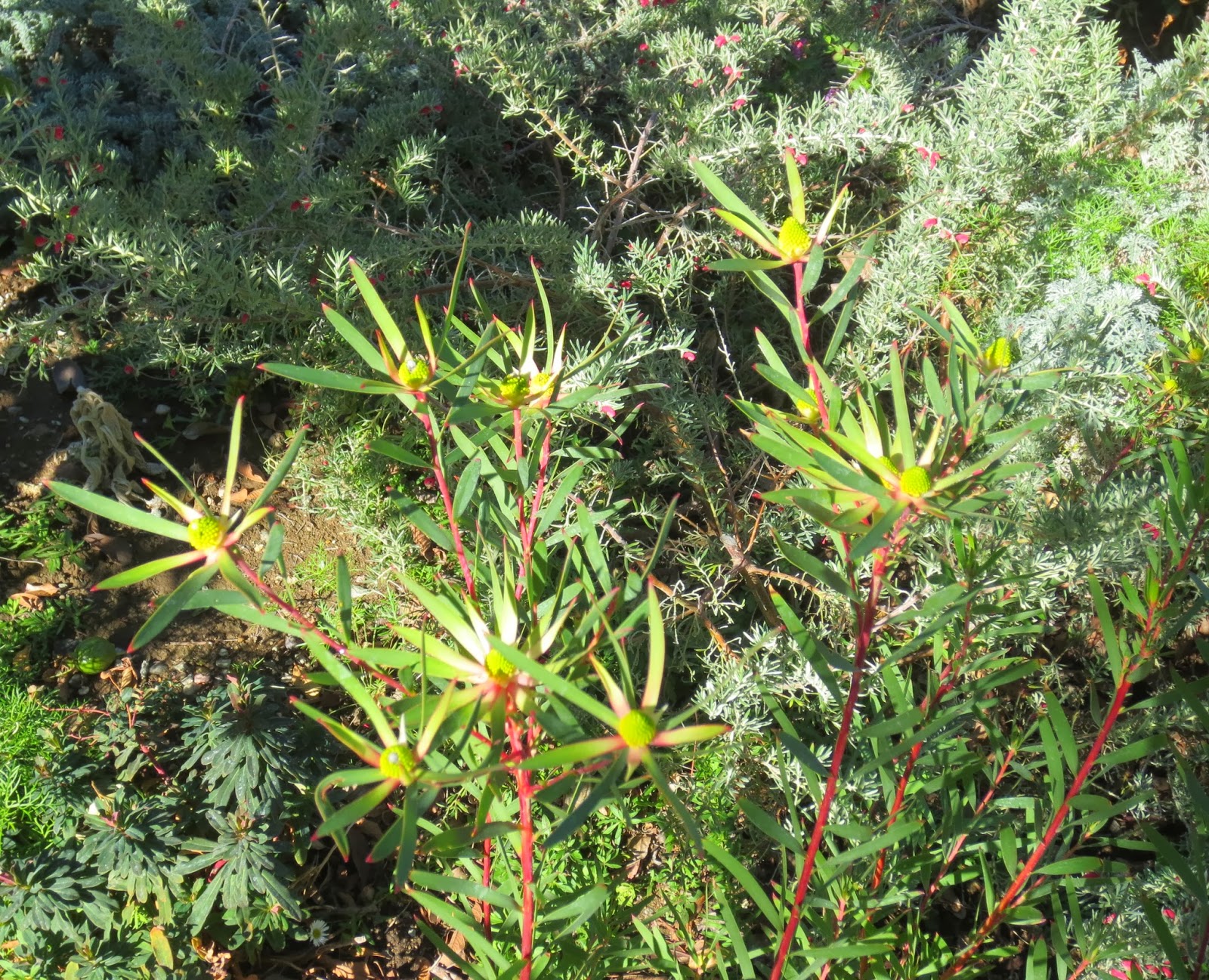
In winter, yellow cones form and the surrounding bracts take on a pale yellow shade.


Leucadendron 'Wilson's Wonder,' which hails from South Africa, grows about 6 feet tall and 6-8 feet wide.  It prefers full sun but can tolerate a little partial shade.  It likes well-drained soil and is moderately drought tolerant.  It's reported to be frost tolerant to 25 degrees Fahrenheit (-4C).  It's adapted to USDA zones 9-11 (Sunset zones 16, 17, 20-24 and H1).

The "flowers," which appear in late winter to early spring, are useful in flower arrangements.  The cones, as they mature, will turn brown.


I have a few other Leucadendrons in my garden, all newer introductions; however, none yet make the splash created by 'Wilson's Wonder.'

Leucadendron salignum 'Chief,' which was planted last January

Leucadendron 'Ebony,' acquired in September, hasn't done much since it was planted

Leucadendron 'Pisa' is in a pot for now but I have great hopes for it


L. 'Wilson's Wonder' is my contribution to Loree's weekly meme at danger garden highlighting her favorite plants.  You can see her current selection and those offered by other gardeners, here.


Monday, January 6, 2014

The agapanthus are confused

The Agapanthus in my garden generally begin blooming in late May, peaking in June, and continue to bloom here and there into July.  I hack off the flower stalks in August and appreciate the foliage until the cycle repeats itself again late the following spring.  An errant bloom turned up in November and I didn't think too much about it.  Then there was another in December.  Now several are blooming in 2 different sections of the garden.

Agapanthus (no ID)


It's nothing akin to the stampede of blooms that normally arrives in May (as described here); however, it's odd.  The stalks are thinner and shorter than the late spring blooms, barely stretching beyond the top of the foliage.  I can only guess that this is attributable to the warm, dry weather we're experiencing this winter.  It's as if the plants believe that summer is just around the corner and they're poking their heads up to check what's up.

And the Agapanthus aren't the only blue flowers making an unexpectedly early appearance. My Nemophila menziesii (Baby Blue Eyes) are also blooming.  They're not as shy about it as the Agapanthus either - all 5 of my Nemophila clumps are in full bloom.

Nemophila menziesii


Still another blue spring bloomer has also joined the party - Veronica 'Waterperry Georgia Blue.'

Veronica 'Waterperry Georgia Blue'


Half the US is covered in snow and ice but here in my area of southern California we appear to be skipping winter altogether to plunge head-first into spring on our way to summer.  Frankly, it's a little unnerving.

Friday, January 3, 2014

Wide Shots - January 2014

Not a lot has happened to my main garden borders since I posted wide shots in December as part of the meme sponsored by Heather at Xericstyle but, in the interest of keeping the record intact, here's this month's update, starting with the backyard border as usual, albeit from different angles.

Back border photographed from the far left side of the patio

The same back border photographed from the pathway in the southeast side garden


I purposely keep the plants in the backyard border low so as not to interfere with the view of the harbor on the horizon but I think much of the area is too flat at present.  Some of this will be remedied as the existing plants grow in size but I also think I'll be changing out some of my selections in the coming year.

The side yard was dramatically transformed in 2013, as I discussed in my New Year's Day post.  It's coming along nicely but I expect some plant change-outs there as well as I see how the plants knit together.

Side yard photographed from the front yard

Side yard photographed from the backyard


The front border is in its winter doldrums.  I just finished cutting back the roses and, with the exception of the spots of color provided by the Bauhinia x. blakeana (Hong Kong orchid tree) and Nandina domestica, there's not much to excite the eye right now.  I think it needs some sprucing up with annuals.

Photographed from the driveway entrance (with my cat Ming headed to the front door)

Closer shot of the border to the right of the pathway leading to the front door (please ignore the neighbor's defrocked Christmas tree across the street)

My Leucadendron 'Wilson's Wonder' is going to town on the far left side of the front border (and I pruned it by half last spring)


The vegetable garden, which I don't think I've featured in prior wide shot posts, currently has no vegetables, although there are plenty of herbs and the oranges are ripening.  I've put in some stock, snapdragons and sweet peas for cutting too.


The Grevillea lavandulacea are coming into bloom in the dry garden but the flowers are small and don't show up well when the area is photographed from a distance.  The guava tree on the right is laden with fruit, which the squirrels seem to be happy about.  Buds have formed on the Echium handiense in the middle right section of the photo, which makes me happy.


That's it for this month's wide shots.  Please visit Xericstyle to see Heather's wide shot and find links to other gardeners' contributions.

Thursday, January 2, 2014

My favorite plant this week: Lomandra longifolia 'Breeze'

I've got a belated new year's lunch with friends to get to but I didn't want to miss posting my favorite plant this week.  It's the grass-like evergreen Lomandra longifolia 'Breeze' (aka dwarf mat rush).  This plant has performed admirably in my garden since I planted 3 in the fall of 2012.  In fact, I've been looking to purchase more and have held off only because I can't find it in anything smaller than a 1-gallon size.


My photos don't do it justice.  The foliage is a bright emerald green.  It produces yellow flowers in summer, which reportedly have a honey scent - next summer, I'll have to take a whiff.  The attributes listed by growers are impressive to say the least:

  • Suitable in full sun to partial shade (mine did fine in a mostly shade situation but adapted without difficulty when that became a mostly sun situation after the removal of the nearby Eucalyptus tree)
  • Drought tolerant once established but, according to San Marcos Growers, it can also handle wet soil
  • Performed well in tests with irrigation involving both saline water and reclaimed water
  • Accepting of clay and sandy soil
  • Winter hardy to 15-20 degrees Fahrenheit (reportedly unscathed by temperatures dipping to 16F in the Atlanta, GA area)
  • Evergreen in USDA zones 8-11 and perennial in zones 7-11
  • Successfully grown under Eucalyptus trees (where, I can testify, it's hard to grow anything)
  • Deer tolerant
  • Suitable for use singly or in mass plantings


What more could you want from a plant?  This Australian native grows 2-4 feet tall and wide (mine are currently about 2x2 feet in size).  After reading  more about it, I think I may have to plunk down cash for the 1-gallon size and try it on my back slope.

Lomandra longifolia 'Breeze' is my contribution to Loree's favorites meme at danger garden.  Please check her site for her favorite and those selected by other bloggers.

Wednesday, January 1, 2014

Time for Reflection

Happy new year!  Wherever you are and whatever you're doing, I hope you're enjoying the holiday.  I also hope that, once those of you in frozen zones thaw out, this will be the start of a glorious year in the garden for everyone.

Here in Southern California, it's sunny and warm.  It also remains very, very dry.  In fact, 2013 was the driest year recorded for Los Angeles since 1877, when record keeping began.  We got just 3.6 inches (9.14 centimeters) of rain last year and there's no rain in the forecast in the near future.  It's nonetheless a good day to poke about in the garden but instead I find myself sitting at my computer, looking at the pictures I've taken over the past year, evaluating what I've done and what I want to do in 2014.  The biggest changes in my garden in 2013 occurred on the southeast side of the house, stemming from the removal of a 60 foot Eucalyptus tree.  That one change led to the transformation of a large segment of the garden and it may trigger still more changes in 2014.

I hadn't originally planned on taking out the Eucalyptus tree.  Just before Christmas in 2012, we were approached by a neighbor about removing the tree, which over time had grown to block her view of the Los Angeles harbor.  After discussion with her, review of our local statute on "view conservation,"  and consultation with an arborist regarding the health of the tree, we agreed to cut it down.  It wasn't an easy decision and I felt quite bad about it at the time but I've written about my decision-making angst before so I won't dwell on it here.

Picture of the Eucalyptus tree taken by my brother on Christmas Eve 2011


The decision to remove the tree was made in early January 2013 but, due to rain delays, the tree didn't come down until early February.  It was a major production that literally took all day (which you can read about in detail here).


The side yard was left looking very bare.


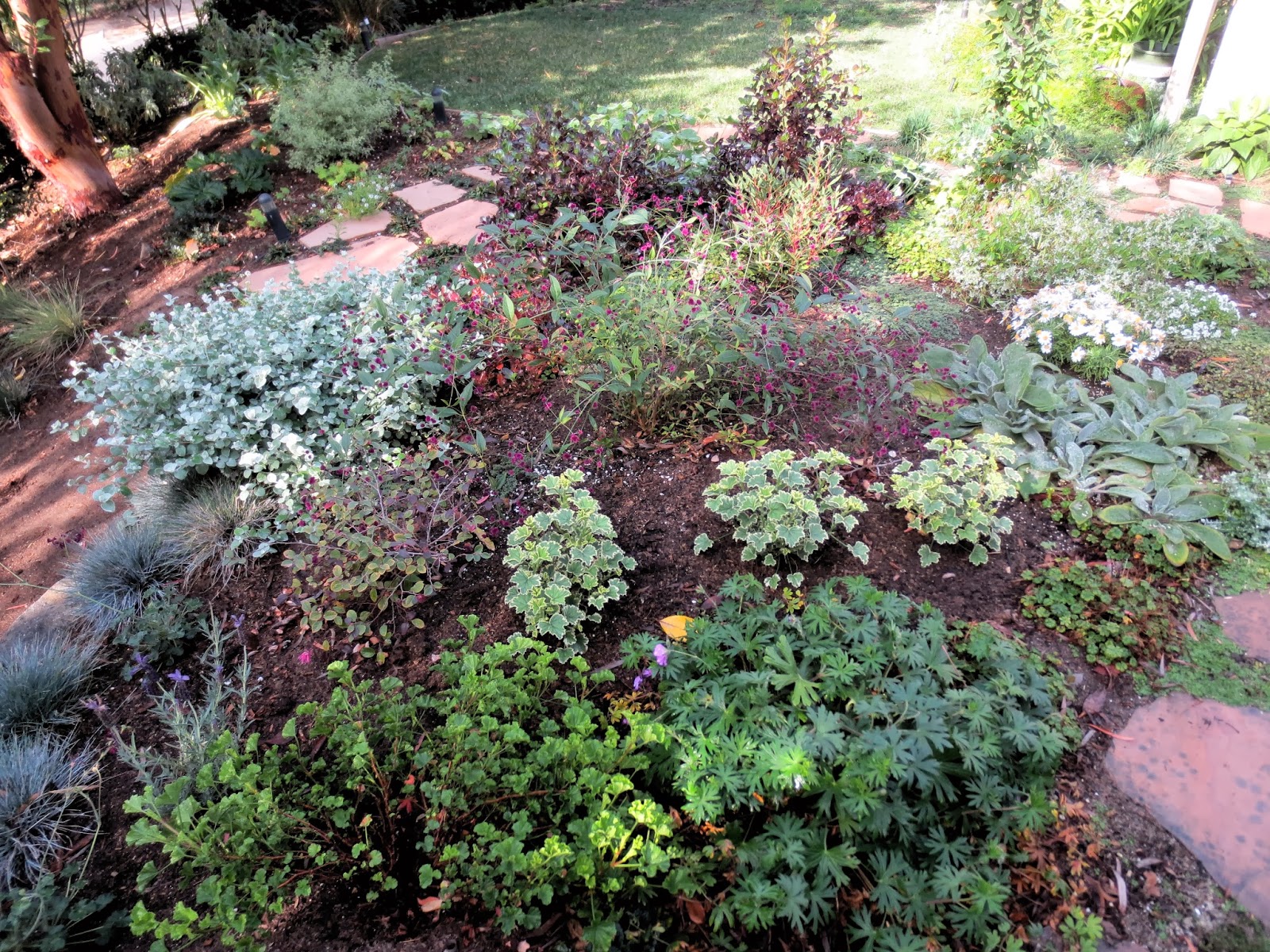
I rushed to plant the vacant area.  While I gave some thought to a planting plan, in retrospect I probably gave less consideration to how I wanted to use the space than I might have, focusing instead on the choice of plants that would be suitable in what had been transformed from one of the shadiest areas of our property to the sunniest.

A little over a month after the tree came down the bed that it had been occupied looked like this:


In the meantime, the plants on the other side of the pathway in the picture shown above were struggling.  They'd been selected for their ability to grow in shady conditions and, while a few enjoyed the increased sun exposure, many did not.  Over time, I moved some and introduced others.  Photos taken in July show that the empty spaces had been filled; however, I didn't feel that the space connected well with the surrounding area.


In fact, the whole area looked chopped up to me.  The grass area adjacent to the side borders hadn't recovered from the battering it received during the removal of the Eucalyptus tree and the pathway that had divided the area now looked silly coming to an abrupt end some 10 feet from the side yard patio.


So, in August, we extended the pathway to the patio and also through the existing archway to connect with another path that led down a slight slope toward an area behind the hedge along the street.


Then we elected to tear out the remainder of the grass in the side yard.


I got a little ahead of myself (as usual) and began planting the area surrounding the new pathway in early September.


I had the sense to haul in more topsoil for the main area we'd stripped of grass.


But I started planting the new space before we got around to laying more flagstone to divide the space into workable borders.


The area's slowly filling in.


Overall, despite leaping into the redesign of this area without a solid plan at the start, I'm fairly satisfied with how the side yard looks, although I already expect I'll be changing out some of my plant selections in 2014.  However, the biggest issue for me now is what to do to improve the flow from the side yard into the backyard.  I think I'm going to pull out more grass in the backyard, extending the planted area around the fountain along the pathway running parallel to our living room to connect with the border adjacent to the side yard patio.

The proposed change will expand the bed around the fountain from the edge of the main patio


and extend the planting area along the walkway to connect with the border in the side yard


I'm still grappling with whether to leave a wide swath of grass to serve as a pathway or tear it all out and continue the flagstone.  The transition from flagstone to grass feels abrupt to me.  My husband believes that I'll eventually pull out all of the grass, which is what I did at our last house.  But this garden is much larger than the tiny space I gardened in before and I'm not sure that getting rid of every shred of grass is appropriate here.  The grass provides a place for the eye to rest and I think this garden needs that.  The idea of pulling out all the grass is also overwhelming - it would require an investment of time and money I'm not sure we're prepared to make all at once.  So, while I want to keep the big picture in mind and factor how one area relates to the areas adjacent to it, I suspect that I'll continue to chip away at my garden renovation piece by piece, allowing one decision to lead to another and then to another...

Do you plan any major overhauls to your garden in 2014?