Wednesday, October 16, 2013

October 2013 Foliage Follow-up

We don't get much in the way of a seasonal foliage color change in Southern California, at least not by comparison to the northeastern parts of the United States.  The only plant in my garden that's showing a definite color shift right now is the coral-bark Japanese maple planted in the vegetable garden alongside our garage.  Its tips tend to burn when the temperatures soar but, in its current placement, it gets full sun only in the morning, which helps to reduce the leaf scorch.

Acer palmatum 'Sango Kaku' in the morning sunlight

Close-up of the Japanese maple's leaves, now shifting from light green to an apricot color


Other plants showing similar coloration unrelated to the seasonal changes in temperature and day length include:


Agonis flexuosa 'Nana,' with new growth in an orangey pink

Euphorbia tirucalli 'Sticks on Fire,' which develops a bright salmon-pink color in full sun


The gray-leaved plants look good regardless of the season.

The artichoke in the half-barrel in my vegetable garden is finally gaining size

I still have some reservations about this combination of Helichrysum petiolare 'White Licorice' and Festuca glauca 'Elijah Blue' - the Helichrysum constantly threatens to overwhelm the grass and other nearby plants

I have no reservations about Stachys byzantina 'Helen Von Stein,' my favorite form of lamb's ear


Other foliage that caught my eye during my garden rounds included:

Coprosma repens 'Plum Hussey,' which is at risk of being swallowed up by the rampant growth of the Pelargonium tomentosum (aka peppermint geranium).  I think the latter is enjoying the extra water I've been giving the new plants nearby a little too much.

Pseuderanthemum 'Texas Tri-star,' in the border along our living room windows - this slow-growing plant looks identical to a plant I saw labeled as a Strobilanthus at a nearby nursery

Schlumbergera x buckleyi (aka Christmas Cactus), showing the beginnings of tiny flower buds

Solenostemon scutellariodes 'Electric Lime Coleus' and 'Mocha Mint Coleus,' which made it through the summer heat relatively unscathed


That's it for this month's foliage round-up.  Please visit Pam at Digging to view her foliage picks for the month and to find links to other gardeners' selections.

Tuesday, October 15, 2013

October 2013 Bloom Day

Purple and blue flowers are making the biggest statement in my garden this Bloom Day.  Plectranthus ciliatus 'Zulu Warrior,' Salvia leucantha and Pennisetum setaceum 'Rubrum' are the chief attention-grabbers.

Plectranthus ciliatus 'Zulu Warrior' continues to produce new blooms

Salvia leucantha is in bloom in my garden and many others in my area

Pennisetum setaceum 'Rubrum' catches the light in my front border


But other purples play strong supporting roles.

Cuphea hyssopifolia (aka false heather) isn't flashy but it makes a great groundcover below the fountain

Hebe speciosa 'Variegata' has bloomed since spring with regular dead-heading (although I think it might be happier with a little less sun)


Some deserve acclaim for sheer perseverance.

The only time Osteospermum ecklonis '3D Silver' hasn't been in bloom is when I've hacked it back but it clearly likes October's cooler temperatures

Acanthus mollis 'Summer Beauty' has been in bloom continuously since late April!  One of it's 2 current bloom spikes has faded but the newer one still looks good.


Bright blues are making a showing too.

Salvia 'Mystic Spires' likes regular dead-heading

This Salvia macrophylla is still a small plant but that blue color is something!

Close-up of bright blue blooms

An Agapanthus flower has made an early return visit


Pink blooms are everywhere but, with one exception, they keep lower profiles.

Angelonia 'Angelmist Dark Pink" provides a bright accent in my dry garden

Arbutus 'Marina' is producing a steady supply of new blooms

Okay, these aren't pink but, in addition to the new blooms shown above, the Arbutus 'Marina' trees are producing berries too

Celosia argentea var. spicata is the least demure of the pink bloomers

Cuphea ignea 'Starfire Pink,' another continuous bloomer, makes a nice combination with Coleonema pulchellum 'Sunset Gold' in the front border

My potted fuchsias responded well to extra water.  I think this one is 'Deep Purple,' which opens with a purple/blue corolla that fades to pink.

Fuchsia 'Bella Rosella'

A hoya (no ID) I've had in a pot for years has finally produced it's first waxy bloom!


These double pink Lisianthus look pretty in a picture but I still don't like them in the back border

The Nandina berries start green, turn pink, then orange and finally red

This Nerium oleander leans into my garden from the neighbor's property


The ivy geranium (Pelargonium peltatum) and Calibrachoa are heavy bloomers in a pot on the sunny front porch

More ivy geranium in bloom in a border alongside the raised vegetable planters


Of course, there are a few white, yellows and oranges too.

Argyranthemum 'Elsa White' in bloom since their installation in March in a side yard bed created as a result of removal of a tall Eucalyptus tree

The white form of Centranthus ruber, a virtual weed in my garden, is entering a new bloom cycle in the dry garden

Some Coreopsis 'Big Bang Redshift' are still blooming in the backyard border

Euryops 'Sonnenschein' is both drought tolerant and shorter than the the Euryops I commonly find in local garden centers, reaching just 2 feet tall at maturity

Gaillardia 'Arizona Sun' is still going strong

I'm hoping that this Helichrysum italicum, new to my garden, will do as well as the other gray-leaved Helichrysum

This dwarf Tagetes lemmonii (aka Copper Canyon daisy) is also a recent addition to the garden


I think that's all that's fit to highlight this month.  Please visit Carol's May Dreams Gardens to find links to other gardeners' presentations of the plants currently in bloom in their gardens.

Sunday, October 13, 2013

Renga Lilies Everywhere

In addition to putting in new plants, I'm taking advantage of the cooler temperatures to begin moving plants around.  In fact, I spent a good part of Saturday doing just that.  The biggest change involved digging, dividing and replanting 3 large Arthropodium cirratum (aka Renga Lily) I'd originally planted on our lower slope.  The summer sun was more intense there than I'd anticipated and, while the plants soldiered through the heat and dry conditions, they didn't look their best as the summer drew to a close.

Arthropodium cirratum in February

Arthropodium cirratum at the end of September 


The plants tolerate dry shade but dry soil in full sun was asking too much of them.  I moved some daylilies from the backyard border to replace the Renga lilies.  As the Renga lily clumps were large, I decided to divide them and spread them around the upper level of my garden.  The plants divided easily with just a tug.

Now I have Renga lilies in the garden bed bordering my neighbor to the northwest, where I installed 3 of the divisions.
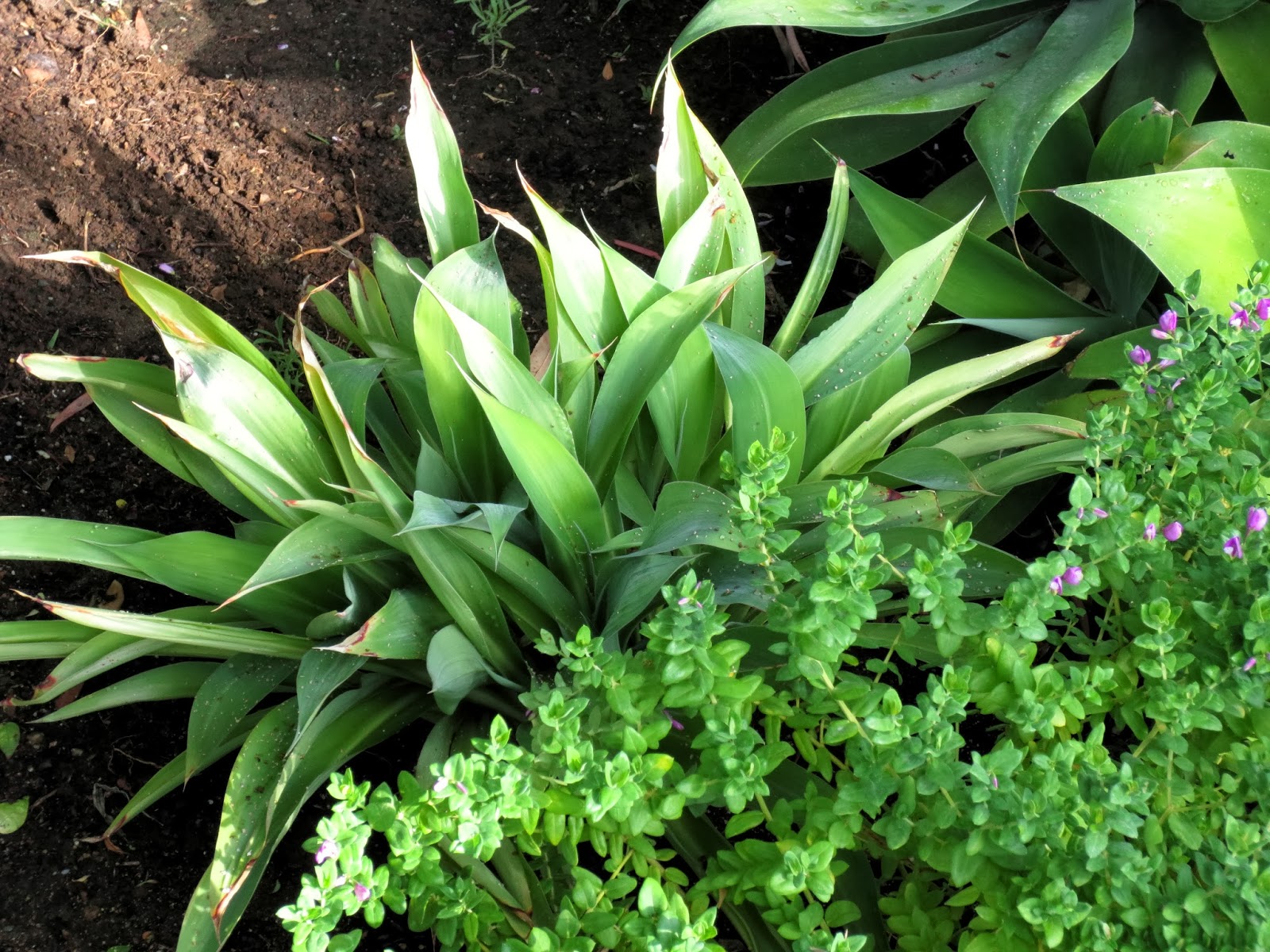

The foliage of the Renga lily looks like a smaller version of the Agave attenuata to the right of it


Another division was added to the bed on the other side of the house near 2 existing plants of the same variety.


And the last 2 went into a nearby dry shade bed, where I haven't been successful in getting much of anything to grow.  I put 3 Renga lilies there this past spring so the additions make 5.  This may be overkill but, until I can come up with an alternative as tolerant of dry shade as these plants, they'll have to do.


I'd moved one Acanthus to a moister end of that bed earlier.  More recently, I transplanted cuttings of peppermint geranium (Pelargonium tomentosum), foxglove seedlings (Digitalis purpurea), and a mint bush (Prostanthera ovalifolia 'Variegata').


The area's looking a little better but I could still use some drought and shade tolerant plants to fill in the bed's mid-section, which is exceptionally dry (probably due to tree roots).  I've tried Geranium catabrigeniense, Geranium macrorrhizum, Hellebores, various Heuchera, and Francoa sonchifolia with little success.   I'm open to any ideas!

Wednesday, October 9, 2013

Early Fall Bouquet

I haven't cut flowers for a bouquet in a few weeks but I was prompted to spend a few moments doing so when I saw a perfectly formed white rose on a trip to take out the garbage.  There are 5 rose bushes arrayed in a semi-circle along the pathway leading to the trash bins.  Not an optimal placement in my book but they were there when we bought the house.  None of the 5 are particularly vigorous either - they get too much shade and are prone to rust.  However, I'm committed to do what I can this year to improve their condition because I do enjoy the sporadic blooms they produce.

I put together a bouquet of purple and white, with a touch of pink.

Rose, Cuphea, Nandina, Plectranthus, Salvia


Here's what I included:

  • Rose (no ID)
  • Cuphea ignea 'Starfire Pink'
  • Nandina berries
  • Plectranthus ciliatus 'Zulu Warrior'
  • Salvia leucantha, aka Mexican Bush Sage


I have a dozen shrubs of the Cuphea, all currently badly in need of pruning.  The Salvia recently sprang into bloom in my garden and, seemingly, all over town.  I featured the Plectranthus as my favorite plant of the week last month.  It has developed more and more blooms every week since, although last week's Santa Ana winds flattened the shrub for a time.  I don't think I've ever used its flowers in an arrangement before and I'm not sure how well they'll hold up.  Although the plant is tough and resilient, the blooms are very delicate (and hard to photograph).

Close-up of blooms on Plectranthus ciliatus 'Zulu Warrior'


I'm joining the Seasonal Bouquet Project with this post.  You can read about the project here.  In brief, it's sponsored by Erin and Jennie, 2 flower farmers and designers working on opposite coasts.  Click here to see their floral productions this week, as well as the contributions of participating gardeners.

Tuesday, October 8, 2013

My favorite plant this week: Yucca elephantipes

At least I think this Yucca is Y. elephantipes (aka Y. gigantea).  It's another plant that came with the garden.  It grows all over the hills in this area of Southern California.  At the moment, it's also in bloom everywhere I look so it's hard to ignore.  The flowers, some of which I can see from my home office window, are downright spectacular.


Not that it's easy to get a close-up picture of the flowers.  The pictures above were taken from a distance.  The yucca sits on the side of our slope, dividing our property from that of one of our neighbors.  Actually, it may be more appropriate to say that it sprawls along the side of the slope.

Yucca, photographed from the top of the stairs that run down to the bottom of our slope

The tree has multiple trunks and appears to have spawned progeny, although it's hard to make out where one tree stops and another starts.  Ivy covers the base and lower portion of the trunks.

Thicket created by ivy and other plants grows up the trunks of the Yucca


Cleaning up this area is a future project.  A neighbor told me that there are a lot of squirrels and rats living in the area surrounding the yucca, which is off-putting.  And the fact that the tree borders the property of a neighbor complicates things - it's not even 100% clear to me which one of us owns the  yucca as the property line is fuzzy.

In the meantime, I enjoy the flowers.  Yucca elephantipes is hardy in USDA zones 9b-11 (Sunset zones 12,13, 16, 17, 19-24, H1 and H2).  It's native to Mexico and Central America and grows fast to 15-30 feet tall and 8 feet wide.

This is my contribution to Loree's favorite plants meme at danger garden.