Saturday, March 23, 2013

Neighborhood Stroll

When we first moved into our current house a little more than 2 years ago, I made a habit of strolling my immediate neighborhood, eventually extending my walk-abouts into other local neighborhoods and along nearby public trails.  It was a great way to get exercise, acquaint myself with my new surroundings, and meet my neighbors.  Then my right knee started pitching a fit.  After consultations and tests, my orthopedist suggested that I find exercise that would put less strain on my knee.  Physical therapy, joint fluid injections, and arthritis medication have helped forestall surgery.  That's great but but I miss my walks - a stationary bike just isn't as interesting.  When I walked I was in tune with changes in my neighborhood but, now, almost 9 months after giving up those daily walks, I'm very out of touch.

I threw caution to the wind this morning and took a walk.  I wanted to see what was going on in early spring at other people's houses.  The first yards I looked at were those nearest to our house and, as I see these when I drive into and out of the neighborhood, there weren't many surprises there.

I can't put my finger on the name of this shrub, distinguished by its bright red spring growth
This house boat-like house has been empty for years and is currently for sale but I don't know what the Salvation Army is doing there

Nasturtium and pelargonium wrap a neighbor's mailbox


My fingers itched to pull the weeds in this recently installed succulent bed

Cistus in full bloom

Self-sown lupin

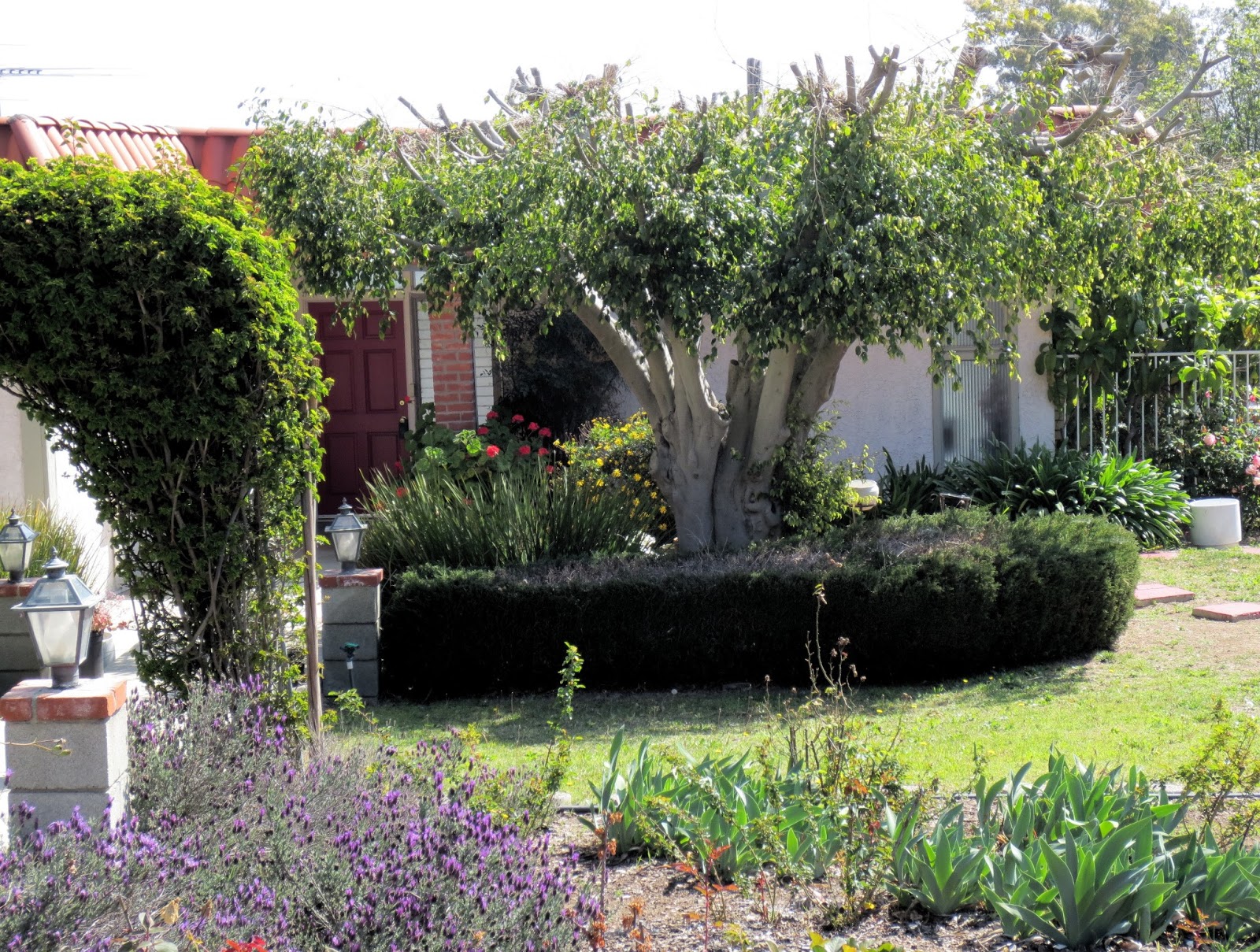
A lot of the houses in the large circle that constitutes our neighborhood are set behind tall hedges, gates or up steep driveways so there often isn't much to see from the street.  This hedge, with a mallow peaking through other shrub material represents a case in point.

8 foot hedge with mallow poking through

I could see bulbs in bloom behind the bars of this gate as I wound my way around the corner.  In addition to daffodils and a camellia in full bloom, this neighbor had tulips, which I've never been able to grow successfully here.  Maybe this spot is more protected from the strong Santa Ana winds that always knock out my tulip blooms before they get started.

Bulbs behind bars

I walked up to the entrance to our area, where I ran into a neighbor I hadn't spoken to in months.  While we got caught up, what little was left of the fog we started the morning with lifted, which made subsequent picture-taking more challenging.  However, even better photos probably wouldn't have helped the appearance of this bed at the entrance to our street.  To the credit of the neighborhood, residents have added drought-tolerant plants here and there but the mix hasn't coalesced yet.  It doesn't help that the area's ridden with weeds.  I may have to volunteer some time there soon.

Weedy bed near street entrance

As I came back into the "circle," I saw this pine covered with cones.


And then I saw that the house of an elderly neighbor has been put up for sale.  I haven't seen her in quite awhile.  One of her 8 cats showed up to say hello so I assume she hasn't moved out yet.

House for sale

Friendly cat

Here's another hedge long a wall 2 doors further down the street.

Hedge bordered by bedding begonias

A renovation that's been in process for 6 or more months is still in process.

A big house getting bigger or just a face-lift?

The next house on my left is one of the few in the area that maintains a large planting bed fronting the street.

Pelargoniums, agave, aloe and miscellaneous other succulents
Diverse mix including phromium, osteospermum, dietes, euryops and succulents

 The neighbor across the street has a vinca "lawn."  Vinca can be invasive here but these plants seem to be effectively contained between the agapanthus on one side and the street paving on the other.


Vinca in lieu of grass
Two neat front doors face a recently hatcheted hedge across the street.

This house always has succulents on the doorstep

The orange clivia looks perfect every spring

I''m not sure what this hedge is/was

As I proceeded in the direction of our house, I passed by an empty lot.  This property, consisting of 2 large parcels with a view of the harbor, has been empty for years.  I've been told that the house that once stood here burned down and the owner is unwilling to sell unless he gets the price he wants for it.   I'm sure the wildlife enjoys the space in the meantime.  There's an interesting plant growing there I wish I could identify.  It grows to the height of a small tree; has large, textured leaves; and produces lavender flowers that the bees seem to adore.

Weeds grow through what remains of the old driveway

This plant is everywhere but I can't identify it

In bud, the flowers resemble Borage on steroids

The blooms attract bees

This is the best close-up I could get

I passed the elaborately terraced front yard of another of my neighbors, an avid gardener.  In addition to alstroemeria, California poppies, salvia, and citrus trees, her front yard contains a spectacular leucospermum in full bloom.

View of terraced slope

Alstroemeria and California poppies

Another view of the terraced slope

Cleveland sage and polygala

More California poppies with daffodils

The Leucospermum

Her garden puts the rest of the neighborhood to shame.

A neighbor who finished construction on his house last year has finally put in a garden.  He's kept the front garden simple in keeping with the simplicity of the design of his house.

Poorly focused shot of neighbor's new garden bed

Iceland poppies in mass near driveway

I came across a pretty 6 foot tall Abutilon as I neared home.

Abutilon (variety unknown)

My own front yard is partially hidden behind a well-established shrub hedge as well.  I'll share a view of my front garden in a future post.

Hedge in front of our own house
I'm off to ice my knee.

Thursday, March 21, 2013

A Suffusion of Succulents

Okay, I have a bit of a thing for alliteration, hence the title of this post, but I think you can say that succulents have "suffused" (i.e. spread in the manner of fluid or light) into our nurseries, at least here in Southern California. There was a time when succulents were rather hard to find outside of specialty nurseries.  Not so any more.  They're everywhere.  Unfortunately, their prices increased with their popularity too, which is frustrating given how easily these plants can be propagated from cuttings.  Recently, a few local nurseries have begun offering inexpensive succulents in 6-packs.  No Agaves or Dyckias - most of the succulents offered for sale this way are the more common CrassulasSedums and Echeverias - but the less expensive offerings are still appreciated.  This little display in my garden was created in February entirely with succulents from 6-packs.

Crassula radicans 'Small Red', Graptosedum 'California Sunset', Sedum 'Salsa Verde'

Whereas succulents, if they were available at all, were once tucked in the odd corner of the nursery, garden centers are now featuring these plants front and center in their displays.  A friend took the following pictures for me at Rogers Gardens in Orange County a couple of weeks ago using her phone:


Okay, in the interest of truth telling, this display wasn't actually at the front of the nursery but rather toward the back near the nursery's business offices but, nevertheless, it is a large and prominent display.  Rogers moved most of the succulents it offers for sale up from the back of the nursery to the front last year, reflecting their increased popularity with shoppers as well as the nursery's push for increased use of "California-friendly" plants.

A lot of nurseries offer fanciful, densely planted succulent pots.  These are generally very pricey but they can provide inspiration for your own creations.  I took the following pictures at Sperling, a nursery in Calabasas, on a recent stop.


This pretty arrangement comes with a birdbath but did you note the hefty price tag?

As those of you who viewed my earlier post on succulents know, I already have a lot of containers filled with succulents.  Even so, I'm preparing to add some succulent-filled hanging baskets.  With our Santa Ana winds, hanging baskets filled with herbaceous plants require constant attention whereas hanging baskets filled with succulents, like the one pictured below, bloom despite benign neglect.

Monday, March 18, 2013

New Planting Bed: Part 2

I wrote about the creation of a new planting bed on the site of a large Eucalyptus tree removed at the request of a neighbor here.  With all the major plants in place, the bed still looked very bare as shown below.

Bed after initial planting in February

It's hard for me to live with so much bare ground for long.  Although I'm well aware of the need to provide shrubs and perennials sufficient space to grow, I find myself filling in with annuals and other short-lived or "dispensable" plants to create a more immediate sense of fullness.  The only exception in dealing with this bed was that I actually started with a working list of fillers and edging plants.  For once, I stuck by my list - pretty much, anyway.

Here's a view of the bed with the added plants:

Bed after the addition of fillers and edging plants in March

The Plectranthus cuttings I added are almost invisible in the picture above.  The foliage of the mature plant, with purple veining and purplish undersides, is beautiful on its own but graceful lavender flower clusters add another dimension when they appear in the fall.  Whether these cuttings will make it is still questionable as they seem to be getting more sun than they'd like in this partial sun bed.

Plectranthus fruticosus (?) cuttings with Helichrysum petiolare

Mature Plectranthus fruticosus (ID unverified)

I added some purple Heuchera as planned.

Purple Heuchera hybrid 'Melting Fire' with Heuchera maxima


And Ajuga reptans 'Catlin's Giant."

Ajuga reptans 'Catlin's Giant'

I also added Teucrium chamaedrys (Germander) along the wall.

Teucrium chamaedrys (with annual Anagallis)

I inserted 3 very small cutting of Stachys byzantina 'Helen Von Stein' in one spot I thought could use a soft gray touch but in other spots substituted Helichrysum petiolare.  This should eventually cascade over the wall along the adjoining pathway.  In lieu of the Seslaria caerulea (Blue Moor Grass) I'd originally planned on, I used the small-sized Festuca glauca 'Elijah Blue' which has an airier quality but also tolerates partial shade.  When the Helichrysum fills out, the Festuca may need to come out.


Festuca galuca 'Elijah Blue (with Helichrysum petolare)

I admit to adding some things I hadn't planned on, like the annual Pericallis x hybrida (Florist's Cineraria).  I picked up the last 2 plants in the dark blue color while on a nursery trip with 2 friends who took me shopping to divert my attention from recent sad events.  When I decided that the jewel-toned plants didn't work in their intended spot, I plunked them into this bed, assuming they'll be gone long before the neighboring Loropetalum spreads out.  This 'Senetti' variety doesn't get as big and isn't as robust as the varieties I formerly grew but it has the advantage of being much less prone to leaf-miner.

Pericallis x hybridya

I also added 2 more Argyranthemum frutescens 'Elsa White.'  It's the first time I've come across a plant carrying my mother's first name and, while there are no doubt more out there, I couldn't pass on the symbolism of running across this particular plant at this particular time.

Argyranthemum frutescens 'Elsa White'

Now I'll give my selections some time and see how they do.  I'm sure I'll have to move plants that become overcrowded and replace or move plants that fail to thrive but, for now, I'll leave them alone to do their thing.

Saturday, March 16, 2013

March Foliage Follow-up

A major shift in my priorities over the past couple of weeks has left me little time for this blog, which I've come to view as a welcome diversion from some of the more stressful aspects of my life, and gardening, which has always been a life-affirming activity for me.  That's a wordy way of saying that I've had less time and less material for this month's foliage follow-up post.  With that disclaimer, I do have some images to share.

I have 5 varieties of Abelia in my garden.  There are 3 with particularly attractive foliage:

Abelia x grandiflora 'Confetti'

Abelia x grandiflora 'Hopley's'

Abelia x grandiflora 'Kaleidoscope' (recovering nicely from an earlier haircut)

Do images of bad foliage belong in these posts?  The Duranta 'Gold Mound' and its relative, 'Burlesque,' darkened again this winter.  Last year, its mottled appearance caused me to yank out some of these plants but, as I found that most regained their gold/chartreuse color as the days grew longer and the temperatures became warmer, I decided to be more patient this year.  Still, I can't say that I'm happy with the seasonal foliage changes associated with this plant.

Duranta 'Burlesque' (I think)

In contrast, I'm very pleased with the feathery foliage of Euphorbia 'Dean's Hybrid.'

Euphorbia 'Dean's Hybrid'

I recently picked up 3 Francoa, drawn mainly by the plant's ruffled foliage.  It's too new to this garden to draw any conclusions about how well it will perform here.

Francoa sonchifolia 'Rogerson's Form'

I love true Geraniums and 'Katherine Adele' is one of my favorites, due mainly to its attractive foliage.  The flowers, when they appear, are a subtle accompaniment.

Geranium x oxomiaum 'Katherine Adele'

I added 2 new Coleus to the shadier end of the bed vacated by my former Eucalyptus tree late last month.

Solenostemon scutellarioides 'Electric Lime Coleus'

Solenostemon scutellarioides 'Mocha Mint Coleus'

I'll close with a mix of foliage textures making an appearance on my slope.

Oenothera speciosa, Geranium incanum (a weed here) and Sedum (No ID)

For links to more foliage photos, please go to Pam's Digging blog.