Wednesday, July 19, 2017

Casa Mariposa - So Very Tammy


On the morning of the last day of the 2017 Garden Bloggers' Fling, we were lucky to have the opportunity to visit Casa Mariposa, the personal garden of Tammy Schmitt, the Capital Region Fling Director.  As I've followed Tammy's blog for as long as I've been blogging myself, the garden was instantly recognizable and, although I'd never met Tammy in person prior to the 2017 Fling, I felt very much like I was entering the garden of an old friend.  Tammy's been a regular commentator on my blog - in fact, she was the very first commentator who wasn't a relative or a local friend.  She even sent me her collection of Amaryllis belladonna bulbs in 2015, certain that they'd find my zone 10b garden more hospitable than her zone 7a garden.  (This remains to be seen as I'm eagerly awaiting the arrival of the late summer blooms now that our prolonged drought is officially at an end.)

Despite the time absorbed in organizing the Fling while maintaining a full-time job and her disclaimers about the condition of the garden, described as "a study in improvisation and imperfection...dogscaped to meet the needs of her canine crew," it looked just perfect to my eyes.  The front was neat as a pin.


But decorative elements surrounding the front steps made it clear that this was Tammy's garden.

Birdhouses are a theme in Tammy's garden and the metal sculpture (lower right), one of at least 3 I found while poking around touring her garden, is a perfect expression of Tammy's joie de vivre


The signs of her effervescent personality became all the clearer as we approached the back garden through the side entrance...

Did you notice how "Be the Good" is highlighted in the sign?

I remember Tammy's story about the creation of this arbor from an old blog post, a great example of her improvisational skill


Tammy is an avid organic gardener, focused on the use of native and other ornamental plants that support pollinators and other wildlife.

This meadow-like scene is one of the first things I saw as I stepped into the back garden.  All those tiny clay pots had numbers linking back to a plant list.  Unfortunately, I didn't take the time to note the numbers as I explored so I'm not going to hazard identifications here.

View looking toward the back of the house from the lawn area, showing just a small number of the 50 or so people that were wandering through the garden from buses 3 and 4

A partially shady section of the back garden adjacent to a neighbor's property

A section of the aforementioned dog run utilized by Tammy's "canine crew"

Why can't my shade area look like this?


But perhaps the most immediately recognizable element of Tammy's back garden were the steps off the back of the house.

I somehow managed to get a shot of the back steps without legs or feet in it!

A closer shot of the large pot collection that surrounds the back steps


That's a LOT of pots, right?  But that wasn't all of them by any means.

Tammy sows a huge number of seeds for annual plants each winter, as part of her ongoing effort to avoid the systemic neonicotinoid pesticides used by so many growers


There were quintessential Tammy touches embedded throughout the space.

More birdhouses (!!!), along with other fun decorative items


And there were lovely plants everywhere.
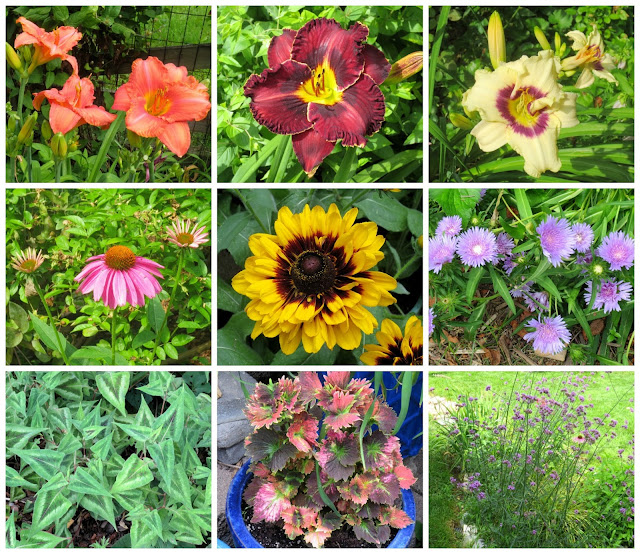
Daylilies were a constant in the Capital Region gardens - how I wish I had that orange variety in my own garden.  The plants in the middle row, Echinacea, Rudbeckia and Stokesia generally aren't happy in my area of Southern California.  Those in the bottom row, Persicaria, Plectranthus scutellarioides (coleus) and Verbena bonariensis do better but don't look nearly this good.


I don't think Tammy's garden could be mistaken for anyone else's.

Tammy answering questions about her garden with Genie's assistance


Thanks, Tammy, for inviting a horde of bloggers into your garden and for organizing a truly wonderful event!


All material © 2012-2017 by Kris Peterson for Late to the Garden Party

Monday, July 17, 2017

In a Vase on Monday: The Dahlias have Arrived!

I haven't had much success growing Dahlias in the past.  I've previously planted them in my mixed borders but, as most of my borders are filled with drought tolerant plants and as I've restricted irrigation in response to California's ongoing concerns with water usage, they never received the water they need to grow well.  So, this year, when I decided to try growing them again, I placed them in the raised planters I'm now using as a cutting garden.  I water the plants in this area more heavily than any other area of my garden.  That's made all the difference with the Zinnias I'm growing this year and it appears that the Dahlias are responding too.

The first of my Dahlia blooms set the palettes for both vases I created for "In a Vase on Monday" this week.  Vase #1 was focused on Dahlia 'Little Robert', a small pom-pom variety.

The dark centers of the pink Lisianthus (Eustoma grandiflorum) echo 'Little Robert's' magenta tones so I threw the 2 of them them together in this vase

The color of my noID ivy geranium (Pelargonium peltatum), used here at the back of the vase, is almost identical to that of the Dahlia, although the former photographs as a stronger red

Top view

Clockwise from the left, the vase contains: Dahlia 'Little Robert', Artemisia ludoviciana, Eustoma grandiflorum, Pelargonium peltatum, and the variegated foliage of Pseuderanthemum 'Texas Tri-star'


The second vase was constructed around Dahlia 'Terracotta', a semi-cactus variety.

I wasn't sure about using yellow, even pale yellow, in this mix but there are touches of yellow in the Dahlia and, heck, I have a lot of yellow Lisianthus in bloom too

I relegated the salmon-colored cactus Zinnias to the back of the vase as they competed too strongly with the Dahlia for dominance when positioned in the front

Top view

Clockwise from the upper left, the vase contains: Dahlia 'Terracotta', Abelia x grandiflora 'Hopley's Variegated', Callistemon 'Cane's Hybrid', Eustoma grandiflorum, Tanacetum vulgare, and Zinnia elegans


These 2 Dahlias and a third, 'Loverboy', which just produced its first blooms, have whetted my appetite for more, although I do have space constraints.  I have 4 more Dahlia varieties that have yet to bloom, so perhaps I'll be pulling out some of what I have at the end of this season, which would make room to try others next year.  Or, perhaps I'll simply have to add some large pots to my cutting garden next year.

Coincidentally, on a Saturday whirlwind trip to Roger's Gardens in Orange County to pick up succulents, I discovered that the garden center was having a Dahlia show.

Blooms submitted by customers for consideration


I didn't stay long enough to find out which flowers received the most votes but here are some of my favorites among the submissions:

Very few of the blooms were submitted with cultivar names.  Among those I photographed, the exceptions were the 3 in the bottom row, which are, from left to right, 'Radiance', 'Santa Claus', and 'Thomas Edison'.


If I'd have known about the competition ahead of time, perhaps I'd have submitted 'Loverboy'.

Dahlia 'Loverboy' bloomed on Saturday, after I'd published my Bloom Day post of course...


For more Monday vases, visit Cathy, our IaVoM host, at Rambling in the Garden.

The first vase sits in the front entry and the second on our dining room table


All material © 2012-2017 by Kris Peterson for Late to the Garden Party

Sunday, July 16, 2017

Foliage Follow-up - July 2017

As summer heats up, shade becomes all the more important so, when it came time to identify subjects for the foliage follow-up post hosted by Pam at Digging, trees came to mind.  This past winter I once again had our Magnolia grandiflora "thinned" to accommodate a neighbor's view concerns but the crew went further than I'd expected and, until recently, I felt it looked a bit sad, not to speak of the fact that it provided limited shade.  It's finally looking like it should again.

The Magnolia standing proud in the front garden (left) and a recent flush of new growth along its branches (right)


I also had all 4 of our Arbutus 'Marina' thinned.  They've filled out again too but, this month, even more than the shade they provide, you've got to admire their handsome peeling bark, which is particularly evident at this time of year.

This particular tree sits on the northeast side of the house.  Its bark peels to a degree all year but look at the curls it's got now!


A few other foliage selections also caught my eye.

Purchased as Chondropetalum tectorum, this Cape Rush may be more correctly classified as C. elephantinum, although mine seems to fall mid-way between the 2 species in size.  I originally planted 3 in my street-side succulent bed in 2013 but only this one thrived.  I wish you could see how the sheaths on the joint stems gleam in the afternoon sun but I wasn't able to capture it well in the mid-afternoon glare so I made do with this early morning shot.

The dominant plant in this foliage mash-up is Leucadendron 'Safari Sunset', which develops bright red bracts in summer.  L. salignum 'Winter Red' is planted in front of it.  At maturity, the former should be about twice the size of the latter.  The hedge of Xylosma congestum is shown in the background with Stipa tenuissima in between.  The gray-foliaged semi-weed threatening to engulf the Leucadendrons from the left is Helichrysum petiolare 'Silver Mist'.

I brought this Persicaria 'Red Dragon' with me as a cutting from my former garden.  It's struggled in my current garden even in this afternoon shade location next to the house but I thought it looked pretty good here with the window shade pulled down behind it in a our futile effort to keep the house cooler.  I'm going to try taking some additional cuttings this fall to see if I can find a more hospitable location for it elsewhere.


It's hard for me to let a foliage-focused post go by without featuring at least some succulents so here's this month's selection:

The planter stand here had belonged to my mother-in-law but the rusted steel bowl it originally held corroded and slowly fell apart.  I bought a cheap shiny steel wok, which accommodated me by quickly rusting outside.  I planted it up with a mix of succulent cuttings with a Graptoveria 'Fred Ives' in the center.  I like the way it glows in the mid-day sun in what's otherwise a fairly shady spot on the covered patio on the south side of the house.


Finally, as my Agapanthus flower stalks begin to look scruffy in July, mass decapitations are generally part of my summer tidying-up process.  This year, inspired in part by the Alliums spray-painted blue after the flowers faded I saw during the 2017 Garden Bloggers' Fling, I decided to try leaving some nude Agapanthus stalks in place.  I haven't decided yet whether it's worth the effort of cleaning them up.  We'll see.  For now it's just an experiment.

Painting the seedpods would probably improve the color contrast but I've no intention of taking things that far.  The contrast may be greater when the stalks dry and the Xylosma hedge behind them is trimmed, producing a flush of fresh orange growth.


For more foliage follow-up posts, visit Pam at Digging.


All material © 2012-2017 by Kris Peterson for Late to the Garden Party

Saturday, July 15, 2017

Bloom Day - July 2017


While we've been lucky to avoid the temperatures above 100F that have plagued some areas of Southern California, it's been toasty here.  Many of the flowers that were going strong last month have either finished up for the season or gone into retreat.  With a few exceptions, the flowers that are hanging on are present in small quantities.  However, there are a few heat-loving flowers that are just coming into their own.
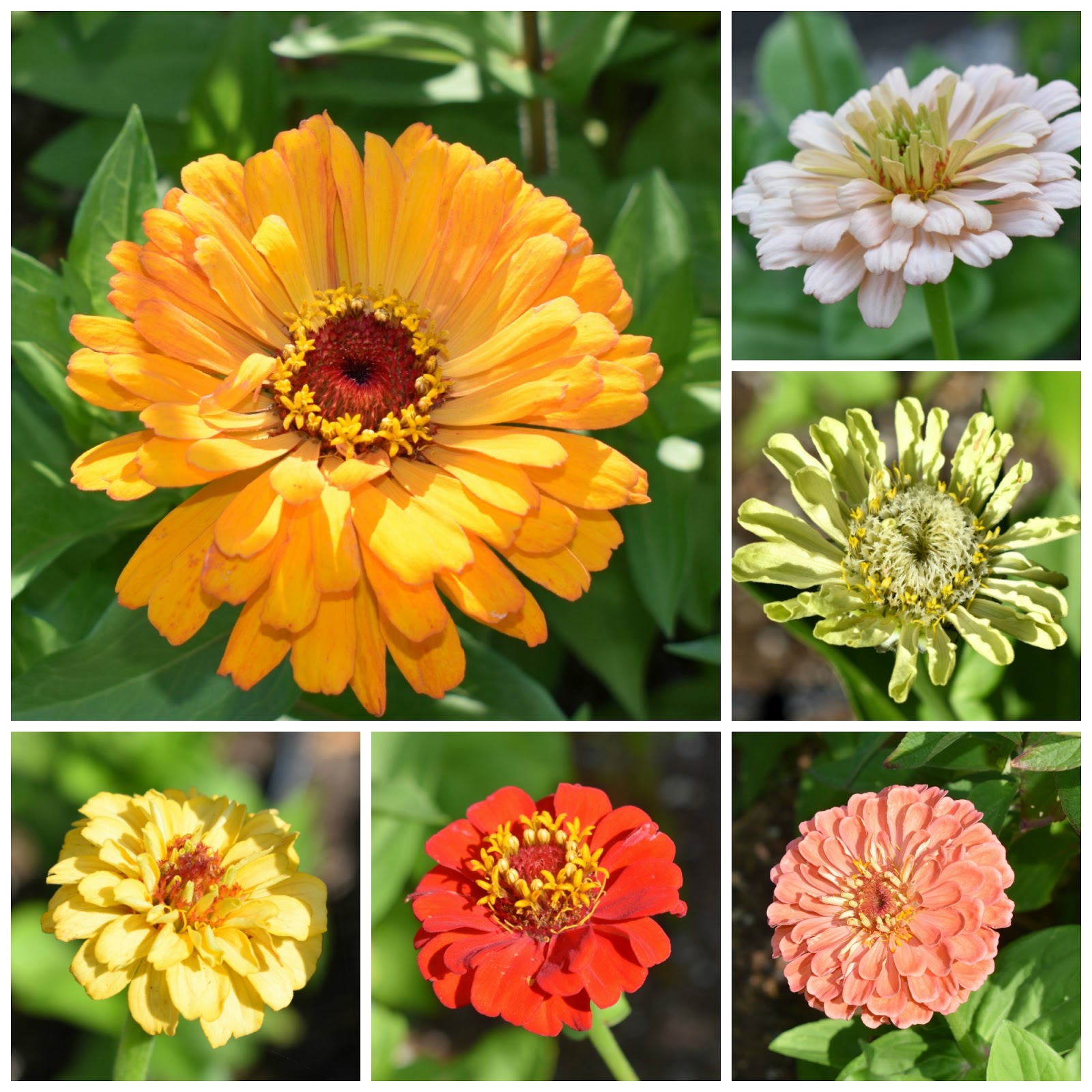
The Zinnias are making the biggest splash at the moment.  While they like the heat, they need more water than most of my garden receives.  They've been failures in the past when I planted them in my borders so this year I planted seeds and a few plugs in the raised planters in what's now my cutting garden and watered lavishly, at least by my standards.  I'm pleased to say they've taken off.

These Zinnia elegans, cactus type, were grown from seeds

These Zinnia elegans were also grown from seed but unfortunately I didn't label which variety was which, except that I think the lime green variety is 'Envy'


The Zinnias hold the attention of the pollinators long enough to allow me to catch them with my camera.

Bee exploring a battered 'Whirligig' Zinnia, planted as a plug 

This skipper butterfly selected another 'Whirligig' Zinnia


I planted sunflower seeds and dahlia tubers in my cutting garden too.  The sunflowers are growing well and have buds but no blooms as yet.  The dahlias are only just getting started.  Not all the tubers were clearly labeled by the grower and I've made some errors in identification already but I think I have these first blooms correctly identified here.

Dahlia 'Little Robert', the first to bloom

Dahlia 'Terracotta'


My beautiful Lisianthus (Eustoma grandiflorum) have also jumped into gear this month.

The majority of those in bloom are pink, although the blue and yellow forms are also relatively plentiful.  I've had only a few white blooms thus far, and most of those have been tinged with lavender.

I mail ordered plugs of a new variety, 'Rosanne Black Pearl', this year.  They arrived in good condition on the first shipping date permitted by the grower but, when an early heatwave hit in May, most perished.  I ordered more plugs when they were offered at 50% off.  Only a couple have bloomed and they're far smaller in size than any of the other Eustoma I grow and not nearly as dark as represented in the grower's photos.


Meanwhile, the stalwart Gaillardias, which also appreciate a touch of heat, are still blooming well.

Gaillardia 'Arizona Sun' (left) and G. 'Gallo Peach' (right) 


But the biggest floral display, if not the most welcome, is that provided by the mimosa tree (Albizia julibrissin).

As I complain every summer, it's a messy thing.  I sweep up the back patio every morning and pluck fuzzy flowers from the plants in the surrounding area whenever I have time, while trying to keep in mind that the hummingbirds love the darn tree.


I'm resorting to collages to present the best of the rest.

Clockwise from the upper left: Salvia cacalifolia, noID Agapanthus, Catananche caerulea, Duranta repens 'Sapphire Showers', Laurentia axillaris, and Tibouchina urvilleana

Top row: Aloe 'Johnson's Hybrid', Alstroemeria 'Indian Summer', and Anagallis 'Wildcat Mandarin'
Middle row: Cotyledon orbiculata, Grevillea 'Superb', and Hemerocallis 'Sammy Russell'
Bottom row: Lantana camara 'Irene', Leonotis leonurus, and Lotus berthelotii 'Amazon Sunset'

Clockwise from the left: Centranthus ruber, Digitalis purpurea, Echeveria 'Afterglow', Origanum 'Monterey Bay', Pelargonium peltatum 'Pink Blizzard', a heat-singed 'California Dreamin' rose, and Thymus serphyllum 'Minus', beloved by the bees

Clockwise from the upper left: Bauhinia x blakeana, Gomphrena decumbens 'Itsy Bitsy', noID Pelargonium peltatum, Pelargonium 'Rembrandt', Pelargonium 'Tip-Top Duet', and Rudbeckia 'Cherry Brandy'

Top row: Alstroemeria 'Claire', flower of noID guava tree, and Gazania 'White Flame'
Middle row: Leptospermum 'Copper Glow', Leucanthemum x superbum, and Magnolia grandiflora
Bottom row: Nandina domestica, Pandorea jasminoides, and Romneya coulteri

Clockwise from the left: noID Anigozanthos, noID succulent, Crassula pubescens radicans, and Phalaenopsis


That's it for this month's Bloom Day report.  To see what's blooming elsewhere in the world, visit Carol at May Dreams Gardens, our Bloom Day host.


All material © 2012-2017 by Kris Peterson for Late to the Garden Party