It feels as though everything in my garden wants to bloom at once. Many of the winter bloomers made late arrivals and the spring bloomers are now off and running too. The embarrassment of riches in terms of floral choices could have set my head spinning but I focused my attention on the climbing rose offering its first flush of bloom and let that direct me in preparing this week's arrangement for "In a Vase on Monday," the meme hosted by Cathy at Rambling in the Garden. However, I did stuff the vase full of flowers.
The front view emphasizes the coral colors of the rose
The back view shows off some of my yellow flowers
The top view merges both colors
Here's what I included:
Clockwise from the upper left: 'Joseph's Coat' climbing rose, Agonis flexuosa 'Nana', Cotula lineariloba 'Big Yellow Moon', a red Freesia, yellow Freesia, Heuchera sanguinea 'Bressingham Hybrids', Narcissus 'White Lion', and a noID Narcissus with Coleonema album
The new vase sits on the dining room table
But wait! There's more. (Do I sound like an infomercial?) The orchid arrangement that had been sitting on the dining room table for 2 weeks was looking haggard but the Cymbidium centerpiece was still in perfect condition. I threw away the other contents of the vase and created a new one using that same Cymbidium flower stalk.
The buds at the top of the Cymbidium's flower stalk have opened since I created the original arrangement for my February 29th "IAVOM" post
Left: close-up of Cymbidium Sussex Court 'Not Peace' shown surrounded by Leptospermum scoparium 'Pink Pearl'; right: Coleonema album
I was tired of breakfasting with the Cymbidium so, this week, it landed in the front entryway
No, I didn't stop there. With some rain expected Sunday evening, I decided to "rescue" a few of my Camellias as they don't usually look their best after rain.
Camellia hybrid 'Taylor's Perfection' has been blooming for 6 weeks and hasn't received the attention it deserves
I briefly considered creating a blue or purple arrangement as well but I stopped myself. Maybe next week.
You may recall that we removed the last sections of lawn this past fall. The process of remediating the soil in preparation for planting carried the project well into the winter months. I started planting the area alongside the street at the front of the house in January and, although tweaking will continue ad infinitum, I'm declaring the project complete.
Here's what the area looked like in late January:
The succulent area in the distance was mostly planted but the area along the driveway was still relatively bare
Here's what the area looks like now:
I've finished planting out the area along the driveway, although the plants I've used are mostly small specimens that will take time to fill the space
This photo shows how the new area relates to the borders surrounding the front door in the distance
Turning around in the other direction, here's a closer view of the the intersection between the flagstone path and the railroad-tie/gravel path used to move our garbage bins to and from the street.
The area beyond the gravel path is planted mainly in succulents
About half the succulents in this area are cuttings from my garden and a friend's garden. The 3 small Agave attenuata on the upper right are cuttings from the larger specimen on the left, which I inherited with the garden.
This photo of the same area was taken from a "doorway" entrance through the hedge adjacent to the street. In addition to the succulents (described in my January post), I planted some bearded Iris (moved from elsewhere in the garden), plugs of blue fescue (Festuca cinerea 'Festina'), and alyssum.
I haven't even tried to count the plants I've put in. I've used cuttings, divisions and transplants where possible but I've acquired lots and lots of new plants too.
The Acanthus mollis on the left is one of 2 I moved from elsewhere in the garden. The next two photos show Arthropodium cirratum (aka Renga Lilies) I divided from large clumps in the south side garden where they got too much sun.
New plants grown mainly for their foliage include, clockwise from the left: Dianella tasmanica 'Yellow Stripe' (2 plants were divided to create 4), Abelia x grandiflora 'Confetti', Asplenium x Austral Gem, Aucuba japonica, and Iresine hybrid 'Blazin' Lime'
New plants grown for both foliage and flowers include: Arctotis 'Opera Pink' and Heuchera 'Palace Purple', Ajuga genevensis, Geranium maderense, Plectranthus 'Mona Lavender' and Rhodanthemum hosmariense
Plants added primarily for their floral color include, clockwise from upper left: Cistus saivilfolius 'Prostratus' (aka sageleaf rockrose), Geranium 'Tiny Monster', Pericallis hybrids in shades of blue, and groundcover Prunella grandiflora 'Freelander Blue' shown with annual pansies
For some reason, I've accumulated a lot of garden ornaments in this area. They're a little intrusive at this point but, as the plants fill in, I hope they'll become less so.
Clockwise from the left: The concrete cat my husband bought me for Christmas years ago (he'd be happier if Pipig was also made of concrete); the smiling face I brought from our old house; a wine barrel placed in an area under a tree which would otherwise be impossible to plant; a small birdbath; and a hanging ornament that spins in the wind
Everything is settling in nicely, aided by two good rainstorms just this week. At the moment, everything is looking up in the garden.
A rainbow appeared over the harbor after yesterday's storm dropped almost half an inch of rain
I've been hounded by unwelcome visitors of the furry variety all week. Every morning is spent cleaning up after raccoons who seem undeterred by either rain or the active presence of coyotes in the neighborhood. However, after filling holes, sweeping up dirt and replanting upturned succulents early this morning, I saw this:
Ladybug on the climbing rose, 'Joseph's Coat'
The rose, often blocked from view by my husband's truck, is the first to bloom in my garden this season.
The rose grows up the stone-fronted chimney above a grouping of succulents (previously featured in my favorite plant combinations post)
Unfortunately, annoying furry visitors don't confine themselves to nighttime stalking expeditions. There are daytime stalkers as well.
I saw this fellow from my office window sitting on top of the Xylosma hedge staring intensely at something
Then he moved forward to the Ceanothus hedge
Then he sought a better view from the mimosa tree
A wider view shows the focus of his interest
Seconds later, his goal is achieved (but he looks disappointed to have found the feeder almost empty)
We got rain! It's rained on and off since late Friday night. The latest storm system arrived early this morning (with lots of lightning and thunder!) and the trailing edge is still moving through. Although Northern California and the Pacific Northwest have received significant rain courtesy of El Niño, Southern California, which forecasters originally predicted would receive the lion's share of El Niño's bounty, is still running substantially below "normal" rain levels. According to the little weather station attached to our roof, our total rain for the season to date (i.e. since October 1st) is 4.74 inches. It's not much by comparison with many areas but we've had ourselves a good soak, which is much appreciated.
I took advantage of clear skies between storms Sunday afternoon and cut flowers for "In a Vase on Monday," the meme hosted by Cathy of Rambling in the Garden. I meant to use the pink Freesia blooming in the back border but those blooms were in bad shape; however, I noticed that the pink Alstroemeria were starting to bloom and took off from there, selecting other flowers to complement those blooms.
Front view
Top view
Back view
I don't feel any of the flowers I used can claim the starring role in this arrangement. It seems to be an ensemble cast.
Clockwise from upper left: noID Alstroemeria; Argyranthemum frutescens; Bulbine frutescens; Freesia in shades of dark pink, gold and yellow; Heuchera sanguinea 'Bressingham Hybrids'; and Pelargonium 'Katie'
After bemoaning the failure of my anemones to bloom in comments in response to a few IAVOM contributors, I noticed 3 small blue anemones in the backyard border. Unwilling to risk the chance that they'd be pummeled by rain, I cut those too.
I used a tiny, 3-inch vase to suit the short stems
I included: Anemone coronaria, lavender and white Freesias, and 2 short stems of my new Osteospermum '4D Silver' (plus leatherleaf fern, Rumohra adiantiformis)
After 4 years of drought with no end in sight, most everyone here gets a little giddy when it rains. Articles on rain, or the lack of it, appear in the Los Angeles Times every week and reports of rain are frequently the lead story on local TV news reports. My own mood soars whenever rain is forecast (followed by a frenzy of activity in the garden). If I could sing on key, you'd find me singing and dancing in my garden. However, my singing voice leaves a lot to be desired so I'll pass the task to Gene Kelly, who did it best:
More rain is forecast for the end of the week. It's not exactly a March Miracle but it'll do. Meanwhile, my newest arrangements add color in the face of gray skies.
The sunny floral explosion sits in the front entry
I've been studying my garden from a new angle lately. My wide shots posts consider the major segments of the garden as a whole. My Bloom Day and Foliage Follow-up posts generally look at plants in close-up as stand-alone entities. So what's been missing is an intermediate view of plant assemblages. Some of my combinations are pleasing but many are too busy, especially at this time of year when every other plant seems to be blooming, preparing to bloom, or just finishing blooming. When I take a step back, I find that the combinations I like best usually feature one or more strong foliage accents.
This combination includes Abelia 'Kaleidoscope', Cotyledon orbiculata 'Silver Storm' and Pelargonium x hortorum 'Mrs. Pollock'. Without the mediating influence of the Cotyledon, the variegated foliage of the Abelia and the Pelargonium would fight with one another.
This combination includes Aeonium arboreum, Aeonium 'Kiwi', Euphorbia tirucalli 'Sticks on Fire' and Senecio vitalis. Although the Aeoniums and Senecio do bloom, this combination is based on foliage color alone.
This combination consists of Acacia cognata 'Cousin Itt', Aeonium arboreum and Phormium 'Ed Carmen'. Pops of yellow flower color will be added when the groundcover Cotula lineariloba 'Big Yellow Moon' begins to bloom in earnest, picking up the yellow color in the Phormium. In the meantime, interest is provided by the contrast of textures and shapes.
The contrast of shape and texture is the principal source of interest in this combination too. It consists of Agave attenuata, Euphorbia 'Dean's Hybrid', which is just beginning to produce its chartreuse flowers, and trailing Lantana montevidensis.
Phormium 'Maori Queen' echoes the floral color of Arctotis 'Pink Sugar' in the foreground. The variegated foliage of Correa 'Wyn's Wonder' (to the right and left of the Phormium) picks up the creamy yellow in the Phormium's foliage and the dainty pink flowers and chartreuse foliage of Coleonema pulchellum 'Sunset Gold' complement both. The Correa also produces pink blooms in spring.
Most of my combinations are a crap shoot. I'm waiting and watching to see if this one comes together.
This combination consists of Echium candicans 'Star of Madeira', Argyranthemum frutescens 'Madeira White' and Carex oshimensis 'Evergold'. The Echium has already produced buds but it's anybody's guess as to whether the blue flower spikes will appear while the Ceanothus behind it (not shown) is still in bloom.
Some combinations are tied together by small elements.
The small white and pink flowers of Erigeron karvinskianus neatly mimic the larger flowers of Gazania 'White Flame', which in turn echoes the colors of Coprosma repens 'Inferno' and Phormium 'Maori Queen'
I'm currently working on a new combination in the backyard. It has a ways to go before it fills in but I already like how the foliage and flower colors reinforce one another.
This combination includes Grevillia 'Ned Kelly', Leucadendron 'Jester', Lobelia laxiflora and Melianthus major. The Lobelia was just added and I think it does a great job of picking up the sunset pink color of the Grevillea and the Leucadendon without making it overwhelming.
My successful plant combinations are most often a matter of pure serendipity but a new book on my bed-side table may help me up my game: The Perennial Matchmaker by Nancy Ondra. Nan has written several books and regularly publishes posts on her blog, Hayefield. Although my climate and Nan's couldn't be more different, I always learn something from viewing the wonderful plant combinations she features in her posts from her Pennsylvania garden. Her new book provides a plant-by-plant discussion of ways to complement 80 perennial favorites and a step-by-step guide to good matchmaking. You may notice some familiar photos among the 400 included in her book to illustrate her points - as the credits at the back of the book show, many garden bloggers have contributed photos. I even have one (on page 118)! I received an advance copy but the book is scheduled for release next week.
What could Legos, succulents and a Wednesday Vignette possibly share in common? Well, they all came together in a visit to the South Coast Botanic Garden earlier this week. The botanic garden is sponsoring a nature-themed Lego exhibit. Seeking to avoid visiting the garden when there might be hoards of children towing parents, my husband and I paid a visit early on a Monday morning. We had the garden almost to ourselves - that is, if you discount the presence of a TV crew filming an episode of Scorpion, which my husband described to me as a "nerds save the world" series.
The Lego exhibits were scattered all over the garden, which spans 87 acres. Of the 15 exhibits, we found 13. It turns out that Lego sculptures aren't particularly easy to photograph so I'll show you only a few of my favorites. In addition to these there was a butterfly, a dragonfly, goldfinches at a feeder, a koi fish, a lawnmower, lily pads with a frog and a flower, an orchid, and a rose. Each exhibit was accompanied by a informational placard.
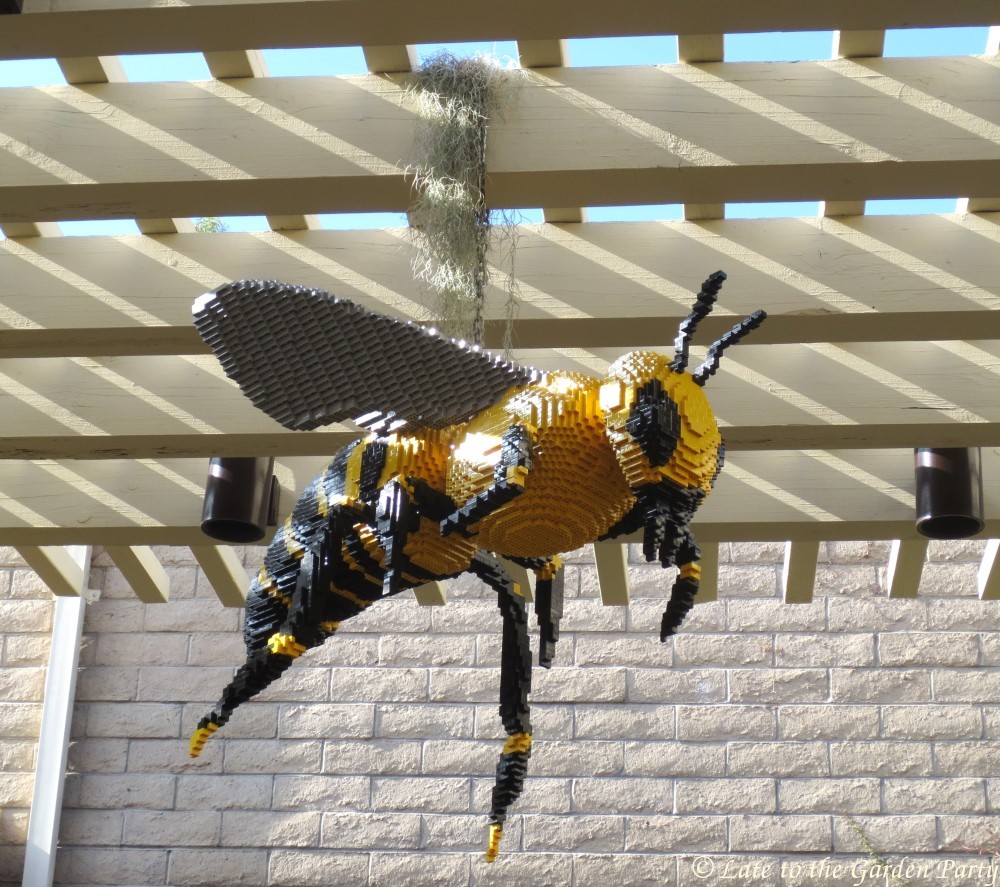
The bee stood sentry near the entrance
The bison (complete with a bird on its back) and its calf were my favorites and the largest of the exhibits we saw, comprised of 61,372 Legos in total
One can hope the rabbit might escape the fox here (although the placard showed a photo of a real fox with a real rabbit in its jaws)
The gardener is inexplicably hoeing rocks but he did have a nice backdrop in the succulent garden
The hummingbird, consisting of 31,555 Legos, is shown in most of the exhibit's promotional materials
The best part of the exhibit was that it provided an excuse to spend a few hours in the garden. I've posted on the garden before (see photos of my spring 2014 visit here) but, each time, I see something different. It's not The Huntington by any means but it's still a nice place to visit and just 5 miles from home as the crow flies. The highlights of Monday's visit include lots and lots of succulents.
The cat's tail aloe (Aloe castanea) at top was hard to miss in full bloom. Bottom row, left to right: Aloe cryptpoda x arborescens, A. maculata?, and A. marlothii.
Clockwise from upper left: Kalanchoe beharensis in full bloom, Agave potatorum?, Beschorneria yuccoides with bloom spikes, Euphorbia ammak, Euphorbia xanti in bloom, and Stenocereus griseus (with wild lupine)
The trees were putting on a good show too.
Clockwise from top left: Cercis canadensis, a noID flowering fruit tree (possibly apricot), Prunus serrulata, and a noID pine
The trumpet trees, formerly classified as Tabebuia but most recently reclassified as Handroanthos, were in glorious color. (See Hoover Boo's post on these trees at Piece of Eden.) From right to left are: H. impetiginosus, H. chrysostricha (next to a coral tree), and H. chrysostricha x impeteginosus.
I might have missed this tree if my husband hadn't plunked down on the bench beneath it. This is Kigelia africana, also known as the sausage tree.
I didn't take too many other garden photos but a couple of shrubs stood out.
A beautiful noID Ceanothus grown as Ceanothus should be grown (unlike the sad specimens I inherited with my own garden, which are shorn mercilessly to maintain them as hedges)
This is a new-to-me Salvia. I couldn't find a label but my best guess based on an on-line search is that its Salvia africana-lutea. Those flower clusters were huge and just a little scary.
This western fence lizard (Sceloporus occidentalis) was nearly invisible of the trunk of the giant Yucca elephantipes which forms the centerpiece of South Coast Botanic Garden's succulent section