Showing posts with label garden books. Show all posts

Monday, May 31, 2021

In a Vase on Monday: Pungent Scents

Since last October, I've participated in an online meeting with other gardeners on a roughly monthly basis to discuss selected garden books.  Last week, we discussed The Scentual Garden: Exploring the World of Botanical Fragrance by Ken Druse.  I'd recommended the book based mainly on its fabulous photographs; however, the general consensus was that it's a "coffee table book."  Druse addressed the science of scent, how it can be captured and preserved, and how scented plants can be presented in a landscape but his central focus was on classification.  I for one was disappointed there wasn't more emphasis on how to use fragrant plants in association and how to carry fragrance through the seasons.  The book nonetheless spurred a lively discussion about how each of us respond to the scents in our own gardens, which fragrances we like and which we don't.  That exchange emphasized points Druse made in the introductory section of his book: scent is in the "nose of the beholder" and, in many cases, how we feel about a scent depends a lot on the long-term memories associated with them.

I didn't set out to select plants for this week's "In a Vase on Monday" post based on scent but, as it turned out, I ended up with two arrangements this week each of which included stems of particularly pungent scented plants.  The first arrangement was inspired by the Agapanthus just now beginning to bloom in my garden.  If Agapanthus has a scent, my nose is incapable of detecting it but two of the other plants I included in the mix did register, one very strongly.

My theme was color, not scent, based.  I chose blue and white colored flowers.  The scent was supplied by Salvia clevelandii 'Winnifred Gilman', another Salvia hybrid, and the minty foliage of Prostanthera ovalifolia 'Variegata'.

Back view:  The mint scent of the variegated Prostanthera is light and very pleasant.  I expect I could tuck a few stems in my pillow case and have nothing but sweet dreams.  In contrast, the Salvias have a heavy, musky scent.  I expect that they would bother me with prolonged exposure in an enclosed space.

Top view: The other elements had little or no noticeable scent
   

Top row: noID Agapanthus and two of the varied colors of Consolida ajacis 'Summer Skies' mix
Middle row: noID Delphinium, Gilia tricolor, and Globularia x indubia
Bottom row: Phacelia tanacetifolia, Prostanthera ovalifolia 'Variegata', and Salvia clevelandii 'Winnifred Gilman'
(Included but not shown in close-up is Salvia leucophylla x clevelandii 'Pozo Blue')

I should note that Druse is based in the northeastern part of the US.  His book emphasizes the plants with which he's most familiar and there's relatively little overlap with the plants I grow in the Mediterranean climate of my coastal Southern California garden.  The inspiration for my second arrangement this week was the Matilija poppies (Romneya coulteri) blooming on my back slope.  This genus isn't mentioned in Druse's book.  I can detect a only a light scent from the flowers but bees love the plant.

I took this photo in the California Natives display garden at Seaside Gardens Nursery just over a week ago.  The bees really do swarm the blooms like this but, as the blooms in my garden are generally well over head-height, I don't manage to catch photos like this here.

The Matilija poppies established a color theme for this arrangement as well

Back view: The only flowers with scent I can detect in this arrangement are those of the Achillea 'Moonshine', which has a marigold-like scent I find unpleasant when sniffed close up, and Tagetes lemmonii, which I like in moderation but I know some people detest

Top view

Top row: Abelia grandiflora 'Hopley's Variegated', Achillea 'Moonshine', and Alstroemeria 'Inca Sundance'
Middle row: Alstroemeria 'Claire' and Centranthus ruber albus
Bottom row: Romneya coulteri and Tagetes lemmonii

My husband is more sensitive to scent than I am.  He's objected to the smell of Tagetes lemmonii in the past so I use it sparingly in arrangements.  I can't remember if he's complained about Salvia clevelandii before but I personally find it a heavy scent so I'm waiting to see if he says anything.  What scents do you prize in your garden?  Are there scented plants you grow despite finding their fragrance objectionable?

For more IAVOM creations, visit Cathy at Rambling in the Garden.


All material © 2012-2021 by Kris Peterson for Late to the Garden Party

Wednesday, January 6, 2021

'Fearless Gardening': Advice from an Expert

I expect that many of you are familiar with Loree Bohl of danger garden fame.  Loree's blog was one of the first I started following, even before I started blogging myself.  I've gotten to know her both virtually, through her blog and her Instagram posts, and in person.  I've prodded her at intervals over the years to write a book to share her garden aesthetic and philosophy and now she's done just that!  Her book, Fearless Gardening: Be Bold, Break the Rules, and Grow What You Love, was released yesterday.  I happily signed on to support a virtual launch party.  In addition to offering input on the book, I get to conduct a drawing for a free copy of her book and one other also published by Timber Press so keep reading.

This and the other photos in this post were provided courtesy of Timber Press

You may be familiar with Loree's love of spiky plants and other growing things that "could poke an eye out."  You might assume that her reference to "fearless gardening" stems from her willingness to garden using such plants in Portland, Oregon, which has a climate that wouldn't seem to support many of her favorites.  Denying the constraints of one's climate could certainly be regarded as "fearless" - and possibly foolish.  But Loree is anything but a foolish or reckless gardener.  Yes, she loves agaves and other succulents that grow happily in dry climates like mine but she's learned how to work within the constraints imposed by her climate to grow what she loves where she lives, and her book shares her approach with you.  I'm not going to try to explain her approach in a few sentences (I couldn't - you need to read her book!) but, among other things, she addresses the importance of developing a thorough understanding of each plant's unique requirements in terms of light, moisture, and drainage as well as an appreciation of the various microclimates in your own garden.  Choosing plants solely on the basis of USDA hardiness zones places arbitrary limits on plant selections.  Two gardens with the same hardiness designation may present entirely different challenges and opportunities.  In my own zone 11a garden, cold hardiness is of far less concern than heat tolerance and water requirements while in Loree's case, both winter freezes and heavy rain are serious considerations.  All gardeners can learn a lot by reading her book and thinking through how to work around the limitations of their environment.


These look like plants that can thrive in my climate (and they do) but this is the view outside Loree's front door in Portland

Loree shares many of the creative ways she's found to grow what she likes by working around specific challenges.  For example, she uses a lot of containers that can be moved or protected when temperatures drop too low or persistent winter rain threatens to drown their contents.  The variety, placement, and even the colors of the containers she uses are all informed by her design aesthetic and together look like a curated collection.  Her summer shade pavilion turned winter greenhouse also must be seen to be believed.  (The same can be said for her basement's winter plant sanctuary, which is mentioned but not shown in her book.)


Loree's fabulous dish planters, containers that can be swapped out when the weather changes

Loree's shade pavilion converted for its winter use as a greenhouse, stylish in both incarnations

The ideas and advice in Fearless Gardening have general application to gardeners in all climates - I can apply much of it to my own circumstances despite the fact that, in coastal Southern California, I live in what's regarded as a Mediterranean climate where summer heat and persistent drought are big factors and winter cold is barely a consideration.  The only chapter I found somewhat inapplicable to my own circumstances was the one focused on hardy plant look-alikes for desert and tropical plants; however, even there, Loree's discussion of her approach to locating alternatives to create the vision she wished to achieve was helpful.  As she says in the introduction to that chapter, she knows people in Southern California that would like to grow tulips and peonies (guilty!) and, like her, I've gradually discovered ways to replace something that will grow here for the plants that stubbornly refuse to.


Pittosporum matudae has a tropical look but handles the colder winter conditions in Portland 

As a final comment before I get to the giveaway, I found Loree's book a pleasant read.  She has a straightforward yet friendly way of approaching each topic.  She weaves useful information in without ever coming off as teachery.  Her attention-grabbing plant vignettes, used to knit together areas of her garden, are inspiring in themselves.  She's done an excellent job illustrating her points with photos (mostly her own) from her garden, as well as other gardens.  She challenges all of us to think beyond the boundaries defined by common practice to find inventive solutions to create the gardens living in our mind's-eye.


A glorious combination of Leonotis leonurus and Ensete ventricosum

Okay, if you'd like to participate in the giveaway and you have a valid US mailing address, please leave a comment below by January 16th.  I'll put all names in a hat and ask my husband to pull one out at random.  I'll request the winner's address and provide this to Timber Press, which will mail that person a copy of Fearless Gardening, as well as The Art of Gardening: Design Inspiration & Innovative Planting Techniques of Chanticleer by R. William Thomas, one of the books specifically mentioned in Loree's book.  Good luck!


All photos used in this post are copyrighted © 2021 by Loree Bohl and/or other copyright holders.  All rights reserved.

All other material © 2012-2021 by Kris Peterson for Late to the Garden Party

Saturday, March 5, 2016

Favorite Plant Combinations

I've been studying my garden from a new angle lately.  My wide shots posts consider the major segments of the garden as a whole.  My Bloom Day and Foliage Follow-up posts generally look at plants in close-up as stand-alone entities.  So what's been missing is an intermediate view of plant assemblages.  Some of my combinations are pleasing but many are too busy, especially at this time of year when every other plant seems to be blooming, preparing to bloom, or just finishing blooming.  When I take a step back, I find that the combinations I like best usually feature one or more strong foliage accents.


This combination includes Abelia 'Kaleidoscope', Cotyledon orbiculata 'Silver Storm' and Pelargonium x hortorum 'Mrs. Pollock'.  Without the mediating influence of the Cotyledon, the variegated foliage of the Abelia and the Pelargonium would fight with one another.

This combination includes Aeonium arboreum, Aeonium 'Kiwi', Euphorbia tirucalli 'Sticks on Fire' and Senecio vitalis.  Although the Aeoniums and Senecio do bloom, this combination is based on foliage color alone.

This combination consists of Acacia cognata 'Cousin Itt', Aeonium arboreum and Phormium 'Ed Carmen'.  Pops of yellow flower color will be added when the groundcover Cotula lineariloba 'Big Yellow Moon' begins to bloom in earnest, picking up the yellow color in the Phormium.  In the meantime, interest is provided by the contrast of textures and shapes.

The contrast of shape and texture is the principal source of interest in this combination too.  It consists of Agave attenuata, Euphorbia 'Dean's Hybrid', which is just beginning to produce its chartreuse flowers, and trailing Lantana montevidensis.

Phormium 'Maori Queen' echoes the floral color of Arctotis 'Pink Sugar' in the foreground.  The variegated foliage of Correa 'Wyn's Wonder' (to the right and left of the Phormium) picks up the creamy yellow in the Phormium's foliage and the dainty pink flowers and chartreuse foliage of Coleonema pulchellum 'Sunset Gold' complement both.  The Correa also produces pink blooms in spring. 


Most of my combinations are a crap shoot.  I'm waiting and watching to see if this one comes together.

This combination consists of Echium candicans 'Star of Madeira', Argyranthemum frutescens 'Madeira White' and Carex oshimensis 'Evergold'.  The Echium has already produced buds but it's anybody's guess as to whether the blue flower spikes will appear while the Ceanothus behind it (not shown) is still in bloom.


Some combinations are tied together by small elements.

The small white and pink flowers of Erigeron karvinskianus neatly mimic the larger flowers of Gazania 'White Flame', which in turn echoes the colors of Coprosma repens 'Inferno' and Phormium 'Maori Queen'


I'm currently working on a new combination in the backyard.  It has a ways to go before it fills in but I already like how the foliage and flower colors reinforce one another.

This combination includes Grevillia 'Ned Kelly', Leucadendron 'Jester', Lobelia laxiflora and Melianthus major.  The Lobelia was just added and I think it does a great job of picking up the sunset pink color of the Grevillea and the Leucadendon without making it overwhelming.


My successful plant combinations are most often a matter of pure serendipity but a new book on my bed-side table may help me up my game: The Perennial Matchmaker by Nancy Ondra.  Nan has written several books and regularly publishes posts on her blog, Hayefield.  Although my climate and Nan's couldn't be more different, I always learn something from viewing the wonderful plant combinations she features in her posts from her Pennsylvania garden.  Her new book provides a plant-by-plant discussion of ways to complement 80 perennial favorites and a step-by-step guide to good matchmaking.  You may notice some familiar photos among the 400 included in her book to illustrate her points - as the credits at the back of the book show, many garden bloggers have contributed photos.  I even have one (on page 118)!  I received an advance copy but the book is scheduled for release next week.


All material © 2012-2016 by Kris Peterson for Late to the Garden Party

Friday, February 19, 2016

Need help creating a water-saving garden?

With drought conditions impacting many areas of the world, more gardeners are looking for ways to save water.  My husband and I have been water conscious for years - we installed our first drip irrigation system in the tiny garden I tended at our former home - but our consciousness was raised to a new level when we moved into our current place in December 2010.  Not only was our new property much larger and our water bill correspondingly much higher, but California entered a period of severe drought in 2012, complicating matters further.  Public notices about the drought began in 2013.  We began voluntary conservation measures in 2014 and, in 2015, mandatory water restrictions were implemented.  We'd managed to reduce our water use by about 25% in 2014 but the 36% reduction required of my community in 2015 (in relation to 2013 usage levels) was still painful.  With no end to the drought in sight, water saving remains an ongoing concern that informs most of my gardening decisions.  I'm constantly looking for ideas to up my game so I was very pleased when Pam Penick, author of the blog, Digging, and a book on lawn alternatives, Lawn Gone!, asked me if I'd like an advance copy of her newest book, The Water Saving Garden.  Of course, I said yes!

Reprinted with permission from The Water-Saving Garden, by Pam Penick, copyright © 2016, published by Ten Speed Press, an imprint of Penguin Random House LLC.


Pam's new book is a logical extension of some of the themes in her prior book, which I've had on my shelf since it was published in 2013.  Pam pointed out that lawns don't make sense in many areas of the country, like the arid US Southwest, where they require unreasonable amounts of water to be kept looking good.  While I removed the lawn in my former garden because it was tiny and I didn't want to give up the space to something as boring as sod, I began removing lawn in stages in our current garden almost immediately after moving in largely because it was a water hog.  I admit that the decision to eliminate all of our remaining lawn, a step we took this past fall, wasn't easy but seeing photos of lawn-less gardens, like those in Pam's book, her blog, and other publications, got me over the hump.

Photo of my front garden in December 2011 when it still was mostly lawn (left) and the same area in 2015 following removal of the lawn and replanting


Recognizing that many people have reservations about low-water gardens based on preconceived notions about what those gardens are like, Pam starts her new book with a look at a range of water-saving gardens in different styles and different parts of the country.  She points out that reducing water use doesn't automatically dictate use of cactus and rock.  While I've become very interested in succulents in recent years and portions of my garden are allocated to such plants, I also rely heavily on a range of Mediterranean plants that are adapted to drought conditions.  Very few people who see my Grevilleas and Leucadendrons turn up their noses.  In fact, some seem to think I must be gaming the water restrictions with such beautiful specimens in my garden.

Grevillea 'Peaches & Cream' in my front garden

And almost everyone who strolls along our street offers positive comments on my succulent garden.


The second section of Pam's book is focused on water capture and retention.  Her suggestions include everything from permeable paving to the use of rain barrels to increasing shade cover.  We were lucky enough to inherit permeable paving with our current house.

The permeable paving in our front driveway, sporting moss growing between the pavers after rain


We've added flagstone paths as we've removed our lawns but all of these have ample spacing to allow rain to seep into the soil.

The gaps between our flagstones are filled with creeping thyme


As anyone who regularly reads my blog knows, I advocate rain collection.  I brought one 50-gallon rain barrel with me when we moved in but I've since added 2 more, a 160-gallon tank and a behemoth 265-gallon tank, which in total has given me 475 gallons of water collection capacity.  My collected rainwater has seen me through some difficult dry periods, while allowing us to keep our water usage well below the budget allocated by our water service provider, despite our 36% reduction target.  As Pam points out in her book, it's truly amazing how much rain one can collect off the average roof.  I was down to about 50 gallons of rainwater earlier this week but, with just over a half inch of rain on Wednesday night, I estimate I'm back up close to 350 gallons.

My largest rain tank, situated out of sight behind our garage, collects rain from the roof gutters 

If time and circumstances permit it, I also collect rain flowing down the rain chain outside our dining room in trugs.  I use some of this to water plants under roof overhangs with any excess going into whichever collection tank still has capacity.


Pam's book also describes ways of sculpting gardens to retain rainwater using berms, microbasins, swales and terraces.  I've done a little experimenting with the first two but, had I read her book earlier, I think I would have factored these strategies into my plans in a more deliberate way.

The third section of the book is focused on planting.  Losing, or at least shrinking, lawn areas is one theme.  In addition, Pam emphasizes use of adapted natives (with appropriate admonitions to define "natives" in terms of one's own microclimates), as well as other adapted plants.  Importantly, she also emphasizes the need to time planting with the needs of the plants in mind.  In California, if not all of the Southwest, that means doing the majority of one's planting in the fall.  I got that message years ago but continue to be frustrated by the difficulty of procuring the plants I want within the right planting window.  Local nurseries and garden centers generally sell most plants when they're in bloom or about to bloom rather than when they should be planted to ensure the development of healthy root structures.  In time, I hope they'll adjust their practices and expend more effort educating their customers.  I know from experience that planting at other times here, even in early spring, can be a recipe for disappointment.

The fourth section of Pam's book addresses the creation of the illusion of water in the garden.  This is a topic I haven't seen covered much in other books dealing with drought, water-saving or summer-dry gardens.  She talks about the value of recirculating water features and the use of both plants and stone to evoke the impression of plentiful water to visually cool garden spaces.  Like all the other sections of her book, this one is accompanied by lots of beautiful photos to prompt the reader's thought processes.

This photo from my own garden shows just how a simple recirculating fountain adds life to a garden


The final section of Pam's new book is a selection of 101 water-saving plants.  Of the plants she listed, I have more than one third in the same genera, if not always the same species.  My beloved Grevilleas and Leucadendrons didn't make the list but I admit that they're not adapted to broad sections of the country so I'll forgive Pam that omission.

Leucadendron 'Wilson's Wonder' in my front garden


Pam's offer of the book was without obligation.  I offer this review out of my own enthusiasm for the book and the subject matter.  If you're concerned about water conservation but aren't sure how to get started, or simply want to step up your game by creating a more sustainable garden, I recommend picking up Pam's book.  It's scheduled for release on February 23rd but advance orders can be placed now.


All material © 2012-2016 by Kris Peterson for Late to the Garden Party

Wednesday, January 7, 2015

Do you love succulents? May I suggest a book?

I have well over 200 garden books, despite the fact that I donated a substantial number to a local library when we moved 4 years ago.  I love each and every one but I've never felt the urge to gush about one on-line, until now.

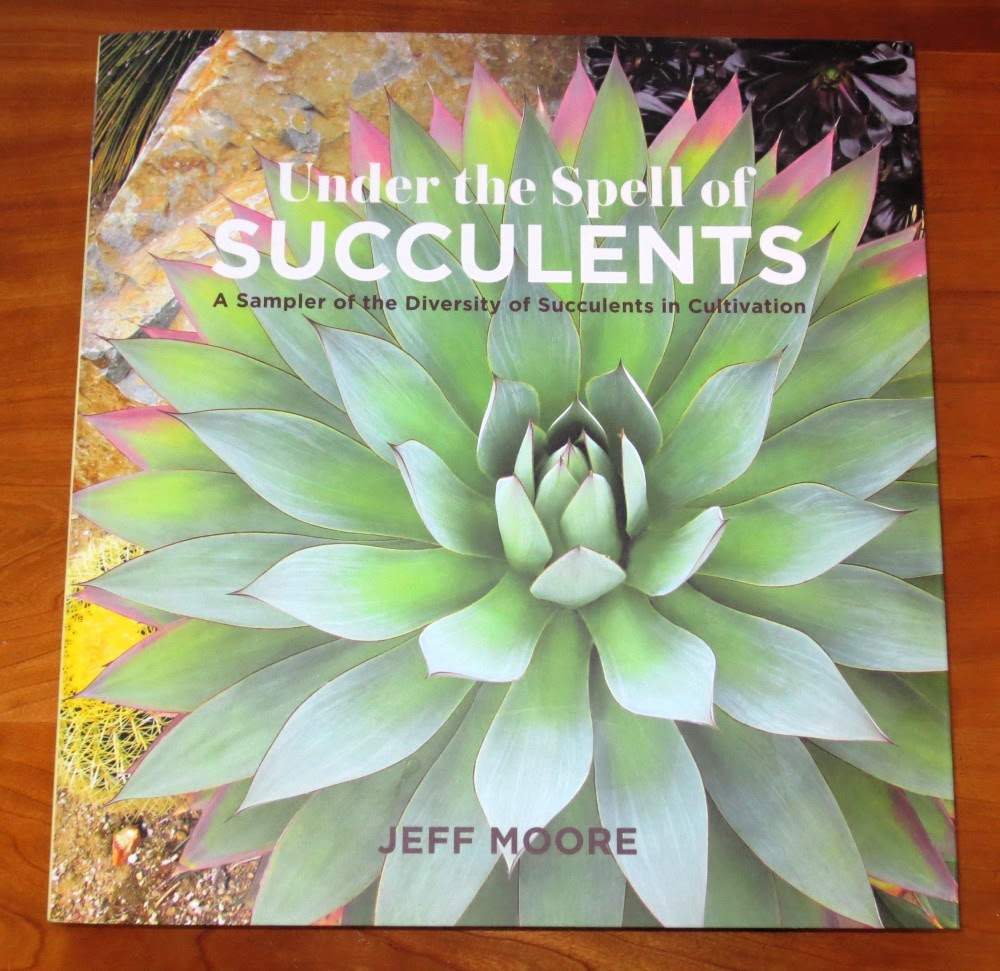
Back in October, when a friend and I made a mad dash through 6 nurseries in San Diego County, I picked up a copy of Jeff Moore's new book, "Under the Spell of Succulents," while visiting his nursery, Solana Succulents.  I was impressed as soon as I opened the book but I remained mum about the book because I decided to buy 3 more copies as Christmas gifts for friends.  I didn't want to ruin the surprise.

Front cover

Back cover


The subtitle on the book's cover describes it: it's an introduction to the wide variety of succulents available in cultivation.  It's loaded with beautiful photos - there are few pages without one or more and, unlike the succulents you find in most nurseries, the featured plants are labeled.  The book contains chapters on a variety of subjects from common topics, such as container and vertical gardens, to the special qualities of selected succulents, such as crests and caudiciforms ("fat plants").  Interspersed between the chapters are sections the author refers to as "interludes" which describe different genera.  Among other topics, Moore describes succulent theme gardens, including the use of succulents to create undersea style landscapes.  In fact, Moore gained a reputation for these landscapes when he designed an exhibit for the Del Mar Fair in 2002 and a permanent display for the San Diego Botanical Garden.  You can find photos on his website.  Coincidentally, when I visited his nursery, I picked up an octopus-like succulent, Dyckia marnier-lapostollii.


This is not a how-to book, although the author does offer advice based on his experience.  Its clearer purpose is to share the enthusiasm the author clearly feels for these plants.  The tone throughout is casual, akin to a discussion one might have with a garden club speaker.  There are no pretensions or heavy-handed lectures, just obvious enjoyment in these plants and a desire to share them. 

If you're interested in the book, you may face a challenge getting hold of a copy.  It's not available from Amazon or another large book retailer.  The softcover book is self-published.  You can contact the author directly through his nursery to purchase a copy or pick one up by attending events at which he is scheduled to speak, including one on January 12th sponsored by the San Diego Horticultural Society.  I bought the copies purchased as gifts for my friends on-line through a San Diego area bookstore.  

Note: This review wasn't requested by the author or any representative of the author and I wasn't compensated in any way for offering an opinion.  My purpose is solely to share a resource other succulent enthusiasts may appreciate.


 All material © 2012-2015 by Kris Peterson for Late to the Garden Party