Showing posts with label native plants. Show all posts

Friday, February 1, 2019

Madrona Marsh: Refreshed by rain

Earlier this week, I paid my second visit to Madrona Marsh, a 43-acre natural wetlands sandwiched between stores, business offices, gas stations, and condos in Torrance, California, about 9 miles from my home. 

This map is provided near the entrance to guide visitors


When I last visited just shy of one year ago, it was so dry the vernal pools (shown in pink in the map above) were empty despite the fact that it was the middle of our rainy season. 

This time, instead of dried mud, I saw this pool as I walked in.  It's depth measured just over a foot and a half.


Last year was the driest I can remember.  We recorded just 3.88 inches of rain here between October 1, 2017 and September 30, 2018.*  This year's rain total is already 276% of last year's total, albeit still short of our annual average.

I could hear birdsong from the moment I stepped inside the gate.  And frogs!  I haven't heard frogs croaking in years.  I didn't have binoculars so I didn't do any proper birding but ducks, geese and herons were readily visible throughout the preserve.

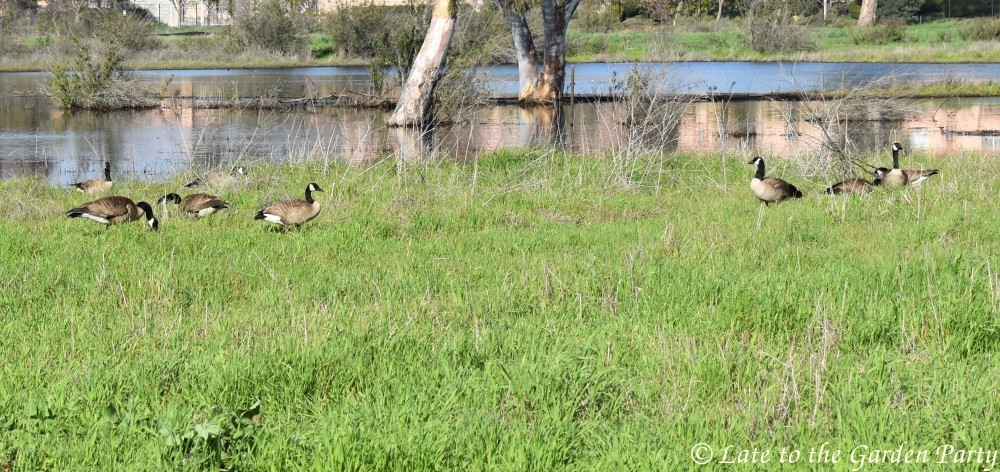


A path my husband and I walked last year was submerged and impassable.


A friend of mine had visited the marsh several days before I did to take photos as inspiration for future paintings.  Wild and unmanicured, I could see what impressed her about the landscape.  The color contrasts and the reflections in the water created picturesque scenes.
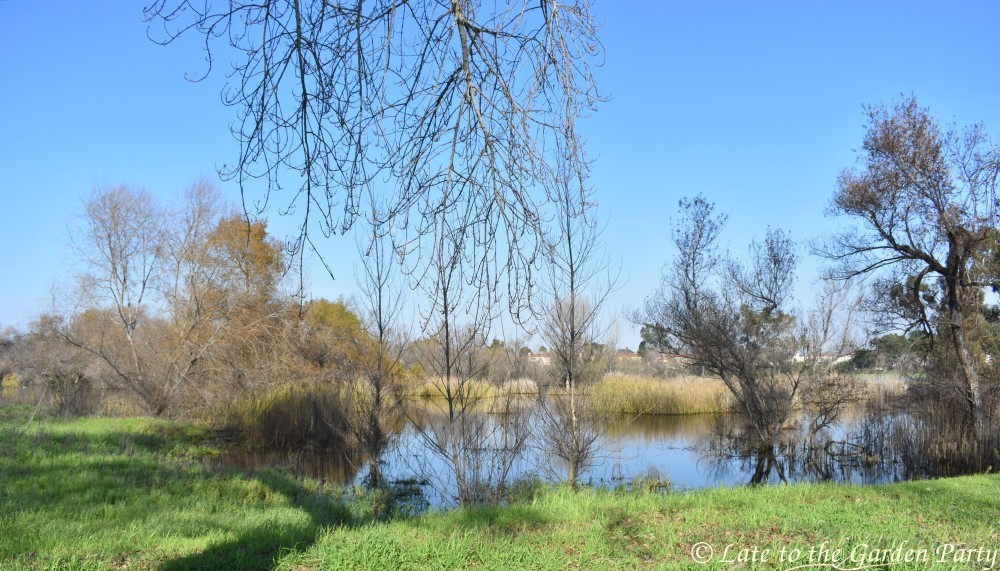
Tule, or wetland sedge, is visible throughout the areas with deeper water


Sometimes it was hard to tell what was solid and what was a reflection

I did my best to crop out neighboring buildings from my photographs but trust me: they ring the preserve on all sides.  Nonetheless, within the preserve you can almost forget that you're surrounded by traffic and all the usual vestiges of life in an urban environment.


After leaving the preserve, I made a brief spin through the Nature Center's native garden across the street.  There wasn't a lot in bloom - even landscapes in Southern California are muted during the winter months - but there was some floral color.

Once again, signs weren't helpful in identifying species by their botanical names

Clockwise from the upper left, my best guess on plant IDs are Calliandra eriophylla (aka fairy duster), Ceanothus, Eriogonum (aka buckwheat), Encelia californica, Verbena lilacina, and I haven't a clue

Along with Encelia californica, Peritoma arborea (aka bladderpod, shown here) was the most common flowering plant in the preserve


We got another three-quarters of an inch of rain yesterday and there are two more storms lined up to pelt us over the next few days.  Spring at the marsh may be very lively this year.  I hope to check it out again in April or May.  According to Wikipedia, after the rain stops, the water level in the marsh drops about one-quarter of an inch (6mm) a day, drying it out entirely by the end of August until the rains return the following winter.

Have a wonderful weekend!


*"Rain years" in California are calculated from October 1st through September 30th of the following calendar year.  Rain in SoCal is almost exclusively a winter/early spring phenomenon.


All material © 2012-2019 by Kris Peterson for Late to the Garden Party

Friday, February 9, 2018

Visit to Madrona Marsh Preserve

Did you know that much of Southern California's coastal area used to be marshland?  I didn't.  My husband and I visited the Madrona Marsh Preserve in nearby Torrance for the first time this week.  Hidden in plain sight, surrounded by condos, gas stations, retail stores and a stone's throw from a major shopping mall, neither of us knew much of anything about it.  I knew that it offered birds a sanctuary within this urban area, mainly because my mother-in-law, an avid birder, used to visit there to observe migrating birds.  I learned that it was scenic from a friend who visits seeking inspiration for her paintings.  But, despite passing the area more times than we can count during the years we've lived in the South Bay, neither of us had ever visited the Preserve.  Of course, visiting a marshland in the middle of the driest rainy season I can remember probably wasn't the best choice for our first visit but one takes these opportunities when they present themselves.  If nothing else, with the weather here still on the unseasonably warm side, it was a pleasant day for a walk.

The wetland preserve is comprised of 45 acres in the middle of the City of Torrance (see map here)


There were many signs within the gated Preserve to remind you of the fragility of the space.


This sign, posted on the back of the metal gates through which we entered, had me double-checking that I had my phone with me.


The Preserve boasts 9 vernal pools but with rainfall at record lows during this year's rainy season it wasn't surprising that they all looked like this:

The vernal pool areas featured sticks to measure the water level.  As best as I was able to tell, all measured zero.


We passed a biofiltration system before heading toward the wetland area.

This biofilter system is set up using a perennial grass from India to filter contaminants (heavy metals, pesticides, and other chemicals) carried into the area by urban runoff  before directing the water to other areas of the wetland.  It was dry at the time of our visit.

The flags along this path signify new native plantings.  Very little is currently in flower so you won't see my usual splashy flowers in this post.


As we approached the wetland area, we saw the grass-like tule first.  Tule (Schoenoplectus acutus) is a giant species of sedge native to the freshwater marshes throughout North America.


Some of those condos surrounding the Preserve are visible in the distance here


We could make out ducks from a distance but the paths kept us from getting too close and some areas were fenced off to protect them from being disturbed.

The reflections in the water showed me why the area attracts my painter friend


The Preserve's website has much better photos of the many birds known to migrate through the area, including hummingbirds, woodpeckers, hawks, egrets, and herons.  The Preserve's winged visitors even featured in a float at this year's Rose Parade.

This was my best duck photo.  My husband spotted 2 geese sunning themselves on a berm in the middle of the pond but my photo is too fuzzy to share.

When water levels are higher, I expect that many of these trees sit right in it


As we headed back toward the entrance, we spotted the on-site nursery, where native plants are grown to be planted out within the Preserve.


There are much better photos available on the Preserve's website, taken during greener periods.  We'll definitely visit again, hopefully after there's been some rain.  (I still have hope!)  There's ample parking outside the Nature Center across the street and entrance is free.

The Nature Center is surrounded by a more manicured garden featuring native plants


Although flowers were in short supply during our visit, I was attracted by a couple of natives and may hunt these down for inclusion in my own garden.

Bush sunflower, Encelia californica (left) and hummingbird sage, Salvia spathacea (right), are both low water use plants


Best wishes for a pleasant weekend!


All material © 2012-2018 by Kris Peterson for Late to the Garden Party