Showing posts with label Plectranthus ecklonii. Show all posts

Monday, September 27, 2021

In a Vase on Monday: Clamoring for attention

After waiting seemingly forever for dahlia and zinnia blooms, I now have several of each blooming at the same time in my cutting garden, all demanding attention.  With our weather subject to sharp changes - hot and dry for stretches at a time with cool and damp intervals in between - I'm inclined to cut them when they're looking their best rather than chancing their availability in later weeks.  Next year, I'll give more thought to growing plants that combine better with one another than those I'm growing this year.

Dahlia 'Break Out' produced its first bloom last week.  It was a soft cream with pale peachy-pink accents and, when examining it on Saturday, I envisioned combining it with flowers that picked up those peachy-pink tones.  However, when I went to cut it on Sunday morning, it had shifted more definitively to a vibrant pink, throwing my plans out the window.

I reused the vase I selected for Dahlia 'Loverboy' last week and some of the very same flowers as accents

Back view

Top view: the vase has a very narrow mouth, only about an inch wide at its center and slimmer as it tapers to each end, which limits what can be stuffed into it

Clockwise from the upper left: Abelia grandiflora 'Hopley's Variegated', Correa 'Wyn's Wonder', Leptospermum 'Copper Glow', Dahlia 'Break Out', and Zinnia elegans 'Queen Red Lime'

My second arrangement this week contains neither dahlias nor zinnias.  I've wanted to use the purple flowers of Plectranthus ecklonii (aka  tall spur flower) for some time.  I'd hoped to pair it with Dahlia 'Magic Moment'  but that plant, although now in bud, is taking its sweet time about blooming so I decided to go ahead before the Plectranthus finishes its season.

I stuck to a purple and white mix, making use of the Cosmos, which like the zinnias are in the process of succumbing to mildew

Stems of Vitex trifolia dress up the back view.  Although this plant is obviously prone to drooping when cut, I love its two-colored leaves, dark green on top and purple underneath.

Top view

Clockwise from the upper left: Angelonia 'Archangel White', Cosmos bipinnatus, variegated Pelargonium 'Lady Plymouth', Plectranthus ecklonii, and Vitex trifolia purpurea

Dahlias 'Enchantress' and 'Gitt's Crazy' were competing for a third slot.  As they most definitely aren't suitable to combine and as I wasn't prepared to create four arrangements, I went with 'Enchantress''Gitt's Crazy' will probably get a vase on my kitchen island within another day or two but I'll spare the reader a fourth arrangement.

This arrangement is admittedly gaudy, verging on garish

Back view: the coleus (Plectranthus scutellarioides) combines the bright pink of the dahlia with the red-wine color of the zinnia

Top view

Clockwise from the upper left: Coleonema pulchellum 'Sunset Gold', Dahlia 'Enchantress, Plectranthus scutellarioides 'Dragon Heart', and Zinnia elegans 'Benary's Giant Wine'

For more IAVOM posts, visit Cathy at Rambling in the Garden.


All material © 2012-2021 by Kris Peterson for Late to the Garden Party


Friday, September 30, 2016

September Plant Favorites

I have to thank Loree of danger garden for hosting a review of the plants that win favorite status each month.  At the end of summer in Southern California, it's hard to avoid looking at the garden with a jaundiced eye.  Entering the garden for the purpose of identifying what's looking good shifts the paradigm.  Yes, there's another dead Leucadendron and many plants are stressed by our current heatwave, but there are still a lot of plants delivering on the promise they held when I planted them.

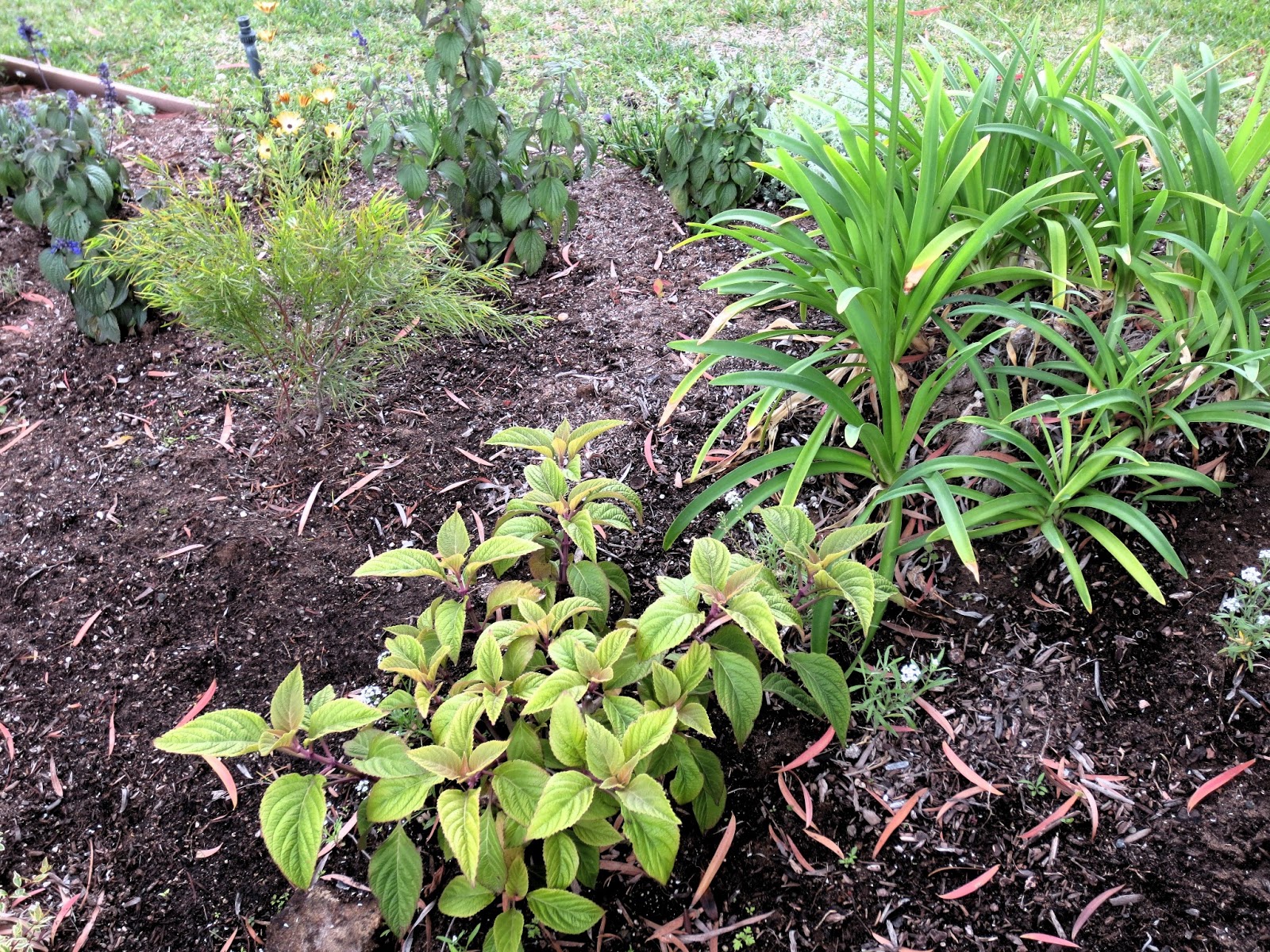
Planted last May and only a fraction of the 6 foot tall specimen it may eventually become, this Plectranthus ecklonii was happy enough to bloom.  My first 2 attempts to grow this plant failed, probably due to excessive sun exposure.  The grower recommends half day sun, which is roughly what it gets sitting behind a dense hedge with northwest exposure but it was still touch and go for a while this summer.  Extra water helped.

The Osteospermums seem to perk up when nighttime temperatures grow cooler.  They responded to that condition earlier this month by blooming in earnest.  Osteospermum '4D Silver', marketed as an improved version of '3D Silver' and offering blooms that remain open in low light, has been blooming non-step all month.  They're short-lived perennials in our climate.

Two of my current favorites are shown here: Phormium 'Tom Thumb' and Artemisia versicolor 'Seafoam'.  I planted 3 of each in July and all are doing well, which is remarkable as planting in July here is foolish at best.  'Tom Thumb' has an interesting form and bronze edges along its green leaves and it handles the afternoon shade in this location.  I've been so pleased by the 'Seafoam' that I recently ordered 6 more by mail when I couldn't find them locally.

With apologies for the sun-soaked photo on the left, I nonetheless wanted to share Hebe 'Purple Shamrock' in bloom.  I planted 3 of these small Hebes last November purely for their foliage, which makes me think of stained glass when it's backlit (as shown in a photo from last December on the right) but the dainty lavender blue flowers they produced this month are a bonus.

My photos of Trichostema 'Midnight Magic' aren't any better than that of the Hebe despite repeated attempts but I also couldn't let it go without notice this month.  I've killed at least 2 T. lanatum (aka woolly curls), a notoriously touchy California native, but this hybrid of T. lanatum and T. purpusii is far more forgiving.  After producing a few blooms now and again, it's rewarded me with lots of blue blooms this month.


The succulents generally pull their weight regardless of the weather so I don't always give them the scrutiny the shrubs and perennials get but a few did warrant attention this month.

Agave 'Jaws' Junior, seen in the photo on the left in front of 'Jaws' Senior, is growing at a remarkable rate.  I haven't decided whether to let him remain in the fraternal embrace or relocate him but I'm impressed by his size - just back in July, he was so small I almost stepped on him.  His growth led me to check the status of my other infant agaves.  I planted 7 A. desmettiana pups (see photo top right) along the front slope last year and all are also growing quickly.  Agave mitis 'Multicolor' (middle right), a gift from Denise of A Growing Obsession last year, started life as a bulbil of her plant (see Denise's post on this here) and is now 4 inches tall.  In contrast, Agave montana (lower right), possibly the tiniest agave I've ever received by mail order, is growing but slowly.

I don't like the flowers produced by most succulents but I do appreciate those produced by this still small Faucaria tigrina variegata.


A couple of very ordinary plants also caught my notice for very different reasons.

The flowers of Catananche caerulea (Cupid's Dart) are gone but I like the silvery bracts left behind even more

Helichrysum petiolare 'Licorice Splash', planted last year, has thrived under a tree in dry shade without attempting world domination as the common species is prone to do in my garden


Visit Loree to see what earned her notice and that of other meme participants this month.


All material © 2012-2016 by Kris Peterson for Late to the Garden Party

Monday, June 10, 2013

The "B" Side

There's a dirt path running along the main section of our backyard between the Xylosma hedge and the sloped area of the property on the other side of the hedge.  When we moved in, the border in front of the hedge was about half as wide as it is now.  The border itself pitched backward toward the slope so that only about half of its width was flat and level with the lawn.  As it's my intent to eliminate most of the lawn over time anyway, widening the border to expand it further into the flat area of the backyard was one of our earliest projects.  I thought I'd written about this project, completed in late Spring 2012, but as I can't find any posts specific to that project, I guess I haven't.  This is the best "before" picture I could find.

The Hebe speciosa 'Variegata' and and Osteospermum '3D Silver' are still part of the border but the area in front of them has expanded

The border immediately after the grass was removed - at its widest point, the border was extended 6 feet


I still use the dirt path regularly to care for the plants at the back of the border.  When I was back there a couple of days ago, I noticed how different the garden looks from that vantage point.  I think some areas actually look better viewed from that direction than they do when viewed from the house and lawn area.  It made me think of the "B" side of a record album.  I'm undoubtedly dating myself with this reference as I'm sure there are many people out there who've never listened to music recorded on vinyl.  In any case, the "B" side of the old vinyl records was generally used, not for a musician's hit songs, but rather for his or her more personal pieces.  That's how I think of the "B" side of my garden.  It's something I expect few, if any, of my friends will see (except here) - after all, how many people want to shuffle along a dirt path less than a foot wide where they're grabbed by plants on both sides?

Here are some pictures of the "B" side of my back border:

This is roughly where the dirt path begins, looking through the side yard area that formerly held the Eucalyptus tree toward the street

The 2 beds on either side of the walkway in the photo above appear to blend together better than I thought they did when viewed from the other direction, probably because the blue and yellow pansies aren't as prominent.  The pansies are waning now and will have to be pulled soon.


Back view of the area featuring Euphorbia 'Ascot Rainbow', Argyranthemum Madiera 'Crested Yellow', some infant lavender, and a self-sown borage

Viewed from either direction, I like how this small, newly planted section is coming together, although I think I should probably pull the borage.


This area will be a bit barren in the back until Acacia cognata 'Cousin Itt" and Plectranthus ecklonii mature

The Plectranthus ecklonii in the foreground of the photo above is happier in this location than the bed closer to the street where I had it until the Eucalyptus tree came down.  It likes the mix of sun and shade it get here.  In time it should get 6 feet tall and 4 feet wide.


The "golden" side of my border looks fuller from the back

From the lawn, I see a lot of bare spots in the section of the garden featured above but, from this perspective, it looks as though it's filling in well.  Most of these plants have been in the ground less than a year - some only for a couple of months.


Mid-border looking across the lawn toward the fountain and the main patio

From this perspective, I really like the way the mint bush (Prostanthera ovalifolia 'Variegata') complements the yellow yarrow (Achillea 'Moonshine') in the photo above.


Photo taken from several feet beyond the last picture and pointed back toward the side yard

I was afraid that the gold tones on one side of the border might clash with the pink and blue colors dominating the other side but, in the photo above, it appears that the blues of the lavender and Geranium 'Brookside' and the yellowish tint of the Mexican feather grass (Stipa tenuissima) are doing a good job of mediating the transition.


Moving past a large mass of Agapanthus toward the 2nd half of the border

A glimpse of the peony, no longer blooming, alongside Cuphea ignea 'Starfire Pink' and Mexican feather grass


A clump of fading alstroemeria bordered by foxgloves awaiting their 2nd flush of bloom and Hebe speciosa 'Variegata'

I love the first flush of bloom on the foxgloves (Digitalis purpurea) but I can't say I care much for how they look between flushes of bloom.  I may skip them here next year - as the surrounding shrubs and perennials fill out, there may not be space for them anyway.


A view of a Loropetalum I recently planted to replace a sickly member of the same species after pulling some of the surrounding foxgloves to provide more room

Agapanthus and an unidentified dormant daylily, now coming into its own, creating a temporary color clash with the last blooms of a nearby clump of alstroemeria, under the canopy of a large, multi-trunked Mimosa tree

The clash between the new blooms of the orange/red daylily and the pink Alstroemeria bother me less here than they do when viewed from the other direction.  In any case, the Alstroemeria will soon re-enter dormancy.

Although the front border was designed to be seen from 2 sides, I generally take pictures from the street side.  Here are pictures of its "B" side:

Photo of the back of the bed on the left side of the walkway taken from the lawn

Photo taken from the right side of the walkway

In both of the last 2 pictures, the Cuphea ignea 'Starfire Pink' already appear to be overwhelming the pink Meidiland roses, which show more clearly in street side photos.

Do you have "B" side views in your garden?  What do they tell you that you don't get from your "A" side views?