I've got hedges on my mind, in part because the
Strelitzia nicolai (giant bird of paradise) that formed a visual barrier between us and a neighbor on our north side was recently
cut to the ground and in part because the
Ceanothus hedges on our property are slowly dying. When I considered topics for today's Foliage Follow-up, the post-Bloom Day celebration of foliage sponsored by Pam at
Digging, hedges seemed the obvious topic.
We inherited a LOT of hedges with the house and garden we acquired almost 5 years ago. In fact, I hired a garden service for the first time in my life after we moved into our current home mainly because I realized it was going to be difficult to maintain all the hedges on our property (with or without my husband's help). By my count, 6 different types of hedges surrounded us:
Auranticarpa rhombifolia (aka diamond leaf pittosporum),
Ceanothus (no ID),
Laurus nobilis (aka sweet bay or Grecian laurel),
Prunus caroliniana (aka cherry laurel),
Xylosma congestum, and Y
ucca elephantipes. We even have hedges next to hedges.
 |
| This view from the backyard shows the Ceanothus hedge running alongside the Xylosma hedge. There's a path approximately 1 foot wide in between, which gives the gardener (or landscape service) space to maneuver in maintaining both. In the distance you can see another sort of hedge consisting of some kind of manicured shrub belonging to a homeowner in a neighborhood below us. |
 |
| Another set of hedges (Ceanothus on the left and Xylosma on the right) runs along the front of the property on the south side of the driveway |
Some hedges have held up better than others. The
Yucca at the bottom of our backyard slope may have been intended serve as a tree but it had turned into an impenetrable multi-trunk mass long before we moved in. Fearing that it had become almost uncontrollable,
my husband had it removed, leaving a gap I'm currently trying to fill with
Pittosporum tenuifolium.
I cut into the Auranticarpa hedge along the street on the southwest side myself in an effort to rejuvenate it but lost several of the component shrubs leaving gaps in the screen these plants once provided. However, I subsequently planted a
succulent bed in this area so I'm not inclined to restore or replace this hedge, especially as the
Auranticarpa tends to suffer from a permanent case of chlorosis.
The best of the hedges are those comprised of
Xylosma congestum, a plant that seems to have no common name. It forms a relatively dense boundary but air and light easily pass through it. It takes regular trimming in stride without developing a thicket of dead interior twigs. It also has glossy leaves with orange-tinged new growth.
 |
| Close-up of the new growth on Xylosma congestum |
A hedge made up of
Xylosma lines the main backyard border, providing a frame for our view of the Los Angeles harbor.
 |
| View looking southeast toward Angel's Gate, the entrance to the Los Angeles harbor |
 |
| View looking northeast |
The hedge neatly blocks our view of the neighbor's property from the backyard.
 |
| This taller portion of the Xylosma hedge, which divides my dry garden from the steps leading down to the back slope, also blocks my view of the neighbor's property |
 |
| This is the view that lies beyond the Xylosma hedge. The hedge in the foreground is comprised of Laurus nobilis, which lines our side of the neighbor's metal fence. |
A
Xylosma hedge also lines the front of the property, giving us some privacy from the street.
The worst of the hedge materials used on our property is
Ceanothus. While I love
Ceanothus in virtually all its incarnations, I don't think it should be used for hedges, at least not of the type created here. When combined with plants that are regularly irrigated as these shrubs were, they struggle. Worse yet, the regular trimming they're subjected to to keep them tidy and low creates and mass of dead growth below the surface and appears to undermine the plants' overall health. Or that's my theory anyway.
 |
| The Ceanothus hedge after a recent shearing to allow passage along the path between it and the Xylosma hedge in the front garden |
One by one, within the last year, the
Ceanothus shrubs making up the hedges in my front and back gardens have been dying. Their removal leaves large gaps.
 |
| The death of one section of the Ceanothus hedge here left a gap of more than 12 feet. With no particular plan in mind, I filled in the space with Aeonium and Pelargonium tomentosum cuttings. Although there's still a lot of soil showing, I'm rather pleased with how the space is filling in. |
 |
| However, the next section of Ceanothus hedge is about ready for removal. The photo on the left shows its best side but it looks sad when viewed straight on as in the photo on the right. |
Rather than try to recreate the
Ceanothus hedge behind the
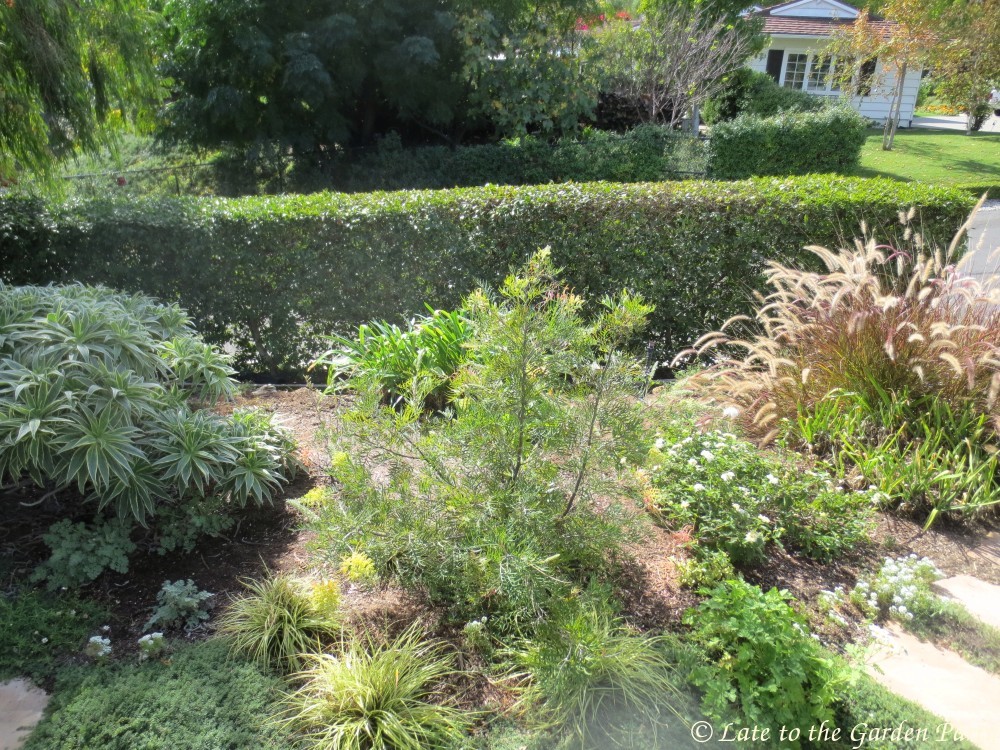
Xylosma hedge at the front of the house, I think I'm going to fill the area in with other plant material. I like the look of the
Pennisetum advena 'Rubrum' with
Pelargonium tomentosum (peppermint geranium) and
Aeoniums below and may continue that approach but I'm open to other suggestions!
What I'm going to do in the backyard is an open question. Although I've lost one section of
Ceanothus there, overall those shrubs are doing better than the ones in the front so I have some time to formulate a plan.
 |
| There was a Ceanothus shrub adjoining 3 others here to form a hedge directly behind the Xylosma hedge at the top of the slope. I'd like to plant something to fill in the space but I need to leave room to move behind the Xylosma for maintenance purposes. |
Got any ideas?
Fortunately, the
Laurus nobilis along the eastern border with the neighbor on one side and the
Prunus caroliniana on the southern border with the neighbor on the other side are holding up just fine.
For other views on foliage of all kinds,
visit Pam at Digging.
All material
© 2012-2015 by Kris Peterson for Late to the Garden Party