Wednesday, June 21, 2023

Managing ornamental grasses

Last week, as I walked through my neighborhood, I snapped a couple photos of a front garden up the street.  The garden, installed last summer, has a simple palette, dominated by Nassella tenuissima (aka Mexican feather grass, fromerly classified as Stipa tenuissima), Senecio serpens (aka blue chalksticks), and white-flowered Lantana with Agaves tucked in here and there.

It's hard to make out many of the Agaves as they're hidden by the masses of feather grass


That garden was installed by a professional landscaping firm.  I saw some follow-up activity immediately after the installation but I haven't seen any maintenance activity since.  I wondered what kind of guidance the firm may have provided the homeowners, especially related to controlling the spread of the feather grass, which is known to be invasive in California.

I have the same feather grass in my back garden in several spots.  I love the way it dances in the wind, especially when it's in flower.  I didn't have any significant problems with it the first couple of years but more recently I've learned just how readily it self-seeds.  I've pulled some of it out and I actively monitor and manage the rest.

These are before and after shots of a section of feather grass in my backyard border.  I rake through each clump of grass by hand, pulling out the flowers, as well as any dead material.  It takes hours and, by the time I've finished all of them, it's usually time to take another pass.

Ridding the garden of tiny seedlings is an endless task, made more tedious and time-consuming when they root in between paving stones and amidst groundcovers.  This is a before and after shot of one small area.


I've been in spring cleanup mode for the past couple of weeks.  I've cut back all the bloomed-out Aeoniums - well, almost all.  I keep finding more.  I'm pulling gobs of weeds and deadheading spent flowers, as well as cutting back shrubs that may run counter to new regulations for managing fire risk.  (All properties in my high fire risk area are subject to evaluation by the local fire department beginning this month.)  Rain is a double-edged sword, something that's been easy to forget in recent years.  While admiring one of my backyard beds this morning, I realized how dramatically many of the trees I had pruned by professionals in mid-December had fleshed out.  I spent an hour yesterday trimming back the smaller of the two Arbutus 'Marina', only making a small dent in its growth.

View of the bed containing 2 Arbutus 'Marina' (aka strawberry trees).  The smaller tree has just about swallowed up the Melianthus major and has encroached on the surrounding plants, including a Leucadendron 'Jester', a Grevillea 'Ned Kelly' (currently invisible) and a Leucospermum "Royal Hawaiian Brandi'.  I discovered that I had gladiolas and lilies (also almost invisible) growing in there too.

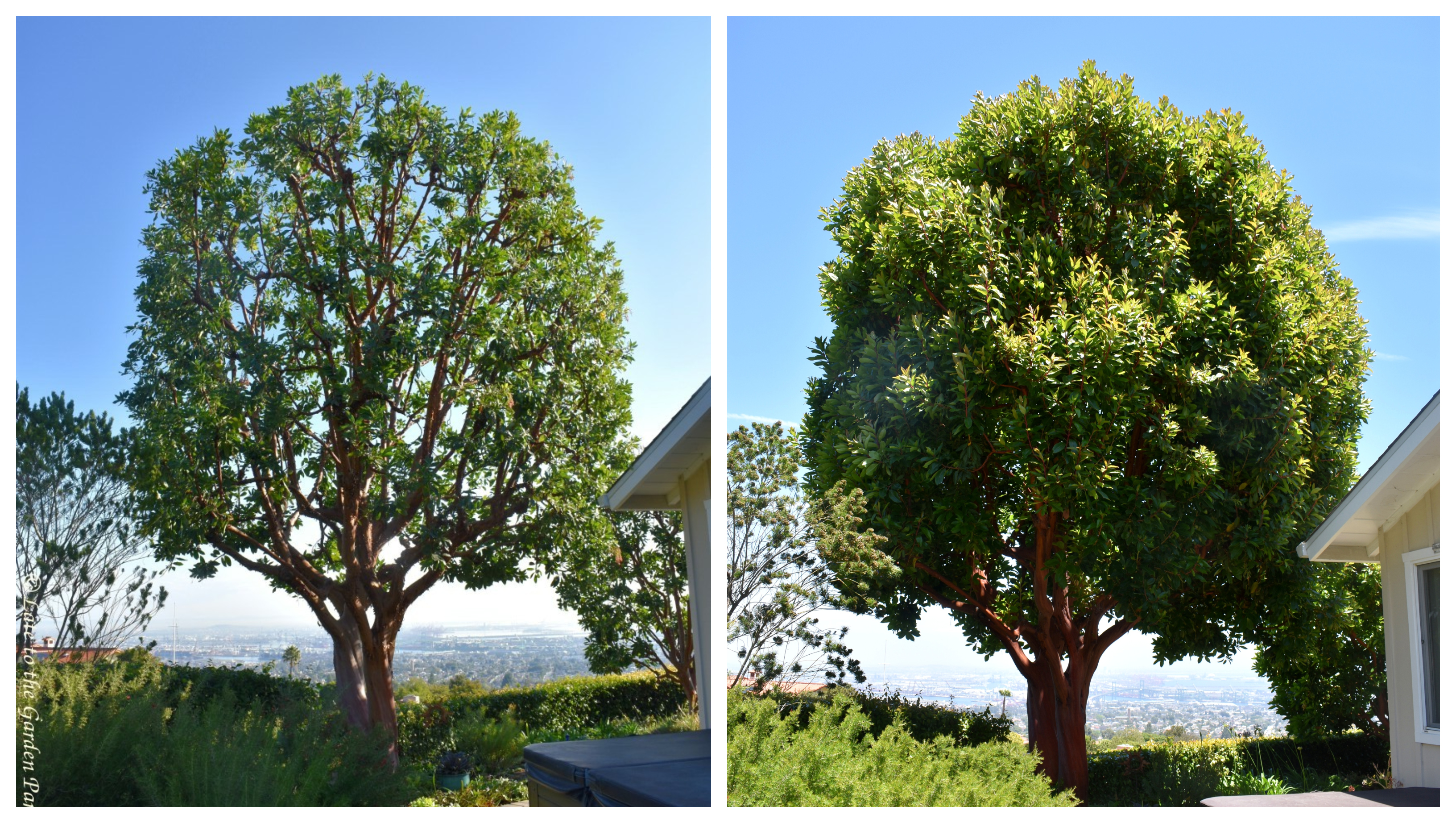
This is a comparison of the smaller Arbutus after its pruning in mid-December and now (after I gave it a light pruning yesterday)

I didn't even try to do anything with the larger Arbutus.  This photo shows it immediately after it was pruned in December and now, 6 months later.


Work on my cutting garden is ongoing but I expect to have an update on that later this week.  We've had a few sunny days in a row now so there's no time to waste.

The fact that Pipig has voluntarily left her heating pad behind and retreated to her catio is proof that we've had warmer temperatures at last


All material © 2012-2023 by Kris Peterson for Late to the Garden Party

Monday, June 19, 2023

In a Vase on Monday: Sweet peas

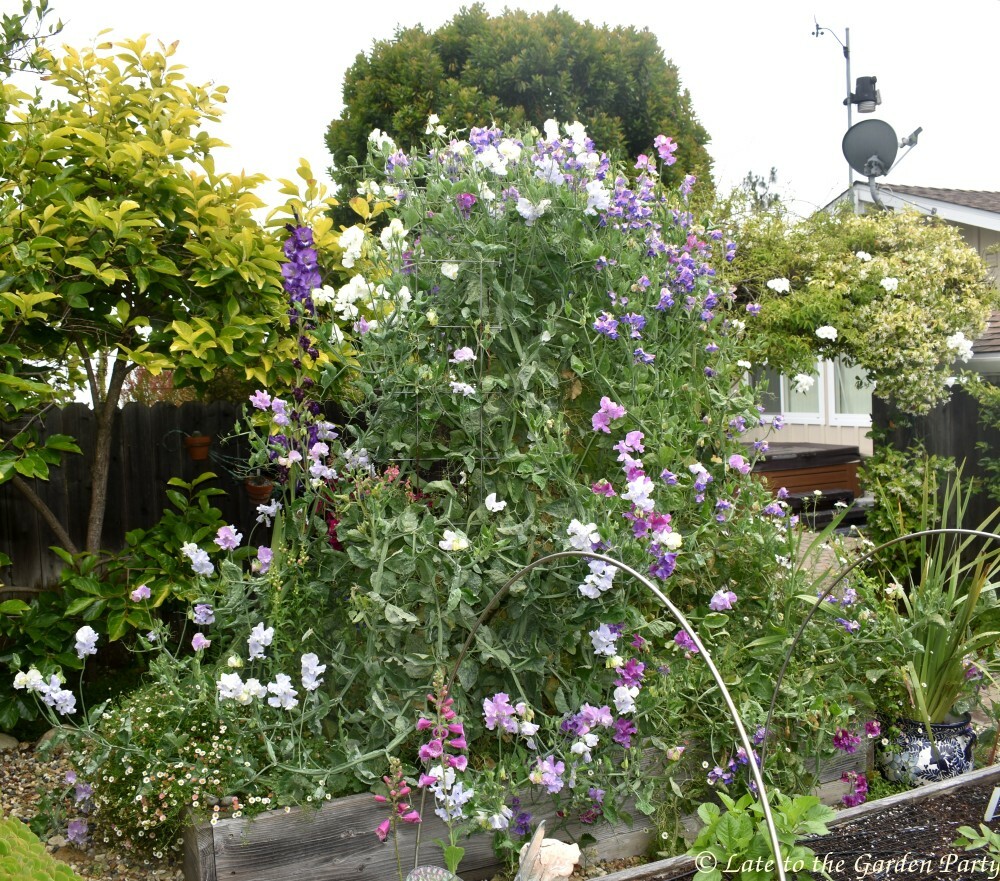
I considered pulling out my sweet pea vines when I cleared most of my cutting garden of the rest of the cool season annuals.  As the result of our cooler temperatures, they'd gotten a slow start and our persistent marine layer encouraged the foliage to mildew.  However, as the sweet peas stepped up production, I found it hard to let them go.  A few sunny afternoons and, all of a sudden, there are more flowers than I can cut.

A lot of those sweet peas are too tall for me to reach without a ladder

In addition to a varied combination of sweet peas, I added 2 stems of Gladious 'Vuvuzela' growing in the same raised planter

Back view: I also cut 3 foxglove stems

Top view

Clockwise from the upper left: Digitalis purpurea 'Dalmatian Purple', D. 'Dalmatian White', Gladiolus 'Vuvuzela', Lathyrus odoratus 'Blue Shift', L. 'Dancing Queen', L. 'Enchante', and L. 'Oban Bay'


My second arrangement was inspired by one of the first lilies to make an appearance this year.

I used the lily as my centerpiece even though it was still in the process of opening

I cut 3 more stems of the 'Golden Celebration' rose this week to dress up the back of the arrangement

Top view

Clockwise from the upper left: Abelia grandiflora 'Kaleidoscope', Achillea 'Moonshine', Alstroemeria 'Claire', Lilium 'Conca d'Or', Lagurus ovatus, Orlaya grandiflora, Prunus lilcifolia, and Rosa 'Golden Celebration'


I'd cut a few stems of Centaurea 'Silver Feather' to include in the first arrangement but they looked wonky so I cut them down in size and threw them into a small vase with more sweet peas for the kitchen island.

The small vase contains Centaurea 'Silver Feather' and Lathyrus odoratus x belinensis 'Erewhon'


For more IAVOM creations, visit Cathy at Rambling in the Garden.


All material © 2012-2023 by Kris Peterson for Late to the Garden Party

Friday, June 16, 2023

Who can pass up turquoise flowers?

I planted a Puya berteroniana  in 2014.  It's a bromeliad that produces dramatic turquoise flowers but, thus far, I haven't seen a single sign of one.  When the local botanic garden announced they had not one but two species of Puya in bloom, I decided to pay an impromptu visit to check them out.

This Puyu alpestris was already looking a little scruffy by the time I paid my visit earlier this week but those turquoise flowers were impressive nevertheless

Even with directions as to its location, I had to ask one of the gardeners for help in locating this Puya venusta.  It had already bloomed out and blended into its surroundings.  You can find a photo of what it looks like in flower here.

Here's a photo of the sad-looking Puya berteroniana in my street-side succulent bed.  Although it's been in the ground nearly 9 years, it was virtually smothered by an Agave desmettiana for several years.  It might bloom someday.  Its flowers are very similar to Puya alpestris, as shown here.


The two Puya species were a considerable distance apart and I walked the full length of the 87-acre garden to find the second one.  In the process I snapped photos of numerous plants, including several trees.

The flaxleaf paperback trees (Melaleuca linariifolia) trees were blooming near the first Puya

The shaving brush tree (Pseudobombax ellipticum 'Alba') was blooming in the Desert Garden

My guess is that this tree in the Mediterranean Garden is a blue elderberry (Sambucus cerulea)

Much of the Banyan Grove is fenced off due to construction but those tree roots are always worth a photo


The construction work in the garden is ongoing.  The plan, at least partially, seems to encompass the Banyan tree grove, or as the plan refers to it, the "fig forest."

So far most of the work on the new Children & Family Garden set to open sometime in 2024 seems to involve moving dirt and creating massive berms.  I saw some new signs that hint more clearly at what the new 3.5 acre garden will look like.


Other plants of note during my visit include the following:

I wasn't sure what this was but my cell phone identified it as a Cordyline stricta

The sign on this one identified it as a Mexican grass tree (Dasylirion longissimum).  I have one in my own garden and can only hope I can keep it looking tidier than this one.

I think this is a Dyckia, another member of the bromeliad family

The Fuchsias were hitting their stride

An oriental poppy of some kind with petals the color of watermelon

A mass of Salvia leucantha (Mexican bush sage)


We got some sun at intervals yesterday afternoon and we may get more this weekend too.  Have a colorful weekend!

A friend dropped off a bouquet of dark pink peonies as a belated birthday gift as we were unable to go out to lunch to celebrate.  I added sweet peas from my garden.


All material © 2012-2023 by Kris Peterson for Late to the Garden Party


Wednesday, June 14, 2023

Bloom Day - June 2023

I'm posting my photos for Garden Bloggers' Bloom Day a day early this month.  I'm not going to replicate the laborious approach I took last month.  This time around, with a few exceptions, I've organized my photos by color rather than the area the plants were growing in.  I've highlighted a few blooms in each category, throwing the rest into collages.


Yellow Flowers

This Helichrysum thianschanicum 'Icicles' isn't a plant I'd usually show off in a Bloom Day post.  In fact, I generally cut off the flowers as soon as they appear but I didn't have the energy to do that this year.  I let it do its thing and I discovered I like it!

Achillea 'Moonshine' is a summer star.  I thought much of it had died back last year and I'd been looking for replacement plants when it showed up looking as good as ever.

Crassula pubescens produces stems with tiny yellow flowers every year at this time.  With sun exposure, the leaves and stems turn red but there's been relatively little sun of late.

Clockwise from the upper left are: Arctotis 'Large Marge', Cotula 'Tiffindell Gold' (which seemingly returned from the dead this year), Helichrysum amorginum 'Ruby Clusters' (shown after the ruby buds turn yellow), Hymenolepis crithmifolia, Leucospermum 'High Gold' (mixed with yellow Gazanias), Dyckia choristaminea 'Frizzle Dazzle', Tagetes lemmonii, and Santolina chamaecyparissus


Orange Flowers

I inherited this plant with the garden and I'm still not sure whether its Campsis grandiflora or Bignonia capreolata but I'm going with the latter

Grevillea 'Superb' is still pumping out blooms like there's no tomorrow

Top row: Aloe striata x maculata, Callistemon 'Cane's Hybrid', and Cuphea 'Vermillionaire'
Second row: Digitalis purpurea 'Dalmatian Peach', Graptoveria 'Fred Ives', and Grevillea 'Poorinda Leane'
Third row: Grevillea 'Peaches & Cream' shrub and floral closeup and Lantana 'Irene'


Red Flowers

Feijoa sellowiana (pineapple guava) still in full flower.  The flowers of a second tree have been stripped off by mockingbirds but they seem to have ignored this one.

Clockwise from the upper left: Gaillardia 'Arizona Sun', Helleborus 'Anna's Red', Hemerocallis 'Spanish Harlem', Lobelia laxiflora, Lotus berthelotii 'Amazon Sunset', and Pelargonium peltatum 'Dark Burgundy'


Pink Flowers

Centranthus ruber is no longer at its peak but it's still plentiful

Epiphyllum 'Monastery Garden', potted up in 2018, just produced its first bloom and there are more buds.  I caught the bloom a little past its prime I think.

Clockwise from the upper left: Arctotis 'Pink Sugar', noID Dianathus, Grevillea sericea, closeup of Cistus 'Sunset' followed by a larger photo of the shrub, and Oenothera speciosa


White Flowers

Arthropodium cirratum (Renga lily) is in full flower

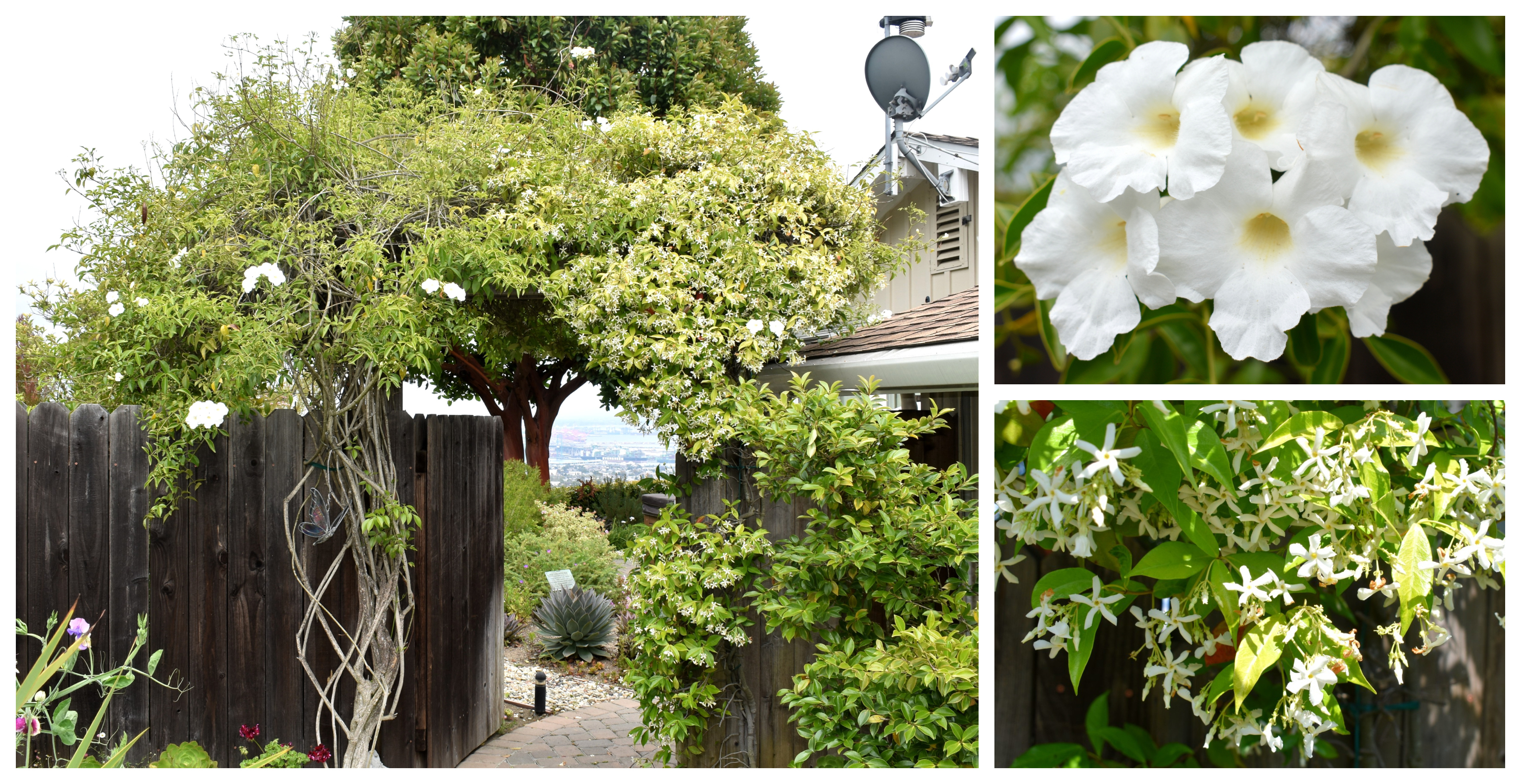
Pandorea jasminoides and Trachelospermum jasminoides have joined forces

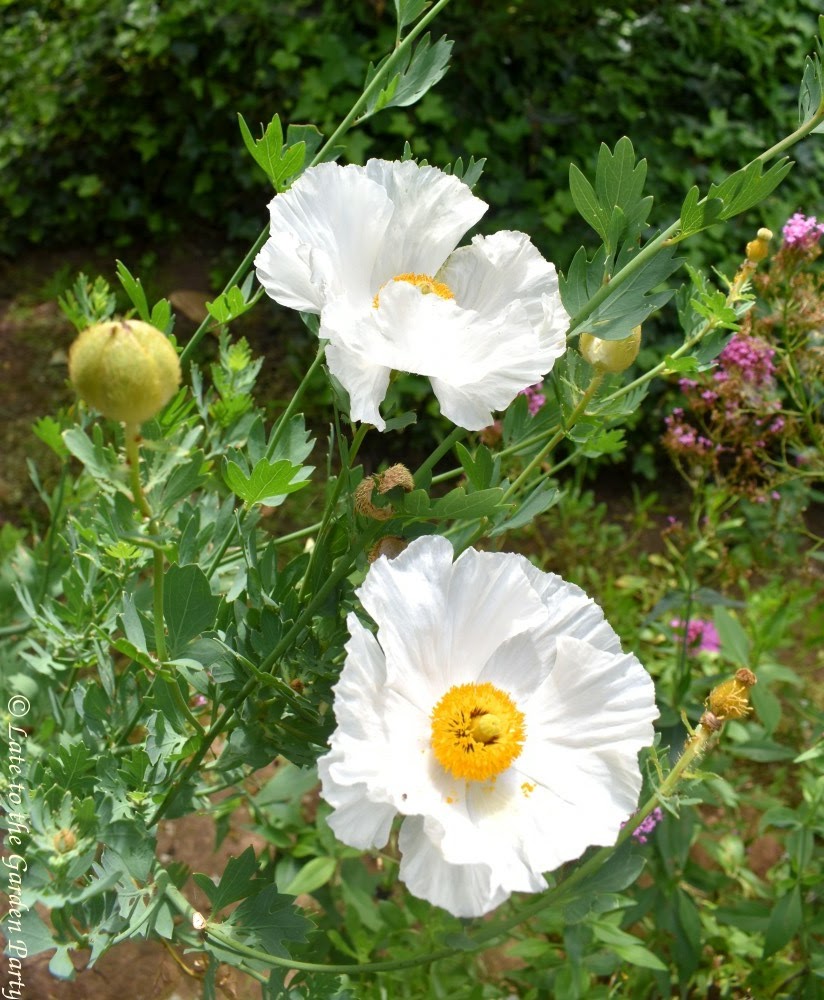
The Matilija poppies (Romneya coulteri) are still blooming at the bottom of my back slope.  Some of the tall stems obliged me by bending over so I could photograph the flowers.

Clockwise from the upper left: Fuchsia 'Windchimes White', Gaura lindheimeri, Lagurus ovatus, and Pelargonium tomentosum


Blue Flowers

This is officially the first Agapanthus to open in my garden but there's a legion of buds right behind it

My first Eryngium planum 'Blue Glitter', which I planted in the wrong spot at the edge of the border

Salvia clevelandii 'Winnifred Gilman' is gearing up to welcome summer when the sun returns

Left to right: blue Anagallis monellii (mingling with its orange cousin), Felicia aethiopica, and Penstemon heterophyllus


Purplish Flowers

Polygala myrtifolia (sweet pea shrub)

Salvia canariensis var candissima

Top row: Abelia 'Chiapas', Centaurea 'Silver Feather', and Erigeron glaucus
Second row: Gladiolus 'Vuvuzela', Limonium perezii, and Lupinus propinquus
Third row: Oscularia deltoides, Pelargonium peltatum 'Lavender Blizzard', and Teucrium cossonii majoricum


I'll close with what I characterized as exceptions in the introduction of this post.  Each of the following collages features plants in the same genus.  They vary in color and, in many cases, location within the garden.

Alstroemeria (Peruvian lilies), clockwise from the upper left: 'Claire', 'Inca Sundance', 'Inca Husky', 'Indian Summer', noID pink, 'Inca Vienna', and 'Third Harmonic'

Argyranthemum frutescens (marguerite daisies), clockwise from upper left: 'White Butterfly', 'Grandaisy Yellow', 'Grandaisy Red', and 'Pink Comet'

The Lathyrus odoratus (sweet peas) vines have grown well above my head.  Clockwise from the upper left of column 2 are 'Blue Shift', 'Dancing Queen', 'Enchante', 'Erewhon', 'Lavender Ice', and 'Oban Bay'.  Only the 'Turquoise' variety I planted from seed didn't show up.

I don't do well with roses but I have several in bloom at the moment, including, clockwise from the upper left: 'Golden Celebration', 'Lady Emma Hamilton', 'Joseph's Coat'. and 'Pink Meidiland'


That's it for this month.  For more GBBD posts, check in with Carol of May Dreams Gardens on June 15th.


All material © 2012-2023 by Kris Peterson for Late to the Garden Party