Wednesday, June 20, 2018

Wednesday Vignette: Gold, green and blue

I have a grab-bag of visual vignettes again this week, all featuring colors that drew my attention for one reason or another.  The first features the golden glow that was cast over the Los Angeles Harbor on Sunday evening.  The effect never lasts long and I did a less-than-optimal job of capturing it with my camera but I wanted to share a semblance of its magic anyway.

The effect occurs periodically as sunset nears when a break in the clouds allows the sun to spill its light over a segment of the horizon, leaving the surrounding areas in shadow

This zoom view shows the effect more clearly


The second vignette features my green-eyed cat, Pipig, who became enamored with a cardboard box sitting at the front door waiting to be carried to the recycle bin.

Pipig used to love boxes but, as she's gotten older, she's shown less interest in them.  She's very fond of this one and sits in it frequently (at least during her limited waking hours).  For that reason, it's still sitting in the entryway.


The last photo features the vivid blue color of Salvia cacalifolia.  I neglected to include any of my Salvias in my last Bloom Day post and as I seldom get a good photo of the blooms on this one I wanted to share it.

Is that blue cerulean or more of a cobalt?  I couldn't decide.


For more Wednesday Vignettes, visit Anna at Flutter & Hum.


All material © 2012-2018 by Kris Peterson for Late to the Garden Party

Monday, June 18, 2018

In a Vase on Monday: One hot, one soft

It hasn't been really hot here yet so, despite the fact that the official start of summer is just days away, the garden is still flush with blooms.  I'd originally planned to cut some blue flowers but they weren't what called to me when I stepped into the garden on Sunday to make my selections for "In a Vase on Monday," the weekly challenge hosted by Cathy at Rambling in the Garden focused on creating arrangements from materials found in one's own garden.  The hot corals, oranges and reds drew me and I ended up with an arrangement that practically sizzles.  I started off with stems of Grevillea 'Superb', a shrub that literally blooms year-round in my garden.

As usual, I stuffed my vase fuller than I'd originally intended but there's a LOT in this color range in my garden

The tubular Bignonia capreolata were a last minute addition.  I'm not sure they'll last long in the vase but they do make a dramatic statement.

The Cuphea and Coleus are elements I don't commonly use in vases either

Clockwise from the upper left, the vase contains: Achillea 'Moonshine', A. millefolium 'Appleblossom', Bignonia capreolata, Cuphea 'Vermillionaire', Gaillardia 'Arizona Sun', Grevillea 'Superb', and, in the center, Plectranthus scutellariodes 'Campfire' ( aka Coleus 'Campfire')


Blue flowers would have created a nice balance for the hot colors of my first vase but the dahlia I brought home from my local garden center two weeks ago is already sporting a number of mature blooms.  The heavy head of one unsupported flower had already broken its stem so I elected to feature Dahlia 'Otto's Thrill' again this week.  Upon close examination, I noticed that one of the dahlia stems had produced an odd double-headed bloom.

I should have photographed the mutant dahlia stem before I stuck it in a vase so you could see the fused stem leading up to the two-headed flower.  This appears to be yet another example of fasciation, similar to that I found in two of my Agapanthus stems last week.


The choice to cut the dahlia blooms also prompted me to cut the last of the snapdragons in my cutting garden.  After weeks of damp mornings due to persistent "June Gloom," the snapdragon foliage was covered in rust so they had to go.  Due to the cool weather we enjoyed in May and early June, I'd delayed clearing both the snapdragons and my sweet peas from my cutting garden, which in turn delayed planting many of my sunflower and zinnia seeds.  Hopefully, they'll still have adequate time to grow before the heat here becomes brutal.

In cutting the dahlia stems long, I gave up several ancillary buds but my hope is that this will prompt the plant to produce new stems

This is another instance in which I almost prefer the back of the vase to the side I'd designated as the front

Top view, showing that I also overstuffed this vase

Clockwise from the upper left, the vase contains: Dahlia 'Otto's Thrill', Abelia grandiflora, Antirrhinum majus, Leucanthemum x superbum' Dorycnium hirsutum, and Pandorea jasminoides


For more Monday vases, visit our host, Cathy at Rambling in the Garden.

The "hot" vase sits on the dining room table and the "soft" vase in the front entry


All material © 2012-2018 by Kris Peterson for Late to the Garden Party

Friday, June 15, 2018

Bloom Day - June 2018

Despite the heat that's been scorching some areas of Southern California and a flurry of wildfires across the Southwest US, we're still benefiting from an early morning marine layer most days here, which has held local temperatures down thus far.  I anticipate the situation is temporary but we're expecting below average temperatures (low 70sF) this weekend and I'm going to enjoy that while I can.  Summer flowers have begun showing up in earnest and the late spring blooms have yet to take cover from the heat so the garden is colorful to say the least.

Unequivocally, the stars of my June garden are Achillea 'Moonshine' and the Agapanthus.

I've lined both sides of the flagstone path in the middle of the back garden with 'Moonshine'.  On this side of the path, the yellow color is mirrored in the tiny blooms of Cotula 'Tiffendell Gold' and the foliage of Coleonema pulchellum 'Sunset Gold'.

Clumps of Agapanthus are spread throughout the garden.  Most bloom in shades of blue but there are some white blooms too.

The front garden is especially colorful right now, as you can see from the photo on the left.  The highlights include: more Agapanthus, Gaura lindheimeri, Hemerocallis 'Spanish Harlem', Cuphea 'Starfire Pink' and Rosa 'Pink Meidiland'.


While the Echiums are fading, the daylilies are pumping out new blooms

Echium candicans 'Star of Madeira', shown here, is waning and I've already cut back the spent bloom spikes of Echium webbii (not shown) in the back garden

New blooms of (left to right) Hemerocallis 'Indian Giver', 'Plum Perfect' and 'Spanish Harlem' greet me every morning.  'Spanish Harlem' has been especially prolific this year despite our very dry winter.


Like the front garden, some areas of the garden are putting on an especially strong show this month.

The bed shown on the left sits outside my home office window.  Clockwise from the upper right, the blooming plants include: Grevillea 'Ned Kelly', Lantana camara 'Irene', Leucanthemum x superbum, Leucospermum 'Brandi', Lobelia laxiflora, the first ever bloom I've had on Melianthus major, and Phylica pubescens.

The arbor over the gate between my cutting garden and my dry garden is once again blanketed in blooms this June.  The photo on the left shows the view from the cutting garden and the photo on the upper right shows the view from the dry garden side.  The flowering plants include: Pandorea jasminoides, a dark pink flowered Pelargonium peltatum that's chosen to climb, and Trachelospermum jasminnoides.

On the back slope Bignonia capreolata is sprawling over property boundaries into two neighboring gardens (photos top and lower left).  It's a beautiful but aggressive plant.  I didn't put it in but its trunk sits on our property.  I believe the neighbor on our north side planted it as she'd originally gardened on our lower slope, believing it was part of her lot until a prior owner of our property had an official survey done.


A few other areas offer more subtle displays of color.

In addition to Catananche caerulea and Convolulus sabatius, there's some noID Brachyscome and thyme in the mix here

Crassula pubescens ssp radicans has filled in the areas between various agaves and aloes on the south side of the house

Penstemon x mexicali 'Carillo Purple' and Polygala fruticosa 'Petite Butterfly' provide subtle color echoes of one another here


And here are some other plants just too pretty to ignore.

NoID Anigozanthos

Arbutus 'Marina'

Eustoma grandiflorum (Lisianthus) - so far, most of the blooms have been produced by the blue-purple varieties.  This is 'Rosanne Black Pearl'.  It didn't flower well last year but the plants that lived to bloom a second year look better than the first year blooms.

Gaillardias 'Arizona Sun' (left) and 'Fanfare Citronella' (right)

Globularia x indubia - it's also known as Globe Daisy but I call it my hairy blue eyeball plant

Hesperaloe parviflora 'Brakelights'

Magnolia grandiflora

Melaleuca thymifolia - the plant itself looks ungainly but the blooms are extraordinary

Romneya coulteri (aka Matilija Poppy), beloved by bees


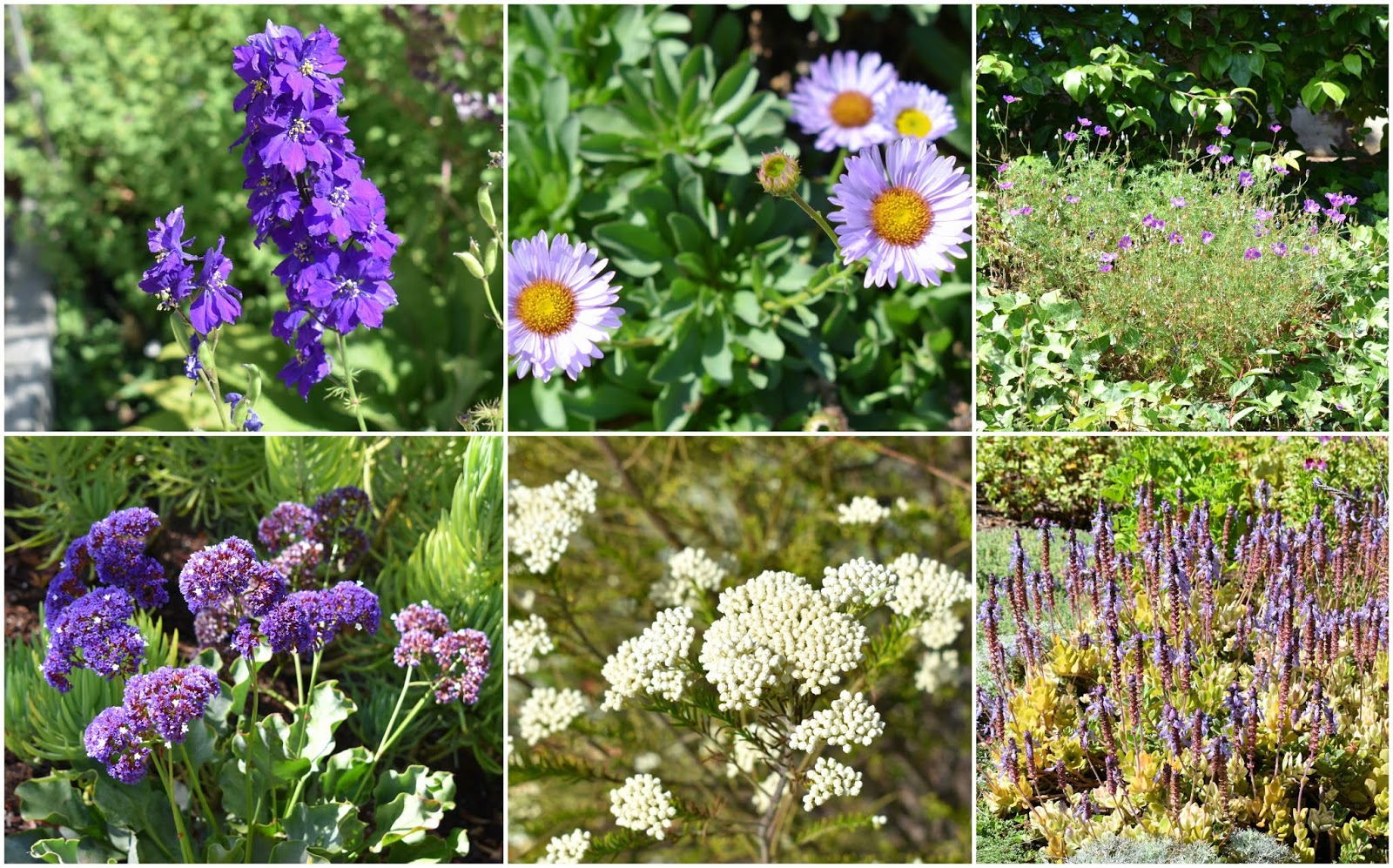
I'll close with a few collages capturing the best of the rest.

Top row: Consolida ajacis, Erigeron glaucus 'Wayne Roderick', and Geranium incanum, a weed in an unreachable spot
Bottom row: Limonium perezii, Ozothamnus diosmifolius, and Plectranthus neochilus

Clockwise from the upper left: Alstroemeria 'Indian Summer', self-seeded Anagallis 'Wildcat Mandarin', Cotula 'Tiffendell Gold', Euphorbia 'Dean's Hybrid', Grevillea 'Peaches & Cream', Hunnemannia fumariifolia 'Sunlite', Hymenolepsis parviflora, Tagetes lemmonii, and, in the center, Grevillea 'Superb'

Top row: Abelia grandiflora, Antirrhinum majus, Cistus x skanbergii, and C. 'Sunset'
Middle row: Dorycnium hirsutum, Grevillea 'Scarlet Sprite', Hebe 'Wiri Blush', and Leptospermum scoparium 'Pink Pearl'
Bottom row: Mimulus 'Jelly Beans Crimson', Pelargonium peltatum, P. cucullatum 'Flore Pleno', and P. 'Pink Blizzard'

And a fond farewell to Lathyrus odoratus, the remains of which I pulled out of my cutting garden on Wednesday evening


For more Garden Bloggers' Bloom Day posts, visit our host, Carol of May Dreams Gardens.


All material © 2012-2018 by Kris Peterson for Late to the Garden Party

Wednesday, June 13, 2018

Wednesday Vignette: Little wonders

Instead of focusing on a single event in the garden or otherwise, my Wednesday Vignette features three images that captured my interest this week.  They're unrelated except that each gave reason to pause and feel wonder at nature's mysteries.

I've expressed concerns about the large mimosa tree (Albizia julibrissin) that serves as a centerpiece of sorts in my backyard garden.  It produced a few random sprigs of foliage off-season this past winter, then failed to leaf out as normal in March.  In late May, it was still bare and, with evidence of shot hole borer, I said I thought it was a goner.  Within a week or so of that pronouncement, I finally began to see leaves appear throughout its canopy.

The tree isn't leafing out uniformly and the coverage doesn't begin to approach what would be normal for this time of year but the event may have earned the tree at least a temporary reprieve


The next surprise showed up among my Agapanthus, which are nearing the peak of their annual bloom cycle.  In one area, I located two mutant stems, each sporting two separate flowers.

In addition to producing a normal flower at the terminus of its stalk, the stem in the foreground shows a second smaller flower emerging mid-way down the stem.   Another such stem can be seen in the background.  An example of fasciation perhaps?


The last observation wasn't unexpected like the first two but it did make me smile.

After rolling about in the anthers of a Matilija Poppy (Romneya coulteri), this bee took off locked and loaded (with sacs of pollen)


For more Wednesday Vignettes, visit Anna at Flutter & Hum.


All material © 2012-2018 by Kris Peterson for Late to the Garden Party

Monday, June 11, 2018

In a Vase on Monday: Experiments

I tried some new combinations of flowers for "In a Vase on Monday" this week, with mixed results.  I'm relatively pleased with the first one, although I think a vase with a wider mouth might have given the arrangement a looser, more pleasing structure.

The starting point for this vase were recent blooms of Arthropodium cirratum (aka Renga Lily).  It's one of my favorite flowering plants; however, its plentiful but small blooms often get eclipsed by larger blooms when they're combined in a vase.

Back view: This time, with the exception of 3 Shasta daisies, I combined it with other smallish blooms

Top view

Clockwise from the upper left, the vase contains: Arthropodium cirratum, Centaurea gymnocarpa, Polygala fruticosa 'Petite Butterfly', Leucanthemum x superbum, and Pelargonium cucullatum 'Flore Pleno' (which isn't as fuchsia in color as it appears in the photo here)


After finding that I'd managed to lose 3 dahlia tubers to rot, I picked up a new plant from my local garden center a few days ago.  It already had buds and I cut one open bloom with little thought as to what I had available to combine with it.  The dahlia, 'Otto's Thrill', is pink with yellow highlights.

This is a mature bloom I cut when I put the plant in the ground last week


I've noticed that pink flowers can be a surprisingly difficult to mix as some have strong yellow undertones while others are decidedly blue.  I sat the flower I'd cut down next to Lantana 'Irene' which varies in color from yellow to pink to fuchsia and decided on the spot to try them together.

Although the 'Irene' is described as a mix of yellow and pink, it reads as more orange than pink here.  I considered removing both the Lantana and the yellow Achillea but that made the arrangement dull to my eyes so I left it alone.

Back view: I reused the Heuchera blooms from last week

Top view

Clockwise from the upper left, the vase contains: Dahlia 'Otto's Thrill', Achillea 'Moonshine', Heuchera maxima, Leucadendron salignum 'Chief', Leptospermum scoparium 'Pink Pearl', and Lantana camara 'Irene'


I'd cut stems of a peach-colored sweet pea too but it was way too far off for the second vase so I tossed those stems into a tiny vase with other leftovers.

The ancillary buds of Eustoma grandiflorum 'Black Pearl' (Lisianthus), used in one of last week's vases, had bloomed and the stem was still in good shape so I combined it with stems of Lathyrus odoratus 'Blue Vein', a small off-shoot of Arthropodium cirratum, and the foliage of Abelia 'Hopley's Variegated'.  The smoky purple Lisianthus flowers might have been better with the foliage alone but it was a chance to show off the blue veins of the sweet pea before I pull all of them.


For more Monday vases, visit our host, Cathy at Rambling in the Garden.


All material © 2012-2018 by Kris Peterson for Late to the Garden Party