Saturday, February 15, 2020

Bloom Day - February 2020

Coastal Southern California really only has two seasons - a cool season during which we get rain (if we're lucky) and a warm-to-hot season, which seems to be getting longer with each passing year.  While our nights are still definitely on the chilly side, we're getting more and more days with temperatures in the upper 60s and lower 70s (Fahrenheit).  I can't say Spring has exploded into being yet but it's slowly creeping in.  More rain might push floral production along more quickly but it's not clear we're going to get much more of that.  In fact, yesterday I heard that California's snowpack is currently sitting at 59% of average with no rain or snow in sight, which doesn't bode well.

Despite the lower than desired rainfall, my usual February blooms appear to be right on schedule.

Ceanothus arboreous 'Cliff Schmidt' on my back slope is putting on its best display yet

Echium handiense 'Pride of Fuerteventura', a native of the Canary Islands and always the first of my Echiums to bloom, is putting on a good show

Euryops chrysanthemoides 'Sonnenschein' (left) and Euryops x virgineus 'Tali' (right) are pumping out blooms in the same color but different sizes

Pyrethropsis hosmariense (aka Moroccan daisy) is pretty in both bud and bloom

Pyrus calleryana (aka ornamental pear) is a messy tree with funky smelling flowers but it stands out at this time of year

The flowers of Ribes viburnifolium 'Catalina Perfume' are tiny but plentiful

My prostrate rosemary have been blooming for some time but the flowers are now too profuse to ignore


Cooler temperatures have given the African daisies their usual seasonal boost.

The photos on the left and the top right are Arctotis 'Opera Pink' and the one on the lower right is my favorite Arctotis 'Pink Sugar'.  I went overboard this fall pulling up scruffy 'Pink Sugar', assuming that I could get more with little problem but, despite the fact that my remaining plants are blooming, I've yet to be able to find more in my local garden centers (even though I've submitted 2 special orders for them).

Gazanias are popping up all over, although the progeny of many of the self-seeded plants haven't replicated their parental stock

Osteospermums definitely prefer temperatures on the cooler side


I was particularly delighted by the appearance of a couple of early blooms.

Anemones don't do well here, seldom surviving more than one season, and I don't plant them every year but this year I ordered some special tubers and planted them in my cutting garden in early November.  This is Anemone 'Mistral Rarity', the first to bloom.  

I often complain that hellebores are slow to bloom here.  This year Helleborus 'Blue Lady (left) and 'Phoebe' (right) are a month or so ahead of schedule.  'Phoebe's' foliage also seems to have taken on some variegation.


Certain plants can always be depended on to show up.

Bauhinia x blakeana (aka Hong Kong orchid tree) has been blooming for months

Camellia williamsii 'Taylor's Perfection' produced its first blooms before Bloom Day last month, peaked in late January, and is now on the decline

Coleonema pulchellum 'Sunset Gold' has also been blooming for months but the flowers blanket the shrubs now 

Gomphreana decumbens 'Itsy Bitsy' has recovered from the hard pruning it received in November

The large-flowered Grevilleas bloom year-round.  Clockwise from the left: Grevillea 'Peaches & Cream' in a wide shot and a close-up, 'Ned Kelly', and 'Superb'

The small-flowered  Grevilleas join in at this time of year to produce a profusion of blooms.  Clockwise from the upper left: Grevillea 'Scarlet Sprite', G. lavandulacea 'Penola', G. alpina x rosmarinifolious, G. sericea, and G. rosmarinifolious.

Leucadendrons (aka conebush) don't have flowers in the conventional sense but their bracts take on the appearance of flowers this time of year.  Clockwise from the upper left: Leucadendron 'Safari Goldstrike' in a wide shot and close-up, 'Wilson's Wonder', 'Blush', and 'Safari Sunset'.


I picked up a couple of new flowering plants this month.

In pots by the front door: Boronia crenulata 'Sharks Bay' (left) and hybrid Pericallis 'Magic Salmon' (right)


I've organized the best of the rest of the blooming plants by color for the record.

Top row: Brachyscome angustifolia 'Brasco Violet', Campanula poscharskyana, Felicia aethiopica, and Freesia
Middle row: Iris germanica in bud, Lepechinia bella, noID Muscari, and noID Violas
Bottom row: trailing Lantana and Polygala fruticosa

Clockwise from the upper left: Cyclamen, Cuphea ignea 'Starfire Pink', Eustoma grandiflorum, Leptospermum scoparium 'Pink Pearl', and Lotus jacobaeus

Clockwise from the upper left: Argyranthemum fruticosa 'Everest', Cymbidium Sussex Court 'Not Peace', Hippeastrum 'Moon Scene', Digitalis purpurea 'Dalmatian White', and Westringia 'Morning Light'

Clockwise from the upper left: Alstroemeria 'Indian Summer', Euphorbia rigida, Phylica pubescens, noID Narcissus, and Rudbeckia hirta 'Denver Daisy'

Succulent blooms, top row: Aeonium arbroeum, Aloe 'Johnson's Hybrid', and A. 'Safari Rose'
Bottom row: Crassula multicava 'Red', C. orbicularis var rosularis, and C. rupestris 'Springtime'


That's a wrap until next month.  To see what's blooming in other parts of the US and elsewhere in the world, visit the host of Garden Bloggers' Bloom Day, Carol at May Dreams Gardens.


All material © 2012-2020 by Kris Peterson for Late to the Garden Party

Wednesday, February 12, 2020

Wednesday Vignette: A Magical Combination

Some of you may be getting tired of seeing photos of the succulents in the bed on the south side of my garden but a sunny morning following a rainy day left my 'Blue Glow' Agaves and the plants surrounding them, yes, glowing and a couldn't resist sharing my photos.

Last year, I planted 2 small pots of Aeonium atropurpurea 'Zwartkop' behind the 3 Agaves for the express purpose of picking up that red edge along their leaves

The spiky plant behind the Aeonium is Dasylirion longissimum.  The purple-leafed plant to its left is Vitex trifolia 'Purpurea' (aka Arabian lilac).

View looking in the opposite direction


For more Wednesday Vignettes visit Anna at Flutter & Hum.


All material © 2012-2020 by Kris Peterson for Late to the Garden Party

Monday, February 10, 2020

In a Vase on Monday: Rainy Day Hustle

Rain was predicted for Sunday, expected to interfere with red carpet activity at the Oscars, but it arrived earlier here than anticipated and exited earlier than I'd hoped.  Thinking I'd get out early to cut flowers for "In a Vase on Monday," the meme hosted by Cathy at Rambling in the Garden, as it turned out I was out scrambling to do that during what proved to be our heaviest downpour (not that we got much rain in total).  Suffice it to say, I didn't make my usual leisurely Sunday stroll around the garden to select plant material but simply grabbed what I could and headed back to the house to dry out.

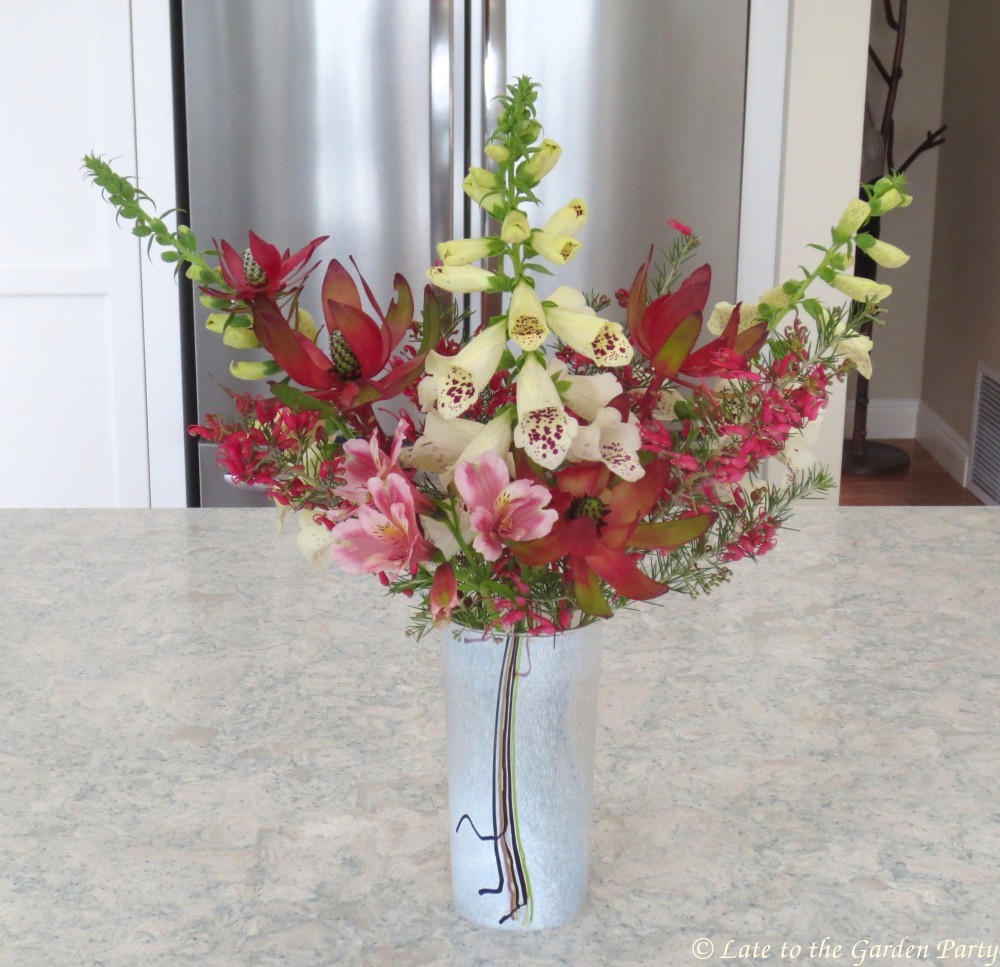
As we celebrate Valentine's Day this week, I immediately fixated on the Grevillea 'Scarlet Sprite' now dominating my garden on the northeast side; however, I ran into a bit of a challenge finding suitable companions for it.

When the first match I'd thought of for Grevillea fell flat, I picked one of the next plants I saw that I thought might work, the foxgloves in my cutting garden.  The foxgloves and the other 2 plants I selected ended up eclipsing the Grevillea stems, at least in this front view.

'Scarlet Sprite'  shows up better in the back view but, in hindsight, I should have cut taller stems to give the plant more prominence in this vase

Top view

Clockwise from the upper left: noID Alstroemeria, Leucadendron 'Safari Sunset', Grevillea 'Scarlet Sprite', and Digitalis purpurea 'Dalmatian White'


I'd initially thought I'd cut a stem of hellebore or two to pair with the Grevillea in the first vase but, not only was the hellebore significantly shorter than the Grevillea, the color was off.  Whereas the Grevillea leans toward rosy-pink, the hellebore's flowers had a definite blue bent.  As I got wetter, I quickly regrouped.

I used Helleborus 'Blue Lady' in this vase. pairing it with flowers that were blue or leaned in that direction

Back view: I used the blue Echium handiense with pink buds again this week

Top view: This turned out to be my own favorite vase this week.  The daisy blooms of hybrid Pericallis 'Magic Salmon' I picked up for a pot by our front door turned out to be the perfect complement for the hellebore.  I was perplexed by the name of the Pericallis when I bought it but the centers of the blue flowers shifted after it'd been in place a few days, offering an explanation for its odd cultivar name.

Clockwise from the upper left: Pericallis 'Magic Salmon', Echium handiense 'Pride of Fuerteventura', Helleborus 'Blue Lady', Grevillea sericea, and Lavandula multifida


Last week's vases were still in good shape so I gave them fresh water and a few minor touch-ups and found new spots for them.

The "sunshine" vase, less sunny now, landed on the kitchen island.  A simplified version of the blue and pink vase landed on the mantle my husband built for our living room fireplace, which we installed last week, finally bringing our remodel to a formal conclusion.


Meanwhile, the new vases assumed the vacated spots.


For more IAVOM creations, visit Cathy at Rambling in the Garden.  Have a happy Valentine's Day!


All material © 2012-2020 by Kris Peterson for Late to the Garden Party

Friday, February 7, 2020

Empty pots no more

I recently emptied two large pots sitting in our front entry area and relocated their contents.  Those pots stood empty for more than three weeks, which surprises even me.  While I think an empty pot can add mystery or perhaps an artistic touch in a well-placed spot in a garden, I'm not capable of leaving mine unplanted for long.  It's arguable that the front entry isn't the right place for empty pots anyway.

This week, on a trip to the local garden center to pick up compost and planting mix (my usual excuse for such trips), I discovered several plants that I thought would do to fill those empty pots.  My choices are a little iffy as one of my key plants has shown itself to be short-lived and I've killed another at least twice but I plunged ahead anyway.  Those empty pots were starting to bug me.

The empty pots in question, photographed in January


The plants I chose to fill the two blue pots were these:

This is Prostanthera ovalifolia 'Variegata' (aka mint bush).  It produces lovely purple blooms but the scented foliage alone is worth its inclusion in the garden.  They never survive more than a couple of years in my garden yet I still love them.

This is Boronia crenulata 'Shark Bay', the plant I've killed twice

I filled in with Nemesia '7th Heaven Mix', white Violas, and Lobularia maritima (sweet alyssum)


The effect is muted but pleasing.  Both the Prostanthera and the Boronia are Australian natives that can get by with partial shade.  I expect the mint bush could grow to 4x3 feet and the Boronia to roughly half that size in their pots.  It's an experiment - and I've been known to swap out potted plants seasonally in any case.

One of 2 identical pots


But I didn't leave things there.  You see, there was this Pericallis hybrid I'd been eyeing for some time and the garden center finally got a supply of smaller plants in stock.  I couldn't pass it up.  One came home with me and I popped it into an empty pot I had stored behind the garage.

This is Pericallis 'Senetti Magic Salmon'.  Isn't that flower color fabulous?


I couldn't get a great after shot of the front door area as it's still shady.

My conclusion is that I could use a few more pots here.  I'll get to that at some point.


Today and tomorrow are supposed to be warmer, with a chance of rain late Sunday and Monday.  Perfect for planting.  Luckily, reinforcements arrived right on time.

I used the gift card a friend gave me for Christmas

My haul includes (clockwise from the upper left): Lobelia fistulosa, Echium wildpretii, Lupinus propinquus, Erysimum x allionii (2), and Clarkia unguiculata (3)


I hope you enjoy the weekend, whatever your weather.


All material © 2012-2020 by Kris Peterson for Late to the Garden Party

Wednesday, February 5, 2020

Time for a haircut

I've been getting our trees trimmed each winter since our third year here, mostly to ensure that we don't alienate one or another neighbor by interfering with their harbor views, which I learned soon after moving in is a very big thing here.  This year the date slid a bit, another byproduct of last year's home remodel.  I just couldn't face squeezing that into the schedule during the holidays.  We finally got the deed done yesterday, although I scaled back the scope of the effort.  We had all six peppermint willows (Agonis flexuosa), all four strawberry trees (Arbutus 'Marina'), and the five cherry laurels (Prunus laurocerasus) that make up a hedge on our south side trimmed.  I skipped the Magnolia grandiflora that got scalped too close last year, the mimosa (Albizia julibrissin) that was literally cut in half last year, the ornamental pear (Pyrus calleryana) that's already blooming, and all the citrus trees that are loaded with fruit.

Some cuts were more dramatic than others but the net effect is a sunnier garden, at least for a time.  In all cases, I've shown the before shot on the left and the after shot on the right.

A peppermint willow and a strawberry tree sit side by side on the northwest area of our property.  The strawberry trees (Arbutus) were all cut back hard to provide air circulation, which is necessary to prevent the leaves from developing soot.  I hated to lose all the flowers, though, and I suspect it's going to take some time before the hummingbirds forgive me.

I hadn't cut back the willow (Agonis) at the southeast end of the back garden in 2 years and the foliage was dense.  The thinning should provide more sun to the plants below.

I think it's been about 3 years since I had the Agonis next to the front driveway trimmed.  I usually trim the messy ornamental pear (Pyrus) next to it too but it was too late - the tree sprang into bloom this week.

The 2 willows planted along our west side were thinned but they still provide a nice curtain.  Another willow around the corner apparently got a light unplanned trim as well but I don't have a before shot of that one.

The strawberry trees in the back garden don't look all that different from this angle in their before and after shots

But this photo of the larger of the two from a different angle shows just how much it was thinned.  Arbutus fills in very quickly and will have a thick blanket of foliage again by this time next year.

This Arbutus on the southwest side of the garden is the most difficult to trim as it sits atop a moderate slope largely covered in succulents

The cherry laurel (Prunus) hedge was topped off  and stripped of its shaggy appearance.  I'm tempted to have it removed because the fruit produces seedlings all over the area.  In addition, mice have been carrying the fruit into my shade house and storing it there like a pantry.


Collateral damage to the surrounding areas was mostly avoided.  I asked the tree service to make a special effort to protect the succulents and bromeliads on the garden's northwest side.  Most of the damage I have is on the southwest side of the property on the slope below the large Arbutus; however, I didn't lose anything I consider precious.  Osteospermums were squashed but they'll probably recover once cut back.  Several clumps of Senecio vitialis were damaged but I'd been thinking about pulling it out anyway.  A lot of tall Aeonium blooms were inadvertently beheaded but I'll use this as an opportunity to thin out those plants.

After very warm temperatures last week, we turned cold again this week so I'm content to continue garden clean-up this week.  Mulching is on my to-do list too.  Hopefully, while I putter, our local garden centers to restock their shelves and I can get back to the fun stuff, replanting the areas of my garden I've targeted for this year.


All material © 2012-2020 by Kris Peterson for Late to the Garden Party

Monday, February 3, 2020

In a Vase on Monday: Sending you some sunshine!

I know many of you in the Northern Hemisphere have colder temperatures and gloomier skies this time of year than we have in Southern California.  As we enjoyed a stretch of warm weather and blue skies all last week, I thought I'd send you a little sunshine.  The temperature in downtown Los Angeles reached 86F (30C) on Saturday.  It wasn't quite that warm in my location but it was certainly shirtsleeve weather.  Our temperature dropped suddenly Sunday afternoon as a storm front moved through the area to the east of us but it remained sunny here and, as I pondered what to put in a vase this week, I noticed that the Leucadendron 'Safari Goldstrike' in my front garden was glowing.  This particular shrub develops luminous yellow bracts in February every year so it was a natural choice for inclusion in a vase this week.

Last year, I used stems of this Leucadendron to simulate tulips.  This year, the flower-like bracts had already lost their tulip-like shape by the time I noticed them, presumably in response to our unseasonably warm temperatures.

The same noID Narcissus I paired with the Leucadendron last year also made an appearance this week

The feathery foliage and dainty flowers of Euryops virgineus provided the perfect filler

Top view

Clockwise from the upper left: Leucadendron 'Safari Goldstrike', Abelia grandiflora 'Kaleidoscope', noID small-cupped Narcissus, Euryops virgineus 'Tali', and Prunus laurocerasus


After a week of warmer-than-average weather, the Leucadendron wasn't the only plant putting on a show.  After weeks of flaunting promising buds, Echium handiense 'Pride of Fuerteventura' finally flowered, seemingly overnight.

This is the first of the 3 species of Echium to bloom in my garden each year.  Endangered in its native habitat in the Canary Islands, it's also relatively uncommon here.  I got my plant from my local botanic garden, the only place I've ever seen it offered for sale.

The stem of pink Lisianthus (Eustoma grandiflorum) was a last minute addition to the arrangement.  I have some misgivings about including it as it competes with other elements in the vase I find more interesting.

I used stems of Ceanothus arboreus 'Cliff Schmidt' to dress up the back of the arrangement.  After nearly 5 years on my back slope, this plant is finally assuming tree-like proportions.


Top view: I added the pink flowers of Grevillea sericea  to play off the pink color of the Echium's buds

Clockwise from the upper left: Echium handiense 'Pride of Fuerteventura', Ceanothus arboreus 'Cliff Schmidt', Eustoma grandiflorum, Grevillea sericea, and Westringia 'Morning Light'


While the vase I created using Camellia 'Taylor's Perfection' last week fell apart within 2 days, the vase featuring Leucadendron 'Wilson's Wonder' is still going strong.

Over the course of last week, the cones at the center of the Leucadendron's bracts turned brown, echoing the color of the Leptospermum 'Copper Glow' foliage.  I think I like it better now than I did last week.


The two new vases took pride of place in the front entry and on the dining table.


For more IAVOM creations, visit Cathy at Rambling in the Garden to see what she and other gardeners have put together this week.


All material © 2012-2020 by Kris Peterson for Late to the Garden Party