Monday, August 7, 2017

In a Vase on Monday: The drama continues

So, when we last left Blue Eustoma she was laying low and limiting her contacts.  However, this week, she appears more sociable.  Her colorful companions have lightened the mood surrounding her and she looks all the more striking in their midst.  Perhaps she's overcome her heartbreak over Dahlia 'Loverboy'?

A couple of new suitors have come calling.  The tall, wispy character is Symphyotrichum chilense, who prefers to go by the simple handle, California Aster.  His distant cousin, Erigeron 'Wayne Roderick' , whom prefers to be called Beach Aster rather than Fleabane, has pushed himself into the center of things.  And one can't help noting that cupid's dart, always ready for mischief when it comes to affairs of the heart, is on the scene too. 

The job of keeping things loose and light has fallen to local peacemakers, Artemisia ludoviciana and Tanacetum parthenium, with a little help from a sunny Australian, Westringia fruticosa 'Morning Light'

Everything revolves around Blue Eustoma, which wasn't the case in her relationship with 'Loverboy', but is that important to her?

Clockwise from the upper left, the group includes: blue Eustoma grandiflorum, Artemisia ludoviciana, Catananche caerulea, white Eustoma grandiflorum (currently looking a little green, with envy maybe?), Symphyotrichum chilense, Tanacetum parthenium, and Westringia fruticosa 'Morning Light'


Has Blue Eustoma moved on?  It's hard to say.  California Aster is supportive but lacks substance and tends to burn out when the heat is on.  Beach Aster is nice but awfully short.  It may be that she simply needs time to rest.  There are signs that she's packing her bags to take off.  Whether she'll be gone for a few days, several weeks, or the balance of the season isn't yet clear.

Meanwhile, 'Loverboy' is still carousing about, seemingly unprepared to settle down.  Frankly, he was feeling the heat last week himself and his usual stamina was diminished.  He once again sought out new companions, perhaps as a way of avoiding any chatter about his persistent infidelity.

Iochroma 'Mr. Plum' isn't all that happy in 'Loverboy's' company.  In fact, he started falling apart as soon as he joined this crowd.  For his part, Prunus laurocerasus takes up a lot of space and is prone to dropping his seed with abandon, which 'Loverboy' finds annoying.

The Zinnias can take or leave 'Loverboy'.  They have a fine time on their own.

As far as the Zinnias are concerned, the world revolves around them, not 'Loverboy'

Clockwise from the left, this group includes: Dahlia 'Loverboy', Cuphea 'Starfire Pink', Iochroma 'Mr. Plum', Prunus laurocerasus, and a mix of Zinnia elegans


If any readers are concerned about the fate of Gomprena 'Itsy Bitsy', don't be.  She's a lot tougher than she looks.  While there wasn't a long-term relationship in the cards with Dahlia 'Little Robert', she and Phalaenopsis are still together and doing just fine.

Rising above the sordid affairs elsewhere in the garden, the sunflowers all but demanded attention this week.  The only problem they presented had to do with locating a vase capable of holding up their heavy heads.

The noID sunflowers, grown from a 'Flash Blend' seed mix, dominate the front view 

Seed grown Zinnias hold their own in the back view


Clockwise from the upper left, the vase contains: Helianthus annus 'Flash Blend', Abelia 'Kaleidoscope', dried flowers of Jacobaea maritima, Leucadendron salignum 'Chief', Pennisetum advena 'Rubrum', and a mix of Zinnia elegans


Visit Cathy at Rambling in the Garden for more vase views.

The first vase sits in the front entry, the second in the living room, and the third on the dining table


All material © 2012-2017 by Kris Peterson for Late to the Garden Party

Friday, August 4, 2017

Sherman Gardens - Part 2

Wednesday's post covered the Sun Garden, the Central Garden, the Perennial Garden and selected plants at Sherman Gardens, a 2.2 acre botanical garden in Corona del Mar.  While very nice, these were perhaps less interesting than the areas I'll cover in today's post: the Tropical Conservatory, the Shade Garden, and the Succulent Garden.

As you'd expect, the inside of the Tropical Conservatory was very warm and moist.  I felt as if I'd been transported back to Washington DC on the first day of the Garden Bloggers' Fling.

This large Koi pond, surrounded by bromeliads and ferns, set the scene.  I assume the brightly colored balls are part of the glass display that runs from June through October.

This handsome fellow demonstrated just the right touch of attitude

There were lots of massed plant displays like this one


While the flashy pink Cordyline shown here is pretty, I'm head-over-heels about the other variegated Cordyline, C. terminalis 'Miss Andrea', which I've seen in blog postings but not in my local garden centers

There were blooming orchids tucked in here and there throughout the conservatory

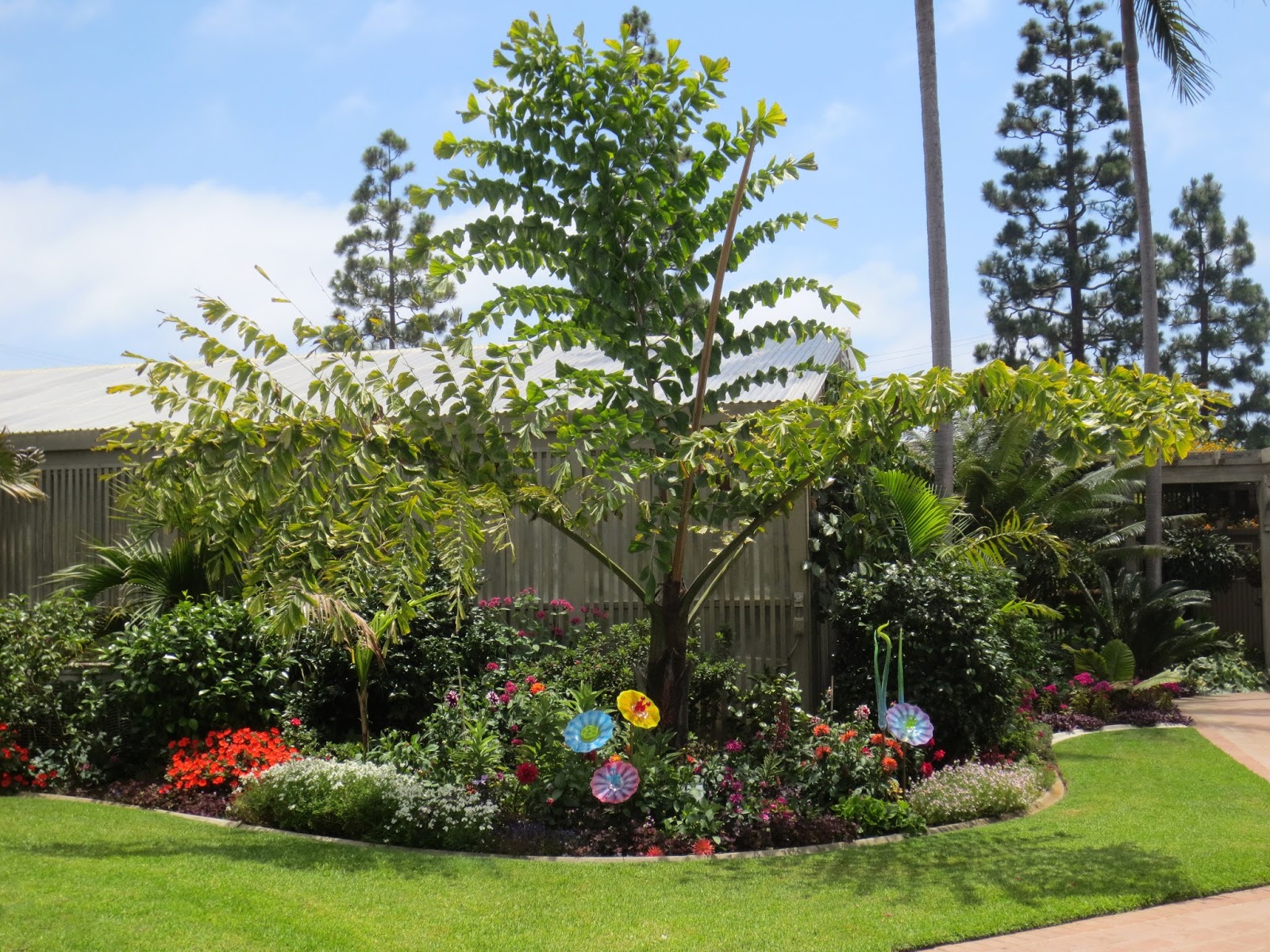
I'm not certain but I think I snapped this photo outside the Conservatory although then again it might have been part of the gardens' Palm Collection.  I can't identify the tree at the photo's center but I think it's a palm.


We toured the Specimen Shade Garden next.  This was enclosed in a very large lath house.  The space got me thinking about adding a structure like this, on a far smaller scale of course, to my own garden.  I'd previously asked my husband about building a shed/greenhouse but arguably this is an unnecessary addition to our garden.  I have adequate (if not particularly attractive) space to store my garden tools in our garage and, as our winters are exceptionally mild, I don't actually need a greenhouse to protect seedlings and tender plants.  However, I can definitely use some shade protection.  I miss the fuchsias, begonias, ferns and other shade-loving plants I grew in my former garden.  Luckily for me, my husband has embraced the lath house idea to a greater extent than the shed/greenhouse idea so my fingers are crossed that this plan will get off the ground - eventually.

View of the lath house from the outside

View from the inside with fuchsias in hanging pots as far as the eye can see

A nice massed planting of bromeliads

A healthy clump of variegated Iresine, paired with New Guinea impatiens

A huge staghorn fern (Platycerium) and lots of tuberous begonias in pots positioned on the shelves lining the sides of the lath house


The last area we toured was the Succulent Garden.  Like every other section of Sherman Gardens, it was densely planted.  Parts of it were also more stylized than most succulent gardens I've toured.

The entrance gates were decorated with wreaths, which I didn't notice until I reviewed my photos

A huge Furcraea foetida 'Mediopicta' anchored one end of the artistically decorated succulent bed

This is the other side of the same bed, bordered by the entrance gate

This area bed was situated on the opposite side of the Succulent Garden

There were glass pieces in this garden too


I think the mounded plant in the center foreground (repeated both to the left and the right) is Deuterocohnia brevifolia (formerly Abromeitiella brevifolia), a bromeliad

These 2 mature specimens of Agave 'Jaws' serve as yet another reminder that I need to move at least one of mine before it gets too big

The largest Rhipsalis baccifera I've ever seen

Perhaps the best example of both the focus on detail and the insistence on making use of every square inch of planting space by Sherman Gardens: succulents planted in the gap between every stair tread


You can find Hoover Boo's posts on our visit to Sherman Gardens at Piece of Eden herehere and here.  The earlier post by Denise that launched our trip can be found at A Growing Obsession here.

That's it for Sherman Gardens.  I won't let a decade or more go by before visiting again.


All material © 2012-2017 by Kris Peterson for Late to the Garden Party

Wednesday, August 2, 2017

Sherman Gardens - Part 1

Just a few days after returning from the Capital Region Garden Bloggers' Fling, I joined 2 SoCal bloggers, Denise of A Growing Obsession and Hoover Boo of Piece of Eden, as well as HB's friend and neighbor, in visiting Sherman Gardens in Corona del Mar.  I've visited these gardens before but not for a very long time so I felt as though I was seeing them anew.  Despite the fact that the gardens occupy a space of barely over 2 acres, I took a ridiculous number of photos so I'm breaking this post into 2 parts.  This one will cover the Sun Garden, the Central Garden, the Perennial Garden, and selected plants and plant combinations that grabbed my attention.

The Sun Garden is located near the front entry.  It's laid out fairly formally with a small pond in the center.

The main space was organized in parterre fashion

The glass sculptures are part of an exhibit by California Viscosity Studios running through October

I fell for this otter statue sitting on the edge of the pond

I didn't take a full-sized photo of this Butia capitata (Jelly Palm) tucked into a corner of the Sun Garden but I really liked the way it had been embellished with shade tolerant plants.  Plants were literally crammed into every nook and cranny throughout the gardens.


The Central Garden is a display area directly across from the on-site restaurant.  The current display is all about Dahlias.

The wind was blowing the tall Dahlias about and none of the close-up photos I took are worth sharing but this photo provides visual testimony to the variety and number of plants tucked into this space

Another glass sculpture occupied pride of place


The Perennial Garden sits adjacent to a large lath house containing shade garden specimens.

This area contained many plants that can be found in my own garden, such as Arctotis 'Pink Sugar', Leucadendron 'Jester', Nandina domestica and Phlomis fruticosa; however, the plants are more tightly packed together than mine.  There's a lesson there in terms of how I could create more impact in my own garden.

This is an extension of the same bed shown in the earlier photo.  The large plant near the path leading into the shade structure is Grevillea 'Moonlight', a plant I'd like to add to my own garden


There were a LOT of beautiful plants and plant combinations distributed throughout the gardens but a few stood out for me.

Although this isn't a great photo, the image of this snow bush (Breynia) limbed up like a tree stood out for me.  I grew this plant (or a related species) in a shady section of my former garden and I miss it.  I'm already plotting a way to bring a plant like this into my current garden.

I seem to be developing a thing for red flowers.  This is chenille plant (Acalypha hispida) which I didn't use to care much for but now I find intriguing.

I'm not certain but I think this is another Acalypha, possibly A. wilkesiana

This is Ceratozamia mexicana, a new-to-me cycad from the tropical forests of Mexico.  It's new foliage can be bronze (as shown here) or light green.  It reportedly makes a good house plant as it will grow in very low light but don't get too excited - on-line sources show plants with a one-inch caudex for sale at $50 each and the prices go up dramatically from there.

This bromeliad with the neatly curled foliage is Quesnelia marmorata.  I'm going to a bromeliad show and sale on Sunday and will be looking for this one!

These plants (Aeonium arboreum, Plectranthus aureus variegatus and Coprosma repens 'Pacific Sunset') aren't especially unusual - in fact, I have all of them in my own garden.  However, I've never thought to combine them so I may be copying this.

I also have artichokes, Achillea millefolium, Limonium perezii and Pelargoniums in my garden but I haven't thought to combine those either.  Another great idea.


Part 2, covering the Tropical Conservatory, Shade Garden, and Succulent Garden will follow later this week.


All material © 2012-2017 by Kris Peterson for Late to the Garden Party