Showing posts with label marine layer. Show all posts

Wednesday, August 6, 2025

(Almost) Wordless Wednesday: Fogust

"Fogust" is a term used to describe our coastal Southern California marine layer when it extends into August.  While common in June, they're far less so once summer takes hold.  The first of August, when I took the following photos with my cell phone, was particularly wet and foggy.


The marine layer is still present every morning, although it burns off earlier now.  However, at present, as shown in the photo below, the Port of Los Angeles is visible only through a haze, as if viewing it through tissue paper, and the mountains to the east can't be seen at all.  This is attributable to especially poor air quality, due in part to a major fire burning about 200 miles to the north of us.


All material © 2012-2025 by Kris Peterson for Late to the Garden Party

Wednesday, July 10, 2024

July's ups and downs (so far)

We've been very lucky with respect to our daytime temperatures so far.  While another so-called heat dome is still toasting most of California, launching wildfires, our temperatures along the Southern California coast have yet to climb above the mid-80sF (29C) this July.  I'm crediting the persistence of our morning marine layer.  Most days, it dissipates by 8am but last Saturday we were socked in until 2pm.  It was lovely.

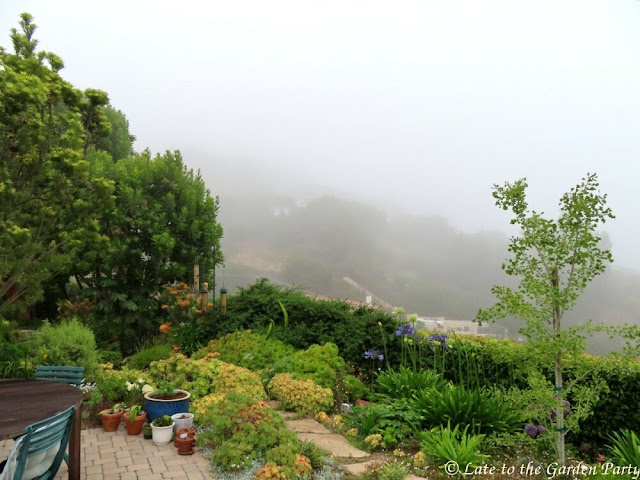
View of back garden after 8am last Saturday.  The harbor below us was entirely invisible,

This photo was also taken in the back garden,  The Ginkgo tree and the hedge looked like they were sitting on the edge of the world with the erasure of the homes across the canyon. 

View from the front garden looking northwest into an apparent void 

This front garden view had a more Twilight Zone edge, with a lone garbage bin left behind on the street.  Unfortunately, it also highlighted the surprising decline of Leucadendron 'Safari Goldstrike' on the left.  I lost 2 branches of that shrub last year and now the rest of it seems to be dying off.  Growing on a moderate slope, I can only guess whether the soil drains too well in that spot or the gopher that formerly resided there was responsible.

This photo was taken around 3pm when the sky was blue and the harbor could be seen again.  A smoggy haze has been present on the horizon since the 4th of July fireworks.  Although private displays are illegal in our high fire risk area, it wasn't evident from the war zone we experienced yet again this year.


A neighbor's cat has paid me periodic visits.

I still miss my beloved Pipig but this big boy has dropped by now and then.  He got stuck on a fence and complained loudly so I picked him up and set him down safely.  He's come back twice since and has been quite friendly.  I don't know his name but I understand that a neighbor 5 doors up the street adopted him when he was dumped in the canyon by someone as a kitten.


Unfortunately, a gopher has also paid me a visit, popping up in, of all places, my cutting garden.

I don't know why a gopher would move in here, where a large area is covered by raised planters and barrels and equal area is covered with a thick layer of gravel, but one did!  When the first hole on the left appeared I poured deterrent granules and water down it, filled it in, and inserted a sonic deterrent spike in that spot.  A few days later the second hole showed up at the edge of a barrel just 3 feet away (shown on the right).  I've looked into the lethal black-hole traps but, after reading the reviews, wasn't sure how helpful it would be.


The Italian Navy also recently paid a visit nearby.  The Amerigo Vespucci, almost one hundred years old and reputed to be "the most beautiful ship in the world," docked at the Port of Los Angeles from July 3rd through the 8th as part of a two-year worldwide voyage visiting fifteen countries.  Visitors with reservations received free guided tours and had the opportunity to participate in a variety of events celebrating the Italian culture.  Although its arrival received some low-key press, by the time I heard about it from a neighbor, all the spots on the tour had been booked.

I managed to get a photo of the ship from my back garden, though.  I used my new camera, which has a 40x optical zoom feature.  This photo was larger and clearer than than the one I took with my Nikon's telephoto lens.


Rounding out early July's ups and downs is an event that involves a little of both.  Yesterday, construction and plumbing crews arrived at 7:30am to replace the copper pipes in our 73 year old house and to refurbish our living room chimney.  We replaced the pipe in our kitchen when we renovated it and other parts of the house in 2019 but we didn't think about repiping the rest of the house until we experienced one after another pinhole leaks later.  As three different teams are involved in the process, I'm not sure how long this is going to take.  The kitchen, the living room, our main bedroom, and my home office aren't directly impacted but everything we removed from the affected areas, two bathrooms, the laundry room and my husband's office, have ended up in those spaces.  And there's no escaping the noise!

Even though I knew they had to open up the walls to replace the pipes, I underestimated just how much space would be affected.  This is just 2 of the 5 walls opened so far.

Even the cutting garden is nominally impacted


The good news is that, when they're done, we shouldn't have to worry about any more bulging walls, water bill surprises, or a leaking chimney.  A little pain now should save us more in the future.


I hope your July offers ups with any downs!  My sympathy to all those experiencing heatwaves or weather-related floods.


All material © 2012-2024 by Kris Peterson for Late to the Garden Party


Wednesday, June 12, 2024

June Gloom

The title of this post isn't a commentary on my current mood (although it's somewhat descriptive).  "June Gloom" is a common term for the marine layer that's characteristic of the weather along California's coast at this time of year.  It's not limited to the month of June either - it can occur as early as April ("Graypril") or May ("May Gray") and as late as September.  (There are names for July and August, "No Sky July" and "Fogust" too but, for some reason, I haven't found one for September.)  The marine layer usually emerges during the overnight hours and gradually lifts sometime in early to mid-afternoon, depending on its strength and how far one is from the coast.

I admit to a momentary sense of disappointment whenever I open the blinds in the morning to see overcast skies without a touch of blue but the marine layer offers benefits by keeping temperatures down, which is especially helpful during the summer months.  While much of California suffered through high temperatures last week due to the so-called "heat dome" hovering over our state, it remained cool and comfortable here.  In fact, it's often referred to alternately as nature's air conditioning or a heat shield.

In the garden, it creates a "Twilight Zone" like sense of being cut off from the world around us.

View from my back door yesterday morning looking east

View from the back patio looking northeast

Homes on the other side of the canyon were visible but just barely

View from the front garden looking northwest.  Taking photos during these conditions is often easier and some colors stand out particularly well.

View from the south-side of the garden looking south.  You can see the outline of a neighbor's house down the street if you look very closely.


The marine layer hides a lot.

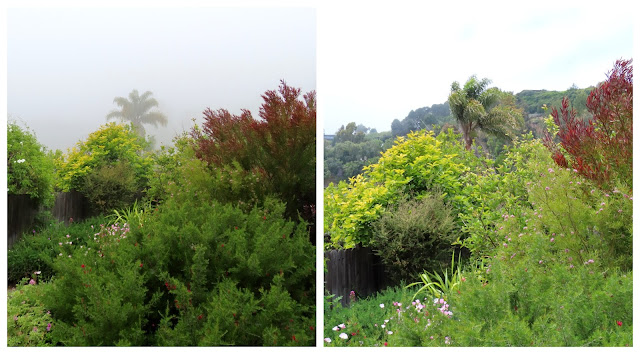
These shots, taken hours apart from the north-side garden looking northwest, compares the view with the marine layer in full effect (left) versus when it's partially lifted (right).  If you hadn't seen the second shot, you might not have realized that there are hills dotted with homes beyond that palm tree.  Sounds also appear muffled, although that may just be an illusion.


The eeriest aspect of the phenomenon in my opinion is evident when the mist moves in - or out.  It's hard to catch in a photo.

This closeup of Callistemon 'Cane's Hybrid' provides a peek at the shifting mist.  It's like walking through a cloud.


The marine layer is reportedly more pronounced when the La NiƱa climate pattern is in place.  It's also relatively uncommon in other parts of the world.  Recent studies suggest that climate change may eventually put an end to it.  A 2018 study offered evidence that California's coastal stratus clouds have declined twenty to fifty percent since the 1970s.  A 2019 study undertaken by CalTech showed that increased carbon dioxide in the atmosphere may eventually wipe out those stratus clouds entirely.  (You can find references to both studies here.)  If that happens, it'll probably mean higher temperatures, contributing further to general global warming; plants struggling for moisture due to heightened levels of evaporation, which may not be available due to persistent drought conditions; and an increased number of wildfires.  None of those things is good.

Our current ten-day weather forecast shows continuation of the marine layer at full strength through this Friday, diminishing on Saturday, and disappearing on Sunday, before returning with less vigor during the balance of next week.  The marine layer may deliver mist and even a bit of drizzle but we don't often receive anything in the way of measurable rain from it, although our roof-top weather station shows we collected 0.01/inch of precipitation last week.  Every bit counts.


All material © 2012-2024 by Kris Peterson for Late to the Garden Party


Friday, October 20, 2023

Off the see the - Trolls?

The weather has felt very unlike fall this week.  The morning hours have been foggy and the afternoon hours have been hot.

Sometimes, at sunrise, the fog/marine layer sits just below our elevation, hiding the Port of Los Angeles from view before the fog rises and encompasses us prior to dissipating 

More often, it wraps us in an embrace well before sunrise


I'm waiting out the current heat spell before I do any serious planting.  Instead of putting my most recent mail order plants in the ground, I simply upgraded them to one-gallon pots pending the return of cooler temperatures.  Earlier this week, tired of taking spins around the neighborhood for exercise, I decided to drive six miles to South Coast Botanic Garden to see the garden's Trolls exhibit.  The Trolls were created using salvaged wood pallets by Thomas Dambo, described as a "recycled art activist" based in Denmark. (A biography on Dambo can be found here.) There are over a hundred of these Trolls scattered around the world.  SCBG has six spread across its 87-acre garden.  Their stated mission is the "save the humans" by helping them reconnect to nature.  The exhibit, billed as the first one on the west coast, will remain in place through January 14, 2024.

I met all six Trolls on my walk through the garden.  A map was provided but most were located fairly close to the main tram road so they weren't hard to find.  I started the tour at the butterfly pavilion, which was retooled to serve as the home of Ibbi Pip, the birdhouse troll.

Ibbi may be the tallest of the 6 at SCBG.  The bag tossed over his shoulder contains birdhouses.  These birdhouses serve as signals to keep visitors on the right path to find other Trolls.

They all introduce themselves through signs like this.  There are also signs asking visitors not to climb on the Trolls.

The inside of the butterfly pavilion, currently empty of butterflies, is full of colorful birdhouses

2 "nests" and a bench are provided to allow visitors to sit awhile.  The pavilion has also been replanted with flowers and other plants echoing the colors of the birdhouses.


My route took me to the other Trolls in the following order:

Basse Buller, also called the painting troll, uses rocks to create art

Softus Lotus, also called the listening troll, is 24 feet long and over 7 feet high.  I heard some children speculate that he was sleeping but others pointed out that he has one eye open.

Kamma Can is the trash troll, who uses the colorful plastics and other trash disposed of by humans to create jewelry.  She is reported to be the second largest troll in the exhibit at over 14 feet tall.

Here's Kamma's introduction and a closeup of her necklace.

Ronja Redeye, the speaking troll, appears to be the smallest one.  The sign on the flag, resembling a birdhouse, represents the troll's logo for their "save the humans" campaign.

Rosa Sunfinger, the botanical troll, is 11 feet tall, and likes to grow plants in places like "the smelly metal boxes humans run around in"


As might be expected, the exhibit attracted lots of parents with children.  The children didn't seem at all intimidated or frightened by the Trolls so that was good.  SCBG is offering a variety of Troll-themed classes as a supplement, as well as selling a book describing the campaign to save the humans.  The classes include making jewelry out of trash, crafting flower crowns, and building birdhouses.


I didn't spend a lot of time gawking at plants on this visit but I did take photos of some.

The photos in the top row feature what I believe is Ceiba chodatii, the yellow-flowered silk floss tree.  Pink-flowered Ceiba speciosa are shown in the 2 bottom photos.

Plants in the Senna species are in full bloom now.  There were cloudless sulphur butterflies all over this one but I didn't manage to catch a single photo. 


In concluding this post, I'll throw in two plants that stood out in my own garden this week as well.

On the left are the unusual flowers of Pelargonium schizopetalum.  On the right is a particularly colorful coleus (Plectranthus scutellarioides) labeled as 'Florida Sun Rose').  The latter looked sickly and unimpressive in a pot by the front door for months but now looks better than any photos in advertisements I've seen. 


Best wishes for a peaceful weekend communing with nature.  Everyone could use a touch of beauty in their lives in the midst of the world's current turmoil and misery.


All material © 2012-2023 by Kris Peterson for Late to the Garden Party


Wednesday, August 10, 2022

Nature's air conditioner

It was sunny at our elevation when I stepped outside just before 7:30am on Monday but a heavy marine layer had created a wall of clouds between us and the Port of Los Angeles below us.  Starting the day with a marine layer is a good thing as it helps to keep our peak afternoon temperature down.

The cloud cover topped out below our elevation, which is about 830 feet above sea level.  The garden glowed in the sun's filtered light.

This is the view looking northeast

And this was the view looking southeast.  The harbor below was invisible.


I assumed that the marine layer was moving out but less than half an hour later we were socked in.

This is roughly the same view as shown in my first photo.  The blue sky was gone and the sun's glow wasn't discernible but my plants stood out against the pale gray clouds.

The house across the canyon, visible in the second photo above, could no longer be seen

A fuzzier view looking southeast

The fog wasn't so thick that I couldn't see in front of me so I proceeded with my morning walk, twice around the large circle that makes up our neighborhood.  This is the view as I walked up hill toward a neighbor's 2 large trees, recently pruned.


The longer the marine layer remains intact, the lower the afternoon temperature is likely to be.  Unfortunately, this one cleared relatively quickly.  Our temperature later that afternoon peaked just below 90F/32C.  Yesterday, with no visible marine layer, it was over 80F by 8am and the afternoon temperature peaked at 94F/34C.  It remains to be seen what today will bring.  All things considered, we've been luckier this summer than many other areas that historically run cooler than we do.


All material © 2012-2022 by Kris Peterson for Late to the Garden Party

Wednesday, August 17, 2016

Wednesday Vignette: The Marine Layer

The marine layer is a key component of the climate here.  When it's present, it keeps temperatures within reasonable bounds and, when accompanied by fog, it adds moisture to the air.  However, until we moved to our current location, I didn't appreciate the mystery it adds to the view.  We sit over 700 feet above sea level, overlooking the Los Angeles harbor and, when the marine layer forms overnight, it pulls a veil over the harbor.  In May and June, the marine layer may persist until mid-to-late afternoon but, during the height of summer, if it forms at all, it usually clears much earlier.

The marine layer deserted us during last weekend's heatwave but I was delighted to find it back in place this morning, making it a good candidate for a Wednesday Vignette, the feature hosted by Anna at Flutter & Hum.

In this photo, taken just before 7am, the harbor is invisible and even the city below is hard to make out, although palms and trees stand out


This afternoon, facing in roughly the same direction, all is revealed.

That dirty gray smudge on the horizon has been with us for months, a sign of the worst smog Los Angeles has experienced in years 


The change shows up more sharply here:

7am view (left) compared to 4pm view (right)


The morning light had a magical quality at 7am and I snapped a couple of wide shots of the back garden.

View from the path in front of our backyard hedge looking west toward the street

View of the backyard borders looking north


Sadly, although the air was cool, it was anything but fresh.  There's another fire burning, this one in San Bernardino County, 2 to 3 hours to the east.  It started yesterday but it's moved fast, consuming 30,000 acres by this morning and prompting the evacuation of 82,000 people.  Current reports still show zero percent containment.   Fires are a fact of life here but they seem all too frequent - and large - this year.   Fire is hard enough to accept when it's touched off by natural causes like lightning but even harder to take when arson is involved, as appears to be the situation in the Clayton Fire, still burning in northern California.

Our house is also located in a high fire risk area so the fire news always makes us jumpy.  My husband's parents lost their home in Malibu to fire many years ago, which contributes to our reaction to these events.  We've had first-hand exposure to the trauma associated with losing a home to flames.  I still have vivid recollections of returning to my in-laws' home after the fire in the hope of finding some part of their lives there intact.  But there was nothing.  Yet they were among the lucky ones - they got out alive and had the luxury of 2 hours notice prior to their evacuation.  They loaded both cars and, that night, I came home from work to find both those cars in our driveway.

This morning, my husband announced that we should be better prepared than we are for that kind of eventuality.  He reminded me how his parents rued their failure to pack up this and that for years afterward.  So, he's put together a draft plan, based on different evacuation timetables: immediate, 10 minutes, and 2 hours.  It's a scary thing to consider.  Other than the cat, a few mementos, and the paperwork necessary to ease a transition in the worst case situation, there's not much in the house that I'd mourn losing.  I would grieve the loss of my garden but that can't be packed into the back of a truck or the trunk of a car.  My husband's list did provide a moment of comic relief, though.  He included "library books" on his 10-minute list, which gave me an attack of giggles (and I don't often have helpless attacks of giggles).  I had him move that item to the 2-hour list.

Visit Anna at Flutter & Hum to find more Wednesday Vignettes.


All material © 2012-2016 by Kris Peterson for Late to the Garden Party