Showing posts with label fruit trees. Show all posts

Wednesday, September 28, 2022

Natural differences

Many gardeners look forward to ripe apples and pears each fall but those fruits don't do well in my part of coastal Southern California.  Due to limited hours of winter chill, most fruit trees other than citrus don't do well here in general.  Persimmons are a notable exception.  Frankly, I knew next to nothing about persimmons before we moved into our current home.  I'd never even eaten one.  We inherited two young persimmon trees with the garden but they bore relatively little fruit until last year.  This year, despite two years of minimal rainfall, water restrictions, and rising temperatures, we've got more fruit than I know what to do with.

The common persimmon, Diospyros virginiana, was growing in North America before Europeans arrived on the continent but the trees didn't become popular until the sweeter Japanese persimmons were introduced in the mid-19th century.  Both my trees are Japanese persimmons, Disospyros kaki.  I have the two most common varieties of the kaki persimmons : 'Fuyu' and 'Hachiya'.  However, other than bearing fruit on approximately the same schedule, they're different in many respects.

This is the 'Fuyu', sited alongside the fence that divides my cutting garden from the dry garden on the other side.  It's being crowded by a larger lime tree on the left.

The photograph on the left suggests a small tree with not much fruit but its heaviest limbs are hanging over the fence, visible from the dry garden as shown in the photograph on the right.  I had to cut 2 limbs 2 months ago because they were threatening to break under the weight of the developing fruit.  I suspect this means I should've thinned the fruit earlier.

Closeup of the 'Fuyu' fruit, which is flat on the bottom and looks a little like a miniature pumpkin

This is the 'Hachiya', sited in the dry garden at the top of the concrete stairway that leads down our steep back slope.  Unlike the 'Fuyu' tree, the 'Hachiya's' foliage is showing signs of stress.

The view of the tree from the concrete stairway shows off the fruit more clearly

Closeup of the 'Hachiya' fruit, which has an acorn shape

Diospyros is Greek for the "food of the gods."  The fruit is rich in beta-carotene, vitamin C, and potassium.

The fruit of 'Hachiya' (left) and 'Fuyu' (right) doesn't look the same but their appearance isn't the only difference between them

Until I started looking into the fruit while trying to decide what I'm going to do with this year's crop, I assumed they differed in shape but not in taste.  It turns out that's not true.  'Fuyu' is the most popular persimmon and the one you're most likely to find in supermarkets.  It's not astringent and the fruit can be eaten much like an apple.  While the darker the color, the sweeter its taste, it can be eaten when still firm.  It works well in salads and can be frozen to be eaten like custard or to garnish for ice cream.  In contrast, 'Hachiya' is so astringent that taking a bite before it's very, very ripe can cause numbness in your mouth.  One source I read likened the taste of an unripe 'Hachiya' to the taste of a a very green banana.  Another source claimed that while 'Fuyu' can be appreciated by impatient consumers, 'Hachiya' requires a consumer willing to until the fruit is so ripe it appears ready to throw out.  Its skin should be translucent and, when held, it should feel as though it's filled with water.  The persimmons used in baked goods are commonly 'Hachiya'.  It's taste is said to combine well with spices like cinnamon, nutmeg, ginger and cloves. Online sources offer many recipes for using persimmons as you can find here and here.

The usual suspects are already stealing the 'Hachiya' fruit while branches of the 'Fuyu' are so heavily laden it's reasonable to expect branches may break even without the additional weight of a foraging raccoon.  I can't leave the fruit in place too much longer or it'll all be smashed or half-eaten.  I expect to harvest the 'Hachiya' within the next week or so and, unless my husband gets an urge to bake, I'll give the fruit to friends and neighbors.  I'd like to wait a bit longer to harvest the 'Fuyu' as that fruit is less ripe.  Fortunately, fruit cut prematurely will ripen in room temperatures given time.  Ripening also can be sped up by placing the fruit in a paper bag with a banana.

A final difference between the trees is also worth noting.  In addition to their difference in appearance, taste, and use in food preparation, the trees differ in terms of their foliage.  The foliage of the 'Hachiya', at least in my location, goes from green to a homely brown as summer comes to an end.  In contrast, the foliage of 'Fuyu' offers the best fall color of any plant in my garden.

Photos of 'Fuyu' taken in November 2021

Let me know if you have any uses for persimmons you'd like to suggest.


All material © 2012-2022 by Kris Peterson for Late to the Garden Party

Wednesday, August 28, 2019

Wednesday Vignette: What a difference 9 months can make

Last November I posted photos of steeply terraced slope I used to pass weekly.  It's on a busy street in the neighborhood I lived in for 20 years, where homes, mostly condos and townhomes, are packed into small lots and garden space is scarce.  When I lived in the area, this particular slope wasn't terraced and, like many of those nearby, it was covered in weeds.  But in 2018, the owner built a 3-tiered retaining wall system and filled the area with fruit trees.  Admittedly, it looked rather stark when I first photographed it.

Here is what in looked like in November 2018, photographed from across the street.  The top tier was planted with fig trees, backed by decorative square frames.  The second tier contained a couple of what I guessed were peach or apricot trees and one humongous tomato plant.  The bottom tier was filled with citrus trees of different kinds and some low-growing herbs.


This week, almost 9 months to the day, I passed through the area again after a long absence and I noticed how different the the terraced slope looked after one year of good rain.  Fire department vehicles passing through forced me to pull over so I decided it was a good opportunity to take more photos.

This is what it looked like on Monday.  All the trees have filled out.  The figs on the top tier have a new espalier support structure.  There are now more fruit trees on the second tier. all of which are espaliered.  The citrus trees on the bottom tier all looked healthy and the rosemary and lavender planted between them is slowly filling in, although it has yet to spill over and soften those walls.  The structure on the upper right has also been spruced up with the addition of wood shingles and a spire topped with a weather vane.


Here's a side-by-side comparison from different angles.

I didn't manage to capture exactly the same angle but both these shots show the structure photographed from the north end looking south.  The 2018 photo is on the left and the 2019 photo is on the right.

These photos (2018 on the left and 2019 on the right) were take from the south side looking north.  The grassy weeds you can see in the distance in the right-hand photo gives you an idea of what this hillside looked like before the area was terraced.  That's the next door neighbor's weedy slope.


I didn't have time to take a lot of close-ups of individual plants but before and after shots of the finger lime tree (Citrus australasica) provide evidence of significant growth over a relatively short period.

2018 photo on the left and 2019 photo of the same plant on the right


Those cement block walls are still austere but, if this growth rate continues, I think the area should be quite attractive in a few years.  It's unlikely we'll get rain on par with last year's in the coming rain year (calculated from October 1st through September 30th) but we can hope and, in any case, this particular fruit tree garden has a drip irrigation system.

For more Wednesday Vignettes, visit Anna at Flutter & Hum.


All material © 2012-2019 by Kris Peterson for Late to the Garden Party

Thursday, November 29, 2018

Terracing a steep slope

Regrettably, this isn't a post on my own back slope, which following the hard hit it took in early July when our temperature reached 110F, is looking uglier than ever.  I took the following photos in my former neighborhood, on a street I pass through each week when I meet friends for lunch.   The retaining walls went in a year or more ago but the area wasn't planted up until this year.  I'd been meaning to stop and snap photos for some time but finally took 15 minutes to do that earlier this week.

This is on a relatively busy residential street, one of main corridors for traffic passing through this neighborhood

The terraced wall has 3 levels, backed by a tall fence behind what I assume is the owner's backyard

I was initially confused as to why the builder omitted grout between the bricks at the base of each tier of the retaining wall before realizing that's probably a strategy to facilitate drainage


I couldn't get close-ups of the trees and plants on the upper tiers of the terraced wall and I was unable to identify most of them, although I believe all are fruit trees.  The 3 trees with wood frames each had wire supports behind them, presumably to espalier the branches as they grow.

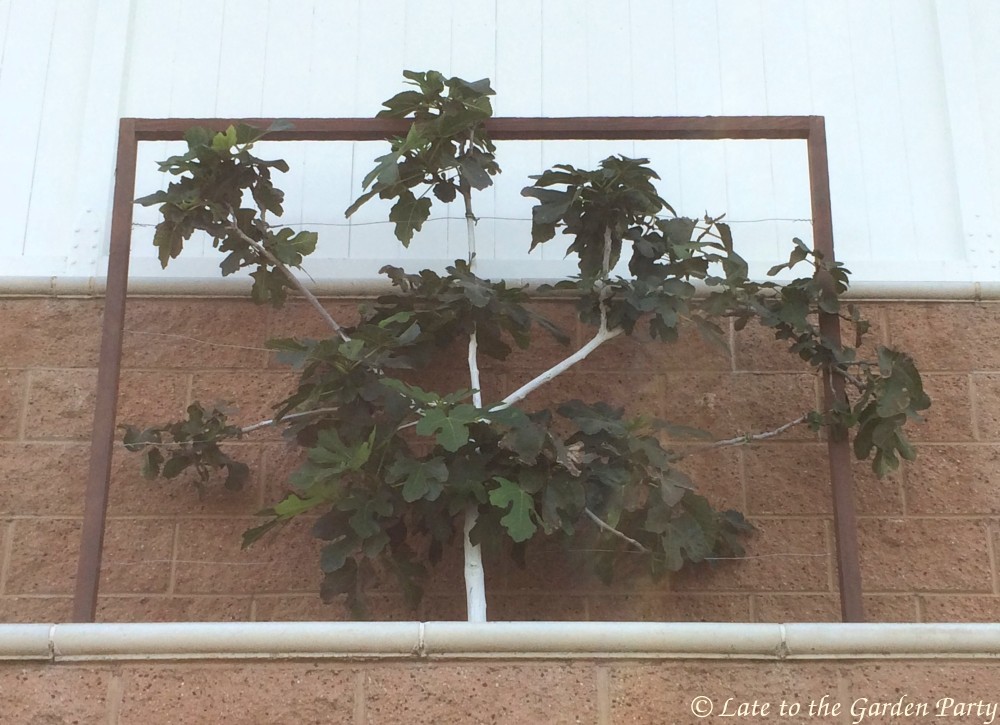
I'm assuming this is a fig tree and I'm guessing the other 2 framed trees are also figs of some kind.  The trunks of all 3 were painted white to prevent the cracking and splitting that can allow insects and disease to infect fruit trees.

In addition to this tomato plant, the second tier appeared to have peach and/or apricot trees, as well as another tree I couldn't even make a guess at identifying


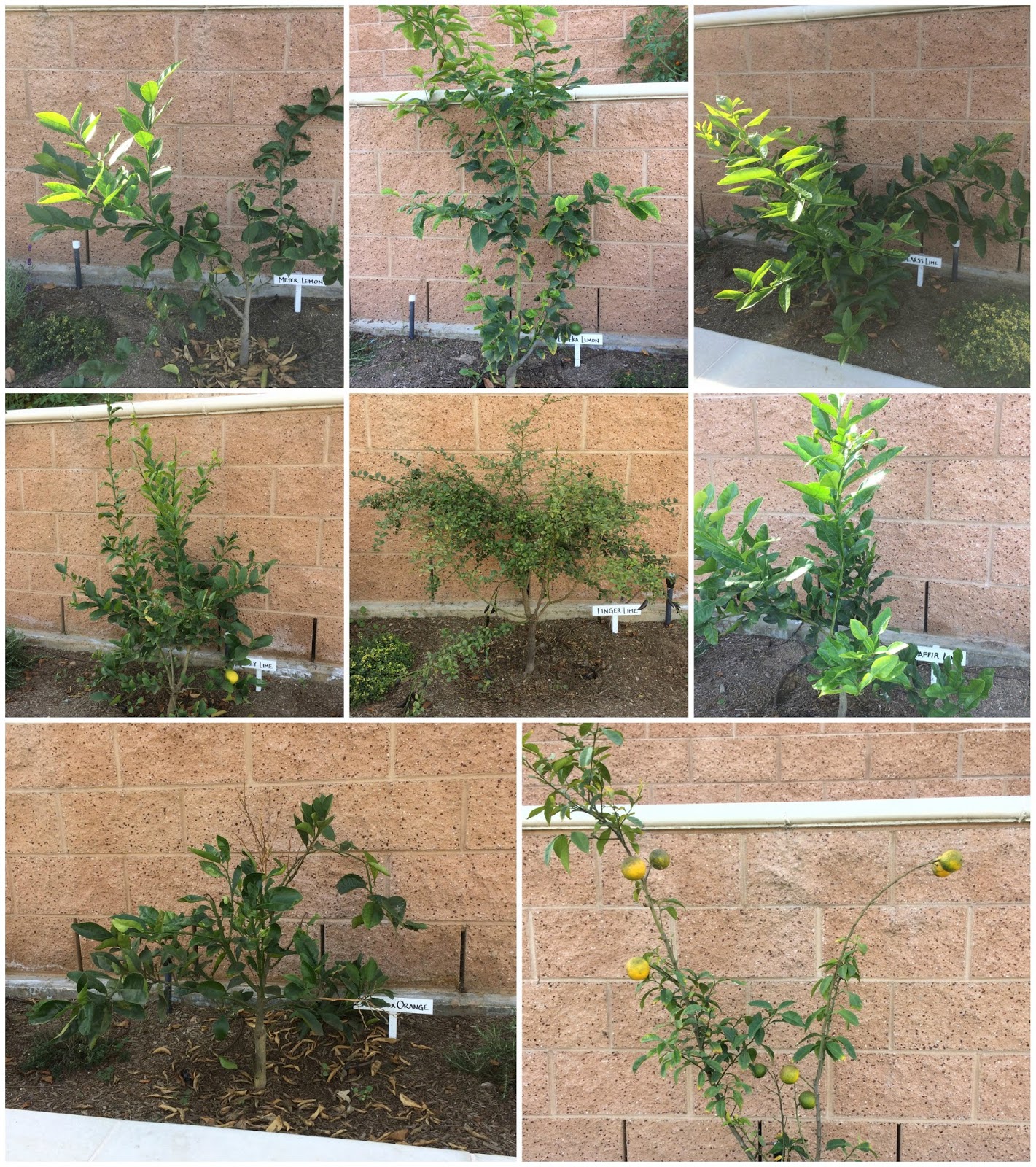
The only area I could examine closely was the lowest one.  It featured a wide variety of citrus trees, all neatly labeled.  Herbs, including thyme, rosemary and lavender, were planted between the trees.  A discrete drip system was in place too.

Top row: Meyer and Eureka lemons and a Bearrs lime
Middle row: Key, Finger and Kaffir limes
Bottom row: Cara Cara orange and Yuzu, a hybrid Japanese citrus tree


It's my dream to have something like this in place on my back slope but, as access to that area is very limited, I can't imagine being able to bring in the equipment or materials necessary to create a wall like this, at least one that I could afford.  Still, it's nice to dream!

In other news, rain has returned to Southern California.  It came down in buckets for awhile this morning.  I can only hope that the burn areas received gentler treatment.

I filled these plastic buckets using what poured down the rain chain in about 30 minutes, after first dumping the contents of 2 of them on the plants under the roof's overhang.  I'm planning to move the contents of these to my 265-gallon tank, which is slower to fill than my other 2 tanks, both of which are already full.


More rain is expected this afternoon and, according to one forecast, still more is possible next week.  I'd be ecstatic except that I can't help worrying about how this will affect the burn areas.  Slow and gentle rain is what we need.


All material © 2012-2018 by Kris Peterson for Late to the Garden Party