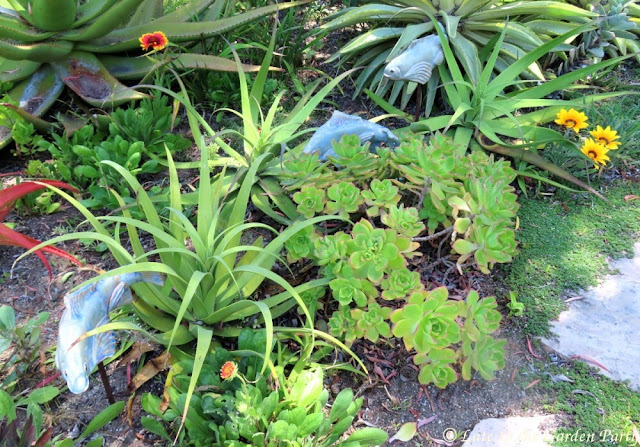
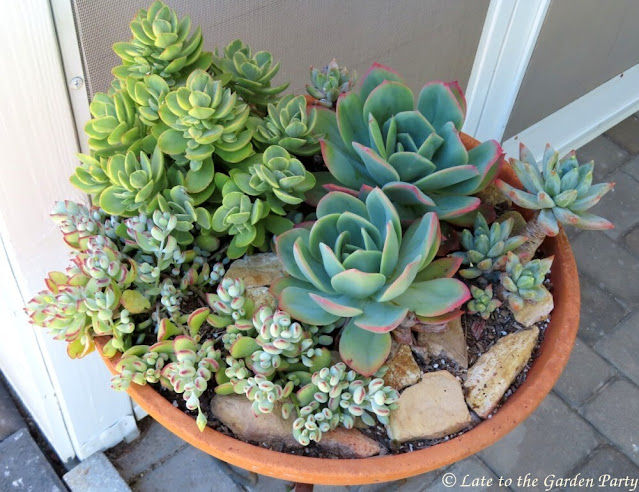
Although I tend to focus on floral displays in early spring, I also feel I need to give the garden's foliage a shout out. When all is said and done, foliage is and always will be the backbone of my garden. I started snapping photos of my foliage standouts as February drew to a close. When I surveyed my photos this week, I was surprised at just how many featured agaves so I'll start with those. Please note that this is not a comprehensive survey of my agaves. I've no idea exactly how many agaves I have but what follows is a drop in the proverbial bucket.
 |
| In my north-side garden, this shot captures a mix of my agaves, including Agave ovatifolia, A. desmettiana 'Variegata', A. potatorum 'Kissho Kan', A. parryi, and A. pygmaea 'Dragon Toes' |
 |
| Agave capensis, also in the north-side garden |
 |
| Agave 'Joe Hoak', accompanied by several A. bracteosa, in the back garden |
 |
| Agave macroacantha and A. parryi surrounded by Santolina rosmarinifolia 'Lemon Fizz' in the back garden |
 |
| Agave 'Mr Ripple' in the south-side garden |
 |
| Not an agave but a relative, Mangave 'Mission to Mars'. The small plant to its right looks like like it could be an offset of 'Mission to Mars'. I've no record of planting it and its colors are similar. I think I need to give it more room, though! |
 |
| Pups of Agave americana 'Mediopicta Alba' keep popping up along the south-side flagstone path, feet from the larger parent plants. While they're attractive plants, I'm almost afraid to give the prolific plants away (even with warning notices). |
 |
| The large specimen of Agave 'Jaws' in the front garden is also a prolific pupper |
 |
| The succulent bed in front of the garage contains a number of agaves but the largest are Agave attenuatas. The clump on the left are progeny of the original agaves I inherited with the garden, The one on the right is Agave attenuata 'Raea's Gold', which I removed from the back garden when it grew too large for its space. The plant between them is Phormium 'Rainbow Sunrise'. |
 |
| When the Agave vilmoriniana 'Stained Glass' (aka variegated octopus agave) in my north-side garden bloomed a few years ago, I harvested bulbils. I gave most away but kept one, which I eventually planted in this large pot. It's starting to look like a real agave now and I expect I need to thin out the Aeonium haworthii 'Kiwi' surrounding it. |
In addition to the agaves, other succulents made the cut for this post.
 |
| Aeonium 'Jack Catlin' stands out when contrasted with the more common green varieties |
 |
| Years ago, I planted Aeonium haworthii 'Kiwi' and 'Kiwi Verde' in a narrow row as edging for the border occupied by 3 Agonis flexuosa 'Nana'. As you can see, the Aeoniums formed massive clumps. The 'Kiwi Verde' (on the right in both photos) were looking sad until the rain finally arrived and they fleshed out again. |
 |
| I've no record to account for this aloe but I'm guessing it's an Aloe vanbalenii. It sits near the much larger Aloe vanbalenii x ferox, which recently finished blooming. |
Here are the other plants that caught my eye, many of which are drought tolerant.
 |
| The 3 Acanthus mollis die back during the summer months, emerging with the rainfall in the fall (when we get it). They usually bloom lightly if at all but the foliage alone is worth their space in the garden. This one is embellished by an adjacent Centaurea 'Silver Feather', also appreciated for its foliage over its flowers. |
 |
| Drimia marttima didn't bloom at all last year but all 5 bulbs have produced healthy foliage in an unirrigated area of the back slope this year |
 |
| I'm guessing that this is Kniphofia caulescens. It came with the garden but grew slowly. I've a vague recollection of it blooming once in the 14 years we've lived here. |
 |
| Leucadendron salignum 'Chief' in the background deserves a nod before I prune it in late spring. I recently thinned its interior a bit to prevent it from swallowing its neighbors. If you look at the center of the photo, you can just make out part of the large Agave ovatifolia in the distance. |
 |
| I cut Melianthus major to inches high in late summer each year and it springs back to life when the temperatures drop. Its serrated leaves are as attractive as the tall flowers, which appear in late spring/early summer. |
 |
| This is a division of a Yucca gloriosa 'Bright Star' I took a couple of years ago when the parent plant lost its shape |
 |
| I refreshed Yucca desmettiana 'Blue Boy' using divisions a couple of years ago too |
One plant of note isn't looking at all good but its current condition is temporary.
 |
| Jacaranda ''Bonsai Blue' is in the process of shedding its older leaf stems, which take on a sickly yellowish-brown color. Although I'd never noted this in the street trees that punctuate the landscape in Southern California, I've recently observed this same shedding process in the full-sized Jacarandas in my neighborhood. The fresh foliage isn't flammable but the dry foliage can be - as the dwarf tree is fairly close to the house, it may have to go when we remove some of our plants in the interest of a more fire resistant landscape. |
We got a decent amount of rain from the storms that passed through here on Wednesday through Thursday, 0.42/inch. Additional storms are expected next week, from Monday through Thursday. It doesn't qualify as a March miracle at this point but it's a positive trend!
 |
| I collected rain via the gutters feeding my collection tanks but also used the rain chain to funnel water into my plastic tubs. As shown above, a lot of pollen was picked up in the process. |
Between storms, crews contracted by the city (or perhaps the power company) have been very active in my area clearing foliage surrounding electrical lines and equipment. The work being done this year appears to be much more extensive than in prior years but then a lawsuit has been filed against the power company by residents impacted by the Altadena Fire in January.
 |
| This pile of debris was left in the street between our house and the next-door neighbor's driveway by the contractors on Wednesday, stretching half way across our neighborhood road. I hunted them down and received assurances that they'd be back to clear it later that day, which they did. |
 |
| The trucks were back yet again Thursday morning both across the canyon (photo, left) and parked in front of our hedge (right). Although the truck and chipper interfered with our weekly trash pickup, the work being done involved a public easement on my next-door neighbor's property, not ours. |
We're expecting inspections to ensure "defensible space clearance" around homes in our area by the Los Angeles Fire Department under the direction of a new ordinance adopted by the Los Angeles County Board of Supervisors in February. The focus is on hazardous brush, dry grass, weeds and any "combusible growth or flammable vegetation." There isn't a master list of problematic plants but those provided as examples included Acacia. If you read my blog often, you may remember that I have quite a lot of Acacia cognata 'Cousin Itt'. I clear the debris underneath these plants a couple times a year, which may not matter to inspectors...I have a call into my arborist for a consultation in advance of an inspection.
Best wishes for a good weekend.
All material © 2012-2025 by Kris Peterson for Late to the Garden Party