Monday, August 9, 2021

In a Vase on Monday: Splashes of color

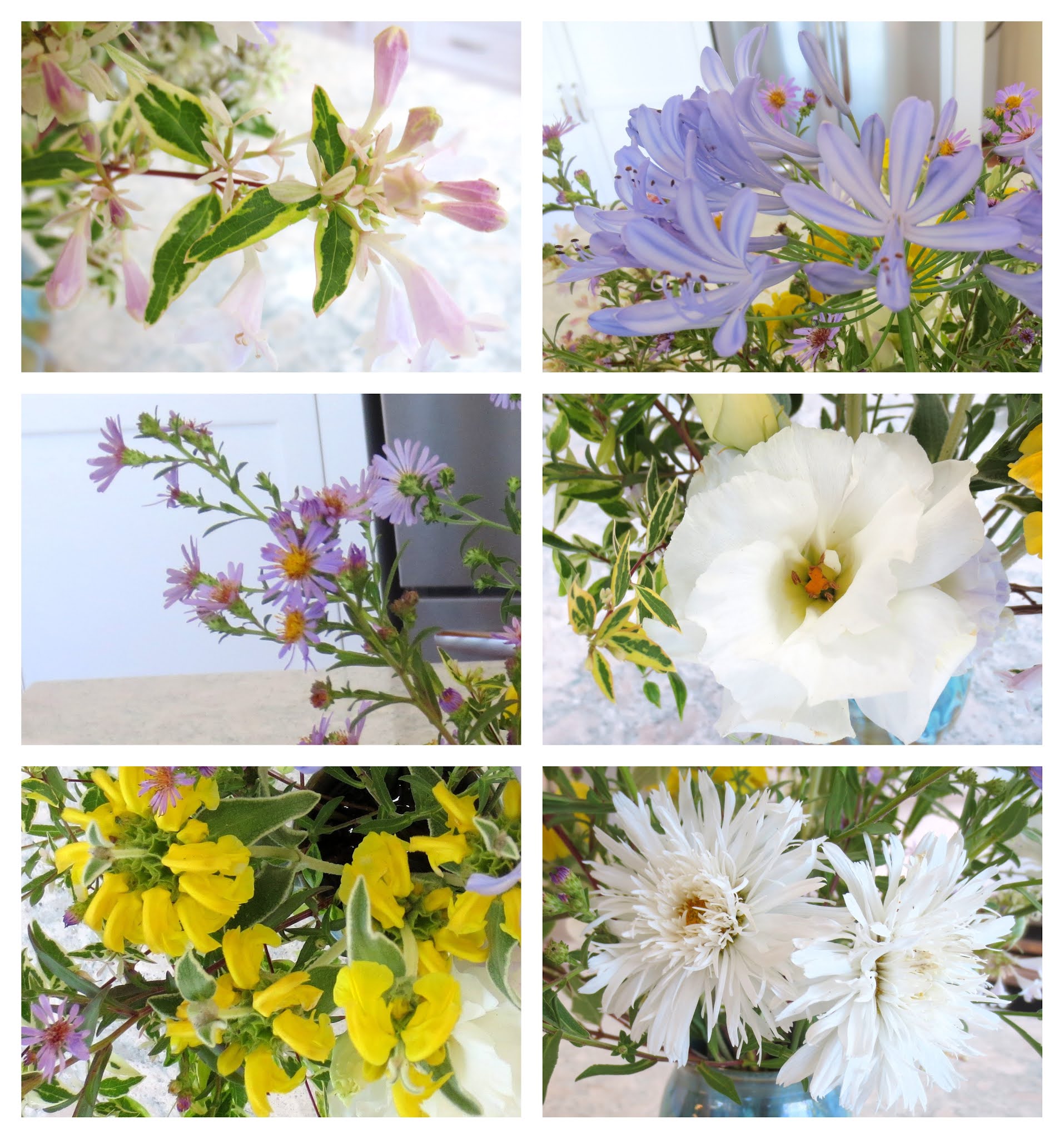
There are still flowers here and there in my garden but their numbers have dwindled and the dahlias haven't yet filled the breach, although the first buds are in the process of opening.  I can't entirely explain why the dahlias have been so slow to develop this year but I'm glad to see that at least my "crop" isn't going to be a complete bust.  If I'm lucky, maybe some will bloom well into October.  In the meantime, I took advantage of some of the most recent arrivals in my back garden borders to fill two vases this week.

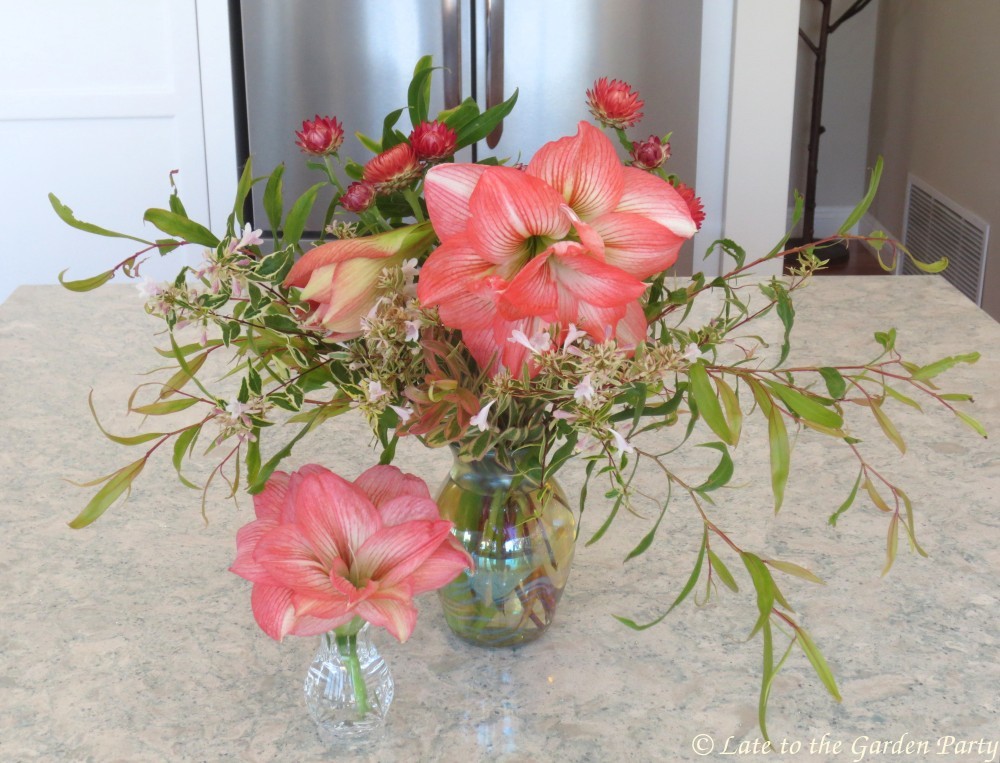
New flower stalks of Amaryllis belladonna continue to appear.  They look gawky where their leaf-less stalks aren't hidden by other plants so I've little reluctance to cut them, especially as the blooms have a relatively long vase life.

I kept the to a relatively simple color mix of pink, burgundy and white

Back view: Daucus carota 'Dara' is gradually finishing up it's long bloom season

Top view

Clockwise from the upper left: Angelonia 'Archangel White', Centranthus ruber, Coleonema album, Amaryllis belladonna, pink and white Eustoma grandiflorum (aka Lisianthus), Leptospermum 'Copper Glow', Plectanthus scutellarioides 'Vino' (aka coleus), and Daucus carota 'Dara'

After a few years of well-mannered behavior, my native California aster, Symphyotrichum chilense, spread throughout one entire bed following the comparatively heavy rainfall we had during our 2018-2019 "water year."  This year, despite very low rainfall, flower stems have popped up all over again; however, many are rapidly turning a crispy brown without flowering but, even with the die-off, there are enough stems with blooms to cut.  I'm considering digging out as much of the aster as I can this fall when it finishes its bloom period to replace it with something more manageable but I intend to enjoy the flowers I have this year.

The yellow Phlomis fruitcosa (aka Jeruselem sage) was a surprise find.  This shrub normally blooms in spring.  While I discovered a few stray blooms on it once before, this is the latest in the year I've had blooms yet.

Back view: I added the last presentable Agapanthus bloom I had to the mix, as well as the last of the ruffled Shasta daisies

Top view

Clockwise from the upper left: Abelia grandiflora 'Hopley's Variegated', noID Agapanthus. Eustoma grandiflorum, Leucanthemum x superbum (aka Shasta daisy), Phlomis fruticosa, and Symphyotrichum chilense 'Purple Haze'

Maybe next week I'll have a dahlia bloom or two to share.  For other IAVOM creations, visit Cathy in Rambling in the Garden.


All material © 2012-2021 by Kris Peterson for Late to the Garden Party

Friday, August 6, 2021

Stepping back in time: Transforming the south side garden

I've published prior posts on the development of my back garden and my north side garden.  This post provides an overview of the development of my south side garden, which we transformed over time from an area dominated by lawn to a drought-tolerant landscape punctuated by succulents.  

Once again, I discovered I'd taken no wide shots of the area during the first two years in residence here.  However, I retrieved a photo off the internet via an old real estate listing.

I'm guessing that this photo was taken in either 2009 (when the house was first listed) or 2010.  We acquired the property in December 2010.


My earliest photos, taken in February 2013, focused on the tall Eucalyptus tree that stood just feet away from the house.  The tree was a source of contention nearly from the date we moved in.  I discovered a growth at its base and called in an arborist to evaluate it.  That person found no reason to take immediate action but suggested that I continue to monitor it.  The tree's removal was ultimately prompted not by my initial concern but in response to a neighbor's complaint that the tree interfered with her view of the harbor.  Apparently, she'd been campaigning to take down the tree for years based on a local community "view conservation" ordinance.  Her persistence, combined with our concern with having a potentially unstable tree so close to the house, led us to agree to take the it down.

I took this photo on February 3, 2013

This was the area three days later.  Even after the tree was gone, there was a dense mass of foliage along the property line, consisting of a laurel hedge, a peppermint willow (Agonis flexuosa), and several massive shrubs, including a tree-sized native Toyon (Heteromeles arbutifolia).

 
I initially focused on planting the area formerly occupied by the Eucalyptus but within months I significantly expanded my effort to transform the entire area on the south side of the house.

My husband built a short concrete block wall (visible on the left) to level the bed.  I supplemented the soil and planted Festuca glaucus, Helichrysum petiolare, Loropetalum chinense, Pericallis, and Argyranthemum, among other things.

In August 2013, we started removing the lawn between the small side patio and the narrow south border containing the preexisting shrubs

I actually created a detailed plan for the area, showing a flagstone path surrounded by creeping thyme, shrubs, grasses and flowering perennials.  Some of the plants identified in the plan were never installed.

This photo, taken in late November 2013, shows new flagstone paths and plants viewed from the front garden looking east toward the harbor.  I'd removed the original Wisteria on the right side of the arbor and replaced it with a Clematis terniflora.  To this day, I'm still trying to get rid of the Wisteria planted on the other (left) side of the arbor.

View of the newly planted beds from the side patio looking south.  The multi-trunked Arbutus 'Marina' shown in the background was eventually removed when half the tree died.

This is another photo of the newly planted area, also taken at the end of November 2013.  I see just one Agave, a 'Blue Glow' (bottom, far left).

There were very few succulent plants in the mix installed in 2013.  That slowly changed between 2014 and 2016.

In March 2014, we removed another large stretch of grass, extending the small bed surrounding the backyard fountain all the way to the garden's south side, connecting it to the bed adjacent to the south patio

This photo was taken at the end of March 2014.  I love how lush and green everything looked at this stage, before drought was a serious issue.  I'd planted a Japanese maple (center foreground) but the wind that blows through this area ultimately proved to be a problem, resulting in its removal later that year.

Photo taken in early November 2014 looking east

This photo, taken in late February 2015, shows the south side garden viewed from a dirt path behind the backyard border, looking west.  You can see the yellow flowers of Bulbine frutescens on the right in the area connecting the extended fountain bed to the south side patio bed.  The shrubs in front of the Bulbine are Rosmarinus 'Gold Dust'.

This photo taken in late May 2015 shows the addition of more succulents on each side of the flagstone path.  State-wide water restrictions were put in place in 2015 in recognition of severe drought conditions.

I didn't take many photos of the area in 2016 but this photo dated October 1st reflects the addition of more succulents, including an Agave 'Blue Flame', more 'Blue Glow' Agaves, Agave 'Mr Ripple', a variety of small Aloes, and a Dasylirion longissima to the bed on the left.  Two Salvia clevelandii 'Winnifred Gilman' (not readily visible) were also added.

By 2017, the southernmost bed had more clearly become established as a succulent garden.

This photo, taken in June 2017, shows three Agave medio-picta 'Alba' pups I received from Gail of Piece of Eden in 2016, as well as three Hesperaloe parviflora 'Brakelights' I'd added as small plants in late 2014

I included this photo, taken in early January 2018, as it shows the lath (shade) house my husband built for me in the distance.  The lath house sits in another area of the garden, several feet below the level of the south side garden but it's now part of the landscape in this area too.

This photo, taken April 1, 2018, had me asking myself why I haven't continued to plant large swaths of the red-flowered Lotus berthelotii 'Amazon Sunset' along the walkway from the south-side patio bed around the curve into the back garden

This November 2018 photo provides a closer look at some of the succulents on the south side, surrounded by the softer foliage of other drought tolerant plants, including Acacia cognata 'Cousin Itt', Leucadendron salignum 'Summer Red', Hymenolepsis parviflora, Metrosideros 'Springfire', and Pennisetum 'Skyrocket'.  All those plants remain in place to this day.

This photo, taken in May 2019, shows how large the three "dwarf" Agonis flexuosa 'Nana' shrubs adjacent to the side yard patio had become since they were planted in 2013

This August 2019 photo shows the mimosa tree in the distance in the back yard, when it still looked somewhat presentable.  (It was removed in October 2020 after shot-hole borers contributed to its rapid decline.)

In 2020, the bed closest to the patio got a renovation of sorts.

In January, I cut the overgrown Agonis flexuosa 'Nana' back hard and planted a mix of small succulents, mostly Aeoniums, along the patio's edge

Photo taken in late March 2020 of the view from behind the south side border looking toward the house.  A few months later, I removed a dense tangle of Bulbine frutescens, pulled out four of the five Rosmarinus 'Gold Dust' shrubs I'd planted in 2014 in the area that connected the south patio bed to the extended fountain bed (shown center right), and moved a Leucospermum 'Sunrise'  into the gap.  It was a gratifying pandemic project.

These two photos show the former "Eucalyptus bed" in April 2020.  In addition to a some succulents, the area includes Agapanthus 'Stevie's Wonder', Arthropodium cirratum, three varieties of Cistus, Coprosma 'Plum Hussey', Grevillea 'Moonlight', and Pennisetum 'Fireworks'.

June 2020 view of the south side garden with the focus on the plants making up the back border.  Salvia clevelandii 'Winnifred Gilman' was in full bloom at the time.

This view, also photographed in late June 2020, provides a clear view of the tree-sized Toyon (Heteromeles arbutifolia) in the background.  It died rather suddenly, possibly from the same pathogen than causes sudden oak death.  (The Toyon is a susceptible species.)  As shown in the foreground, the Agonis flexuosa 'Nana' had no problem rebounding from the severe pruning it received back in January.

That brings me to the garden's current state.

This photo, taken in early April this year, looks more exposed after the dead Toyon was removed.  I planted a daisy tree (Olearia albida) near the spot previously occupied by the Toyon but it's still tiny and struggling to get established despite regular watering.  I may need to try another tree.

This photo was taken at the end of June.  That scrawny tree in the background on the right bugs the heck out of me.  It sits on the property of a neighbor on a nearby spur road.

This photo looking east, also taken at the end of June, reflects the prominence of the Agaves (and indicates that I should probably be pruning the Agonis shrubs on the right on an annual basis)


More than perhaps any other area of my garden, I think the south side area most clearly reflects my gradual response to our hotter summers, punctuated at intervals by blistering heatwaves, and the pervasive drought conditions.  While I still appreciate the lush look the area had back in 2014, it's clear to me that many of those original plants couldn't have survived the intense sun exposure here, especially on a low water regimen.


All material © 2012-2021 by Kris Peterson for Late to the Garden Party

Wednesday, August 4, 2021

Wednesday Vignette: Thwarting a takeover

No, I'm not referring to the violent January 6th takeover of the US Capitol.  The attempted takeover under discussion here occurred in my garden.  It was sneaky but utterly non-violent and thankfully devoid of any political agenda or human stupidity.  The intruder was hiding in plain sight and had clearly been there for some time before I noticed.  

The fern-like plant is a seedling of Albizia julibrissin (aka mimosa tree).  It blended in well with its surroundings.  It was more than a foot tall when I finally noticed it, sitting ten or more feet from the tree we removed in late October last year.  I think I got most of its root up when I pulled it out but only time will tell.

I already knew that Albizia was a rampant self-seeder.  I've joked that I have nightmares of discovering a grove of full-grown mimosa trees on my back slope.  This seedling shows how easily they can grow, even under relatively harsh conditions.  It looked far healthier than the Agave lopantha 'Quadricolor' pup next to it on the right, which appears on the verge of collapse after more than a year in the ground.

Checking the surrounding area, I discovered a second intruder keeping a lower profile.

This one was rubbing elbows with what appeared to be Ranunculus californicus, our native buttercup, trying not to be noticed under the new Ginkgo biloba tree that replaced the diseased mimosa tree

Weeds, you have to keep your eyes open so they don't grow into trees.

For more Wednesday Vignettes, visit Anna at Flutter & Hum.


All material © 2012-2021 by Kris Peterson for Late to the Garden Party

Monday, August 2, 2021

In a Vase on Monday: Dreaming of Autumn

It's most definitely still summer, although I can't help dreaming that autumn is just around the corner.  It's been warmer this past week and humidity has been running higher than normal, making the heat more unpleasant.  Traditionally, Southern California has been known for its dry heat but it seems that, like so many weather trends, that may be a thing of the past.  Our temperature hit 90F (32C) for a time yesterday afternoon but, as summers go, it hasn't been bad here thus far.  (In contrast, the inland valleys are seeing much higher temperatures.)  However, it's still very dry.  My collected rainwater is long gone and, realistically, we won't see rain until late October or November.  I have to think twice before I water anything given the need to conserve water state-wide.  

My first arrangement this week is a mixture of spring and summer flowers.  One of the Hippeastrum bulbs I planted in my front garden last fall surprised me with a bloom last week.  I grew these bulbs in the ground in my former garden with no difficulty but I've had a hard time getting them established in my current garden.  When I didn't see any blooms this spring, I thought I was out of luck again but perhaps the bulb just needed extra time to settle in.  I hope this success signifies that I've finally found the right spot for them.

Hippeastrum are commonly referred to as Amaryllis even by bulb sellers, but they're a different genus than the true Amaryllis, although both are part of the Amaryllidaceae family.  This one is 'Zombie'.  I inadvertently managed to break one of the flowers off the main stem so I popped it into a tiny vase.

The back view is dressed up with Zinnia 'Queen Lime Orange', grown from seed

The top view shows off strawflowers (Xerochrysum bracteatum) grown from a single seedling received as a gift from blogger friend Denise of A Growing Obsession.  She gave me four seedlings but the rabbits apparently ate the three I planted in a backyard bed.

Clockwise from the upper left: Abelia grandiflora 'Hopley's Variegated', Agonis flexuosa 'Nana', Hippeastrum 'Zombie', Leucadendron 'Jester' (pale pink rather than red as it's planted in shade), Xerochrysum bracteatum, and Zinnia elegans 'Queen Lime Orange'

My second arrangement is channeling an autumn mood with colors of red, gold and brown.  The centerpiece is a new-to-me Echibeckia, which is an intergeneric hybrid of Echinacea and Rudbeckia.

I bought the Echibeckia 'Summerina Orange' on a whim a few weeks ago

Back view, filled out with a couple of stems of Leonotis leonurus

Top view, showing off the feathery plumes of Pennisetum 'Rubrum', which are only just beginning to make their annual appearance in my garden

Clockwise from the upper left: Echibeckia 'Summerina Orange', Lantana 'Lucky Orange', Leonotis leanurus, Pennisetum advena 'Rubrum', Plectranthus scutellariodes 'Pineapple' (aka coleus), and a prop celebrating summer harvest season

As usual, last week's most presentable leftovers went into a small vase to brighten our kitchen island.

Eustoma grandiflorum (Lisianthus), Tanacetum parthenium, and Leucadendron 'Jubilee Crown' all have long vase lives

For more IAVOM posts, visit our host, Cathy at Rambling in the Garden.


All material © 2012-2021 by Kris Peterson for Late to the Garden Party