Monday, February 20, 2023

In a Vase on Monday: Scented blooms

Even though temperatures remained cool last week, more of our early spring blooms are creeping into view.  This week many of those I selected for "In a Vase on Monday" are scented.

I started with Abelia 'Chiapas', now classified as Veslea floribunda 'Chiapas', which is one of my favorite blooms, even if it is buried beneath a Lantana on my neglected back slope.  I tried propagating it last year but only one cutting developed roots.  It disappeared during the hot summer months but a seedling recently has appeared in the same spot.  It's too early to determine whether or not it's the same plant.

The Abelia/Vesalea is scented, as are the Freesias and the foliage filler, Prostanthera ovalifolia 'Variegata' (aka mint bush)

I added Osteospermum '4D Pink' to dress up the back view

Top view

I inserted a piece of plastic-coated hardware cloth into the cavity of the vase to help keep the stems from flopping

Clockwise from the upper left: Argyranthemum frutescens 'White Butterfly'; Freesias in dark blue, light blue and white; Limonium perezii, Osteospermum '4D Pink'; Polygala myrtifolia; Prostanthera ovalifolia 'Variegata'; and, in the center, Vesalea floribunda 'Chiapas'


A noID Narcissus is the only scented flower is the second arrangement.

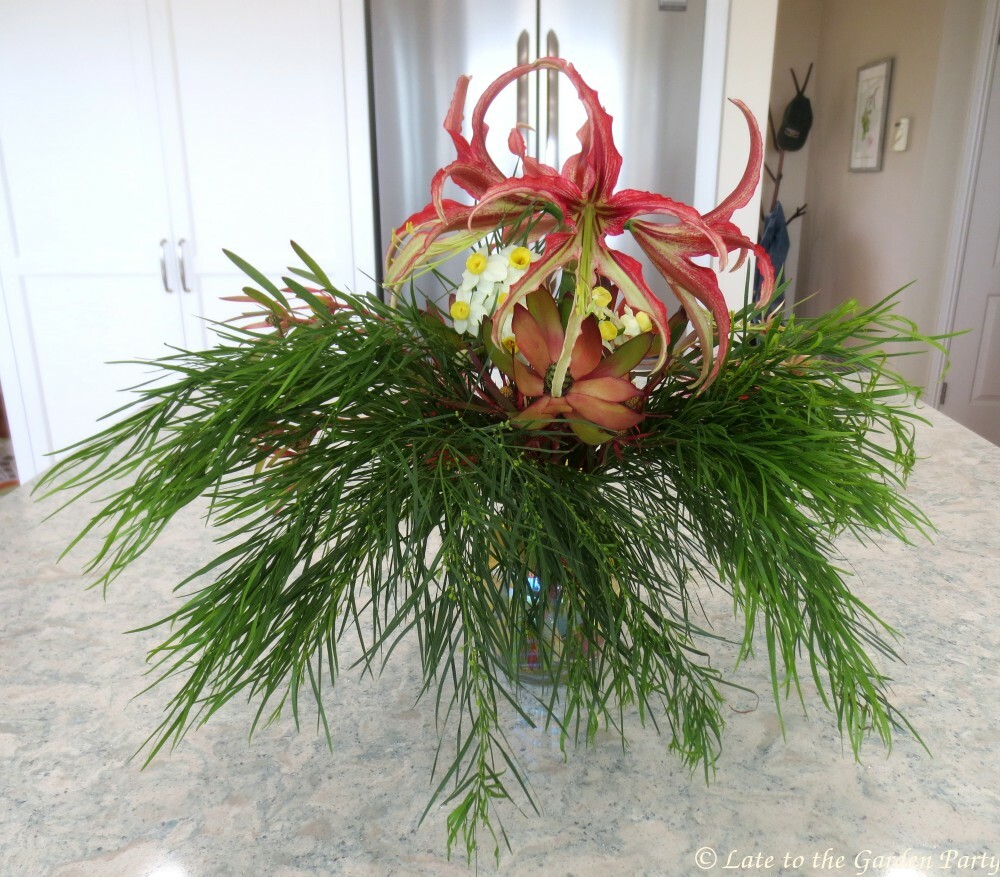
The starring role was given to Hippeastrum 'Rozetta'

Back view: I used the fresh orange foliage of Xylosma congestum and the flower-like bracts of Leucadendron 'Blush' to play off the pinkish-terracotta tones in the Hippeastrum flowers

Top view

Clockwise from the upper left: Hippeastrum 'Rozetta', noID Narcissus, Leucadendron salignum 'Blush', Lobelia laxiflora, and Xylosma congestum


The third arrangement is completely scentless, at least to my nose.

This small arrangement for the kitchen island contains Alstroemeria 'Inca Lucky', Argyranthemum 'Grandaisy Red', and Grevillea lavandulacea 'Penola'


For more IAVOM creations, visit Cathy at Rambling in the Garden.


All material © 2012-2023 by Kris Peterson for Late to the Garden Party

Friday, February 17, 2023

Filling in

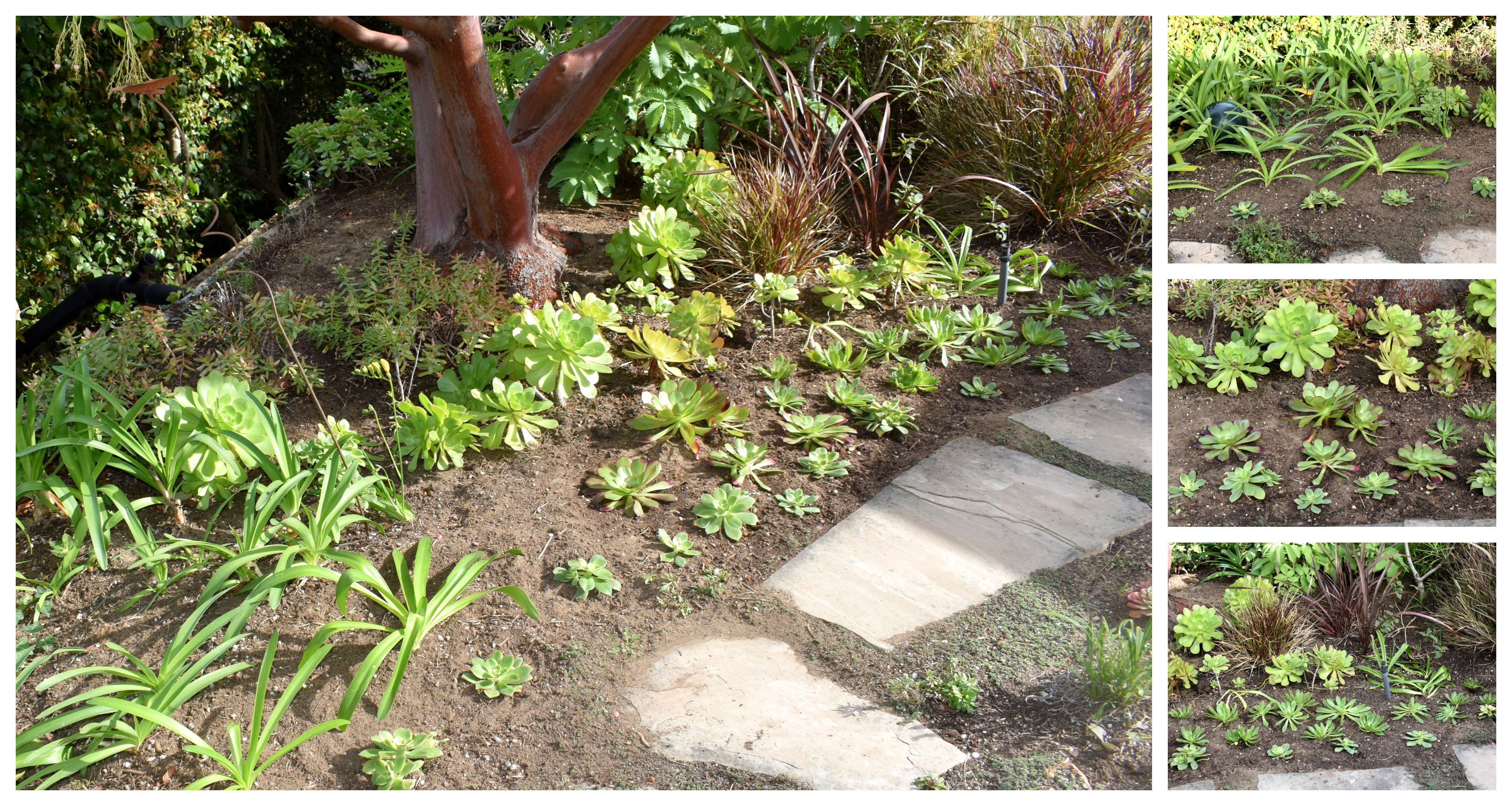
When I last provided an update on the projects that kicked off with my "should it stay or should it go?" post, I reported that I'd removed the shaggy Sesleria grasses (with my husband's help).  This week I followed up by filling in those empty spaces in the back garden with succulents.

Areas on both side of the flagstone path shown here were addressed by planting succulents, some newly purchased and some taken as cuttings from elsewhere in my garden.  It made sense to rely on succulents as both areas already contained a lot of these these plants.

Two-thirds of the area between the flagstone path and the concrete block walkway alongside the house had been planted with succulents in 2021.  I added: 3 Cotyledon orbiculata (cuttings), 3 Echeveria 'Mira', 2 noID blue Echeverias, 3 Graptoveria 'Debbie', 1 noID Graptopetalum (cutting), 1 Mangave 'Catch a Wave' (cutting), and 1 Mangave 'Red Wing'.  I'll probably add additional plants as fillers later.

I filled in the area on the other side of the flagstone path with 2 Agapanthus (divisions) and countless Aeonium 'Velour', A. 'Jack Catlin', and A. haworthii 'Kiwi' cuttings. The Aeoniums may all look alike at present but, with sun exposure and time they'll be distinct once they mature.  (The plants in the background are Agapanthus and noID Aeonium arboreum that have been there for 2 years or more.)


I decided against using succulents to replace the grass removed in the front garden, instead planting plugs of creeping thyme.

I couldn't get the Thymus 'Minus' or 'Elfin' varieties I prefer so I went with Thymus citriodorus, which is supposed to get no taller than 4 inches

This area was formerly occupied by the 8-foot Duranta erecta.  I haven't decided what to put there yet but I'm considering removing the sad Nandina in the backround and the remaining Agapanthus before installing a medium-sized shrub of some kind to hide the heating unit next to the house and a lower groundcover (TBD).


While pulling weeds in the back garden, I concluded that a Russelia equisetiformis (firecracker plant) I'd planted in one area was so riddled with weeds and my arch enemy, asparagus fern, it was irredeemable.  I didn't take a before photo but the Russelia was never happy in this spot alongside the dirt path between the backyard border and the Xylosma congestum hedge that runs the entire length of the main level of the back garden. 

No one walks this path but me, the gardeners who trim the hedge 3-4 times a year, and the occasional coyote.  I removed a pup from Agave attenuata 'Raea's Gold' (bottom left) and planted it in the Russelia's spot, after pulling weeds and removing as much of the asparagus fern roots as I could.

On the other side of the same border I transplanted 3 Agave bracteosa (squid agave) pups I pulled up with the weeds in front of the 2 Agave 'Joe Hoak' shown here.  Given how fast the squid agaves replicate, I may regret spreading them around but I hope they'll prove to be more durable groundcover plants than the creeping thyme in this dry area.


I was taking additional photos of the fabulous fresh orange foliage Xylosma hedge when I noticed something very odd in the the Los Angeles harbor.

I've never seen 2 cruise ships backed up like this to exit the harbor through Angel's Gate.  I had to wonder if the harbor is having the same kind of traffic control problems our airports have been experiencing recently.  The ships do not dock in that area - they enter and exit through a channel next to a common visitor terminal.

I took this photo 15-20 minutes after the prior one as the second ship exited the gate

.

I hope you enjoy a pleasant weekend - and don't get caught in any traffic jams!


All material © 2012-2023 by Kris Peterson for Late to the Garden Party


Wednesday, February 15, 2023

Bloom Day - February 2023

Spring comes early in coastal Southern California and I expect that many who read this post will consider it proof of that statement.  While there are a lot of flowers making an appearance, they're generally less profuse than they were last year.  A few have only just arrived.  I think the lag I perceive may be attributable to the persistence of colder than average temperatures. 

I'll start with the plants making the biggest splash.

I check out the back slope less often than I should.  I hadn't been down there in almost 2 weeks and was shocked when I realized that Ceanothus arboreus 'Cliff Schmidt' was in full bloom.  It bloomed in February last year and the noID Ceanothus hedge on the main level of the back garden is also blooming so I shouldn't have been surprised.

While on the back slope, I found that the plant I purchased years ago as Abelia speciosa 'Chiapas' is also blooming.  An updated online search for the plant showed no new sources but it appears the plant has been reclassified as Vesalea floribunda.  The new classification reflects a differentiation between the glossy Abelias of Asian origin and species native to Mexico and Central America.  I tried propagating it last year but got only one cutting to develop roots.  I thought I'd lost it over the summer but a tiny seeding recently appeared in its spot.  Fingers crossed but I'm going to take more cuttings this month.

The Aeonium arboreums are producing masses of tall bloom stalks all over my garden.  They make long-lasting cut flowers if you like florescent yellow.

Arctotis 'Pink Sugar' arrived on schedule this month.  It's well ahead of other varieties in its genus this year.

This Calliandra haematocephala (red powder puff) is another reliable bloomer.  The other 2 shrubs that also came with the garden rarely bloom, presumably due to receiving less sun.

Euphorbia rigida has florescent yellow blooms rather like Aeonium arboreum but I love these flowers, probably because they're sparser and the blue foliage tempers the bright yellow


Other plants make a splash because of the sheer numbers of varieties that put on a show at the same time.

Most of my Aloes aren't sufficiently well established to bloom but 3 did this year.  Clockwise from the left: Aloe vanbalenii x ferox, A. cryptopoda, and A. vanbalenii x striata.

Argyranthemums are at their best when temperatures are cool.  Clockwise from upper left:  'Aramis Bi-color', 'Pink Comet', 'Grandaisy Red', and 'White Butterfly'.

The large-flowered Grevilleas bloom year-round here but the smaller-flowered varieties join them in late winter and early spring.  Clockwise from upper left: Grevillea alpina x rosmarinifolia, G. 'Peaches & Cream', G. 'Poorinda Leane', and the vigorous G. 'Superb'.

Grevilleas with pink and red flowers include, clockwise from upper left: Grevillea sericea (shown in a wide shot and a closeup), G. lavandulacea 'Penola', and G. 'Scarlet Sprite' (also shown in a wide shot and a closeup)

Several of my potted Hippeastrums, all grown outdoors, are blooming.  Clockwise from upper left: 'La Paz', 'Rozetta', 'Neon', noID sold as 'Blushing Bride' (which should be pink), and dwarf 'Saffron'.

The colored bracts of Leucadendrons aren't true flowers but they're flower-like at this time of year.  Clockwise from upper left: 'Blush', 'Winter Red' (which has pale yellow "blooms" earlier in the year), 'Safari Sunset', 'Chief', and 'Wilson's Wonder'.  The last is usually one of the most floriferous at this time of year but untimely pruning cost me most of those "flowers" this year.

Osteospermums are also at their very best during our cooler months.  Clockwise from upper left: '4D Violet Ice' (wide shot and closeup), 'Double Moonglow', '4D Silver', noID pink variety, '4D Pink' (wide shot and closeup), and a mix of self-sown white varieties.


I've grouped the plants just beginning their spring launch in a single collage.

Clockwise from upper left: Alstroemeria 'Inca Lucky', Lobelia laxiflora, Metrosideros collina 'Springfire', Freesia, Anemone coronaria, Ipheion uniflorum, Limonium perezii, and Pyrethropsis hosmariense


As those plants get started others are quickly making their way to the exit.

I took these photos of Camellia williamsii 'Taylor's Perfection' a week ago.  It's still flowering but dropping handfuls of flowers every day.

This photo of Pyrus calleryana was also taken a week ago,  Half those petals are now on the ground.  It's the closest thing to snowflakes we get here.


As always, Bloom Day came with a few surprises.

I planted 10 of these tulip bulbs (Tulipa humilis 'Alba Coerulea Oculata') in early November and promptly forgot about them until 8 bloomed.  They're supposed to grow 4-6 inches tall but all have stems that are one inch at best.  Only time will tell if they'll return to bloom another year (as some species tulips do here) and if they'll grow any taller in future years.

This Isopogon anemonifolius, an Australian native, has flowered sporadically.  The flowers are supposed to be yellow but all have have this ivory color.

I discovered this Agave vilmoriniana, commonly known as octopus agave, while pruning an out-of-control Leucadendron.  This makes 3 agaves in my garden with bloom stalks.  As all are monocarpic, there are going to be some large holes in my garden several months from now!


I'll end this post as I usually do with the best of the rest, organized by color.

Clockwise from upper left:  Teucrium fruticans 'Azureum', Trichostemma 'Mignight Magic', Viola 'Penny Peach', Pericallis 'Senetti Violet Bi-color', Salvia rosmarinus 'Gold Dust' (aka rosemary), S. 'Pozo Blue', and Felicia aethiopica

Clockwise from upper left: noID Cyclamen, Gomphrena decumbens 'Itsy Bitsy', Primula vulgaris, and Ribes viburnifolium (aka Catalina currant)

Top row: Boronia crenulata 'Shark Bay', Cistus 'Grayswood Pink', and Coleonema 'Sunset Gold'
Middle row: Camellia sasanqua, Cuphea 'Starfire Pink', and Medinilla myriantha
Bottom row: Dianthis barbatus, Hebe 'Wiri Blush', and Pelargonium peltatum

Clockwise from upper left: Crassula orbicularis var rosularis, Dianthus barbatus, Pelargonium 'White Lady', P. peltatum, and Daphne odora

Clockwise from upper left: Arbutus 'Marina', Erysimum 'Winter Orchid', Euryops chrysanthemoides, noID orange Calendula, Gaillardia 'Spintop Copper Sun', noID Narcissus, Senna artemisioides, and noID yellow Calendula


Are you convinced that spring is making an entrance in my little corner of the world?  There are a lot of flowers yet in the wings but, even with almost no rain in February as yet, January's heavier-than-usual rainfall has my dream of a glorious spring looking like it may become a reality.

For more Garden Bloggers' Bloom Day posts, visit our host, Carol at May Dreams Gardens.


All material © 2012-2023 by Kris Peterson for Late to the Garden Party

Monday, February 13, 2023

In a Vase on Monday: Happy Valentine's Day!

Red flowers seem made to order to celebrate Valentine's Day so I felt lucky to have a number of them at present.  I cut a stem of Hippeastrum 'La Paz' to start, only to discover that its color didn't mesh well with many of my other red flowers.  'La Paz' is a brownish-red, which sent my search for appropriate companions in directions I hadn't envisioned.

I think the arrangement could've used lighter filler material than the chunky Leucadendron 'Safari Sunset' stems I selected.  Additional 'La Paz' stems would have been ideal but the other stems aren't fully open yet.

Back view: I may have gone overboard with the foliage of Acacia 'Cousin Itt' here.  Many of those stems have tiny pale yellow flower buds and I thought it would be interesting if they opened, although they seldom do.

Top view

Clockwise from the upper left: Acacia cognata 'Cousin Itt', Alstroemeria 'Inca Lucky', Calliandra haematocephala, Hippeastrum 'La Paz', Leucadendron salignum 'Chief', L.s. 'Safari Sunset', and noID Narcissus (possibly 'Avalanche')

 
Even though I have other flowers that lean pinkish-red, I wasn't up for two red arrangements this week.  So I switched to blue, white and yellow flowers that made me think of spring.
The Hippeastrum 'Blushing Bride' shown front and center was supposed to pink but there's not a trace of the color to be seen in the petals

The back view highlights the single blue Lisianthus (Eustoma grandiflorum) I found blooming in my back garden

Top view

Clockwise from the upper left: more Acacia cognata 'Cousin Itt', Eustoma grandiflorum, noID Narcissus, noID Ceanothus, Hippeastrum not 'Blushing Bride', Osteospermum '4D Silver', and Salvia hybrid 'Pozo Blue'


My Camellia 'Taylor's Perfection' is dropping flowers in large numbers every day now.  That may be the result of the persistent dry winds we've had almost every afternoon for well over a week.  Or it may simply signify the end of the Camellia's season.  The flowers don't last long in a vase but, as they're not lasting long on the shrub either, I went ahead and cut two stems for our kitchen island as a nod to the holiday.


For more IAVOM creations, visit Cathy at Rambling in the Garden.

Best wishes for a happy Valentine's Day!


All material © 2012-2023 by Kris Peterson for Late to the Garden Party